
We read your photo as:
Apply the formula for the circumference of a parallel of latitude.
ScanSolve AI Answer
Answers
3 partsStep-by-step solution
7 stepshere's the solution to your problem. We'll use the Earth's radius km.
Part i· 2 steps
Calculate the circumference of the line of latitude .
Apply the formula for the circumference of a parallel of latitude.
The formula is , where is the latitude.
Here, .Calculate the numerical value.
The circumference of the line of latitude is (rounded to the nearest kilometer).
Part ii
Calculate the shortest distance PQ, measured along the line of latitude.
Points P and Q are on the same latitude .
Longitude of P is .
Longitude of Q is .
Determine the difference in longitude.
The difference in longitude is .
Apply the formula for distance along a parallel of latitude.
The formula is , where is the circumference calculated in part (i).
The shortest distance PQ along the line of latitude is (rounded to the nearest kilometer).
Part iii
Calculate the latitude at which the circumference of the circle of latitude is equal to the length of the equator.
Set up the equation based on the given condition.
Let the unknown latitude be .
The circumference of a parallel of latitude is .
The length of the equator is .
We are given .Solve for .
Divide both sides by :
Find the latitude .
The latitude at which the circumference of the circle of latitude is equal to the length of the equator is (rounded to one decimal place).
Try one yourself
A new problem that tests the same skill.
Still stuck on this one?
Ask a follow-up, and the answer starts from this question.
More Geography Questions
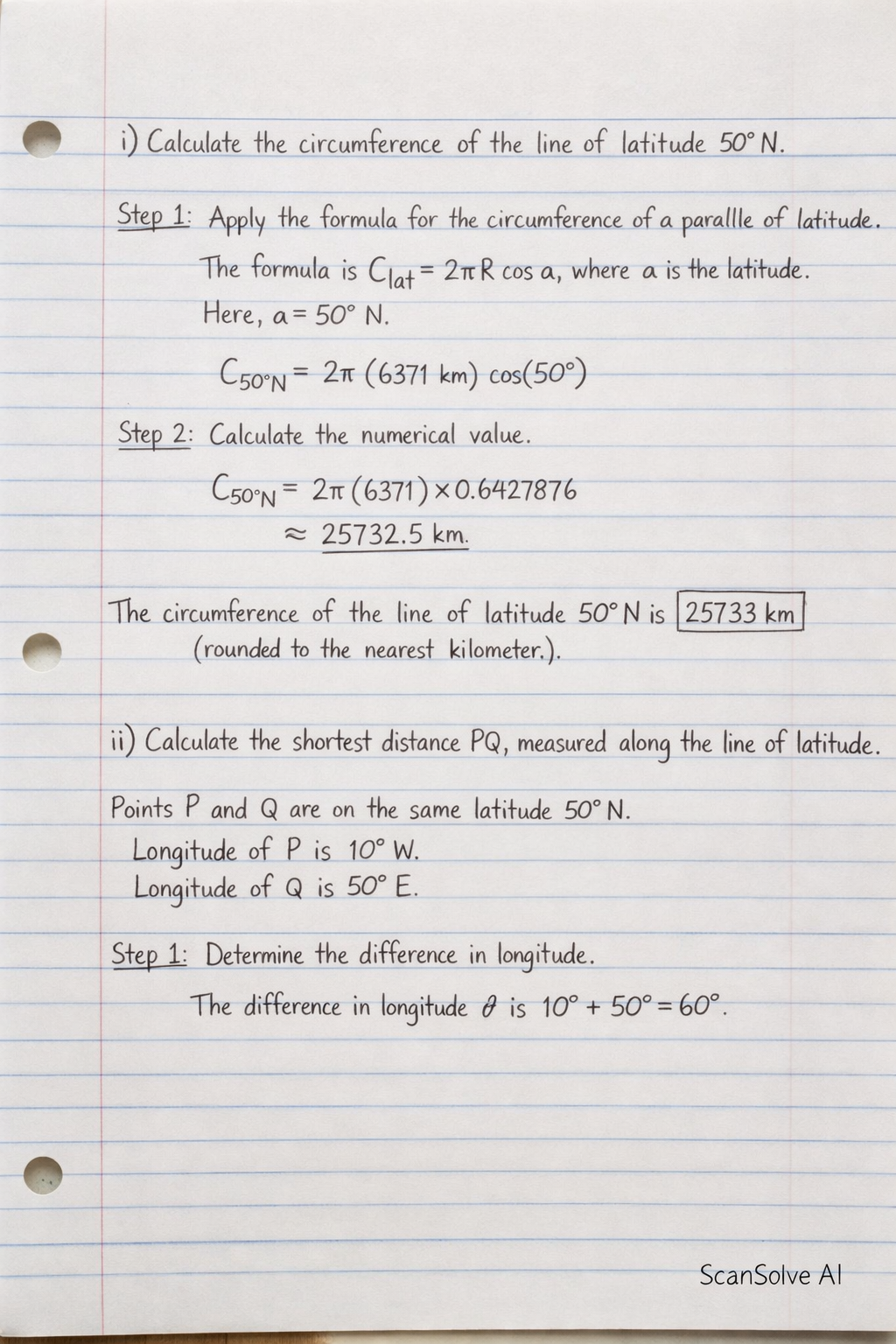
Handwritten Step-by-Step Solution
Get this as a handwritten image on WhatsApp — like a tutor wrote it for you.
Try on WhatsApp