
We read your photo as:
Discuss how society's perception of gender-specific roles has evolved and its impact on modern family dynamics.
ScanSolve AI Answer
Step-by-step solution
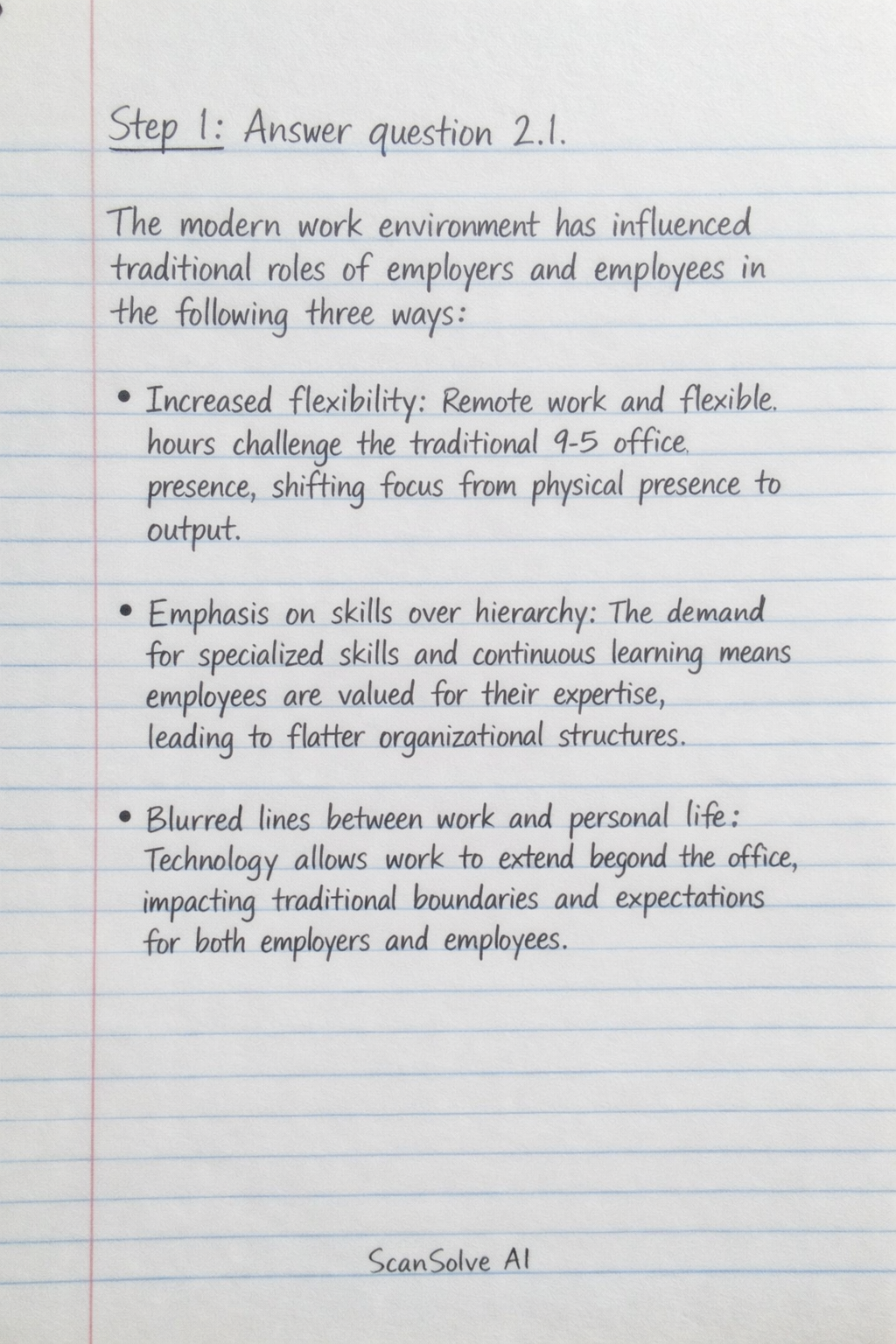
10 stepsAnswer question 2.1.
The modern work environment has influenced traditional roles of employers and employees in the following three ways:
- Increased flexibility: Remote work and flexible hours challenge the traditional 9-5 office presence, shifting focus from physical presence to output.
- Emphasis on skills over hierarchy: The demand for specialized skills and continuous learning means employees are valued for their expertise, leading to flatter organizational structures.
- Blurred lines between work and personal life: Technology allows work to extend beyond the office, impacting traditional boundaries and expectations for both employers and employees.
Answer question 2.2.
Cultural expectations might create conflict when a young person transitions into a partner role due to:
- Differing views on gender roles: Traditional expectations about male and female responsibilities in a relationship may clash with modern egalitarian views.
- Family involvement: Some cultures expect extensive family involvement in relationship decisions, which can conflict with a young person's desire for independence.
- Expectations of commitment and marriage: Cultural pressures for early marriage or specific relationship milestones can create stress if a young person is not ready.
- Communication styles: Cultural norms around expressing emotions or resolving conflict may differ, leading to misunderstandings between partners.
Answer question 2.3.
The changing nature of the student role, particularly due to online learning, can affect a teenager's ability to develop social skills because:
- Reduced face-to-face interaction: Online platforms limit opportunities for spontaneous social cues, non-verbal communication, and direct interaction crucial for developing empathy and social awareness.
- Limited group work and collaboration: While online group work exists, it often lacks the dynamic negotiation, conflict resolution, and immediate feedback present in in-person collaborative tasks.
Answer question 2.4.
A sudden change in life role from being a learner to becoming a caregiver could negatively influence the well-being of a Grade 10 learner in these three ways:
- Academic disruption: Caregiving responsibilities can lead to missed school days, reduced study time, and difficulty concentrating, negatively impacting grades and educational progress.
- Emotional and psychological stress: The burden of caregiving can cause anxiety, depression, and feelings of isolation, as the learner may struggle to cope with adult responsibilities at a young age.
- Loss of social life and peer connections: Time spent on caregiving may limit opportunities for social interaction, extracurricular activities, and developing friendships, leading to social isolation.
Answer question 2.5.
Cultural norms significantly influence youth's views on how leadership roles are practiced in different communities by shaping expectations around authority, decision-making, and communication. For example, in some cultures, hierarchical structures are respected, and leaders are expected to be authoritative and make decisions independently. In contrast, other cultures may value participatory leadership, where leaders are expected to consult with group members and build consensus. These ingrained norms dictate what youth perceive as effective or appropriate leadership behavior.
Answer question 2.6.
One effective way young people can communicate role changes to their friends to protect their relationships is through open and honest communication. By clearly explaining their new responsibilities, time constraints, and how these changes might affect their availability or interactions, they can help friends understand and adapt, preventing misunderstandings and resentment.
Answer question 2.7.
The responsibilities of a partner in maintaining a healthy, respectful relationship include:
- Mutual respect: Valuing each other's opinions, boundaries, and individuality.
- Open communication: Expressing thoughts, feelings, and needs honestly and listening actively.
- Trust and honesty: Being reliable, transparent, and faithful to one another.
- Support and encouragement: Being there for each other during challenges and celebrating successes.
Answer question 2.8.
Factors that may limit a person's ability to adapt to new life roles after leaving school include:
- Lack of practical skills: Insufficient life skills such as financial literacy, independent living skills, or job-specific training can hinder adaptation to adult roles.
- Limited support networks: A lack of family, friends, or community support can make it difficult to navigate new challenges and responsibilities.
- Emotional immaturity: An inability to cope with stress, make independent decisions, or manage emotions effectively can impede successful role transitions.
- Financial constraints: Economic instability or a lack of resources can create significant barriers to pursuing education, employment, or establishing independence.
Answer question 2.9.
Society's perception of gender-specific roles has evolved significantly, moving from rigid traditional expectations to more fluid and equitable views, which has profoundly impacted modern family dynamics. Historically, gender roles were strictly defined, with men as primary breadwinners and women as homemakers. This led to a clear division of labor and authority within families. However, with increased female participation in the workforce, changing social norms, and advocacy for gender equality, these perceptions have shifted. Modern family dynamics now often feature dual-income households, shared parenting responsibilities, and flexible divisions of household labor, challenging traditional power structures and promoting more egalitarian partnerships. This evolution allows for greater individual choice and diverse family structures, though remnants of traditional expectations can still create tension.
Answer question 2.10.
The pressure to be a follower within a peer group can lead an individual to suppress their individuality and personal values. This can manifest as making choices that go against their better judgment, engaging in risky behaviors they wouldn't otherwise consider, or adopting opinions and styles that don't genuinely reflect who they are. Ultimately, this can result in a loss of self-identity, decreased self-esteem, and difficulty in forming authentic relationships based on mutual respect rather than conformity.
Still stuck on this one?
Ask a follow-up, and the answer starts from this question.
More Geography Questions
Handwritten Step-by-Step Solution
Get this as a handwritten image on WhatsApp — like a tutor wrote it for you.
Try on WhatsApp