
We read your photo as:
b) Explain five importance of irrigation in crop production.
Geography
ScanSolve AI Answer
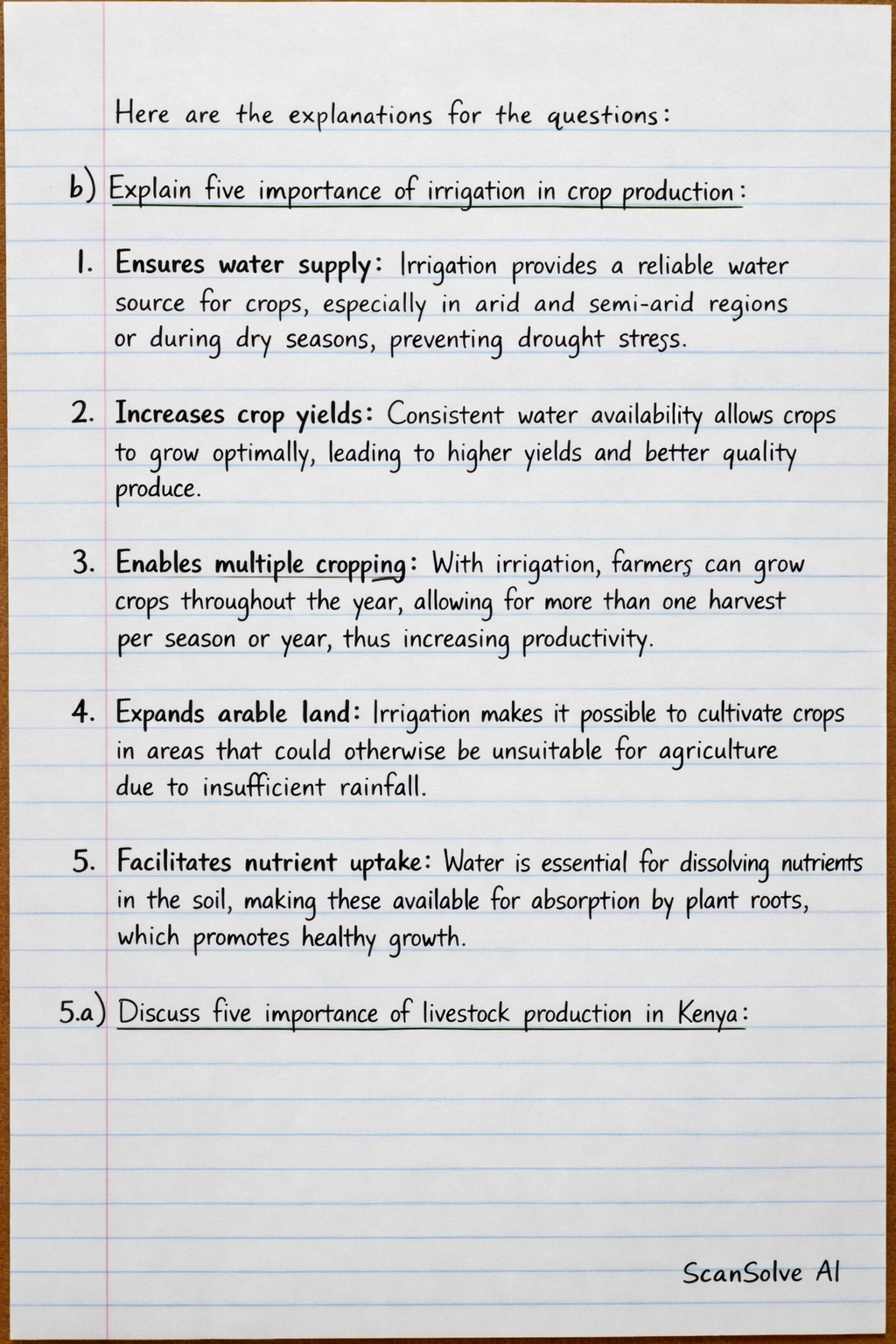
Here are the explanations for the questions:
b) Explain five importance of irrigation in crop production.
- Ensures water supply: Irrigation provides a reliable water source for crops, especially in arid and semi-arid regions or during dry seasons, preventing drought stress.
- Increases crop yields: Consistent water availability allows crops to grow optimally, leading to higher yields and better quality produce.
- Enables multiple cropping: With irrigation, farmers can grow crops throughout the year, allowing for more than one harvest per season or year, thus increasing productivity.
- Expands arable land: Irrigation makes it possible to cultivate crops in areas that would otherwise be unsuitable for agriculture due to insufficient rainfall.
- Facilitates nutrient uptake: Water is essential for dissolving nutrients in the soil, making them available for absorption by plant roots, which promotes healthy growth.
5.a) Discuss five importance of livestock production in Kenya.
- Food security: Livestock provides essential food products such as meat, milk, and eggs, contributing significantly to the nutritional needs of the population.
- Source of income: Farmers earn income from selling live animals, their products (milk, meat, hides), and by-products, improving their livelihoods.
- Employment creation: The livestock sector creates numerous jobs in farming, processing, marketing, veterinary services, and related industries.
- Raw materials for industries: Livestock provides raw materials like hides and skins for leather industries, wool for textile industries, and bones for fertilizer production.
- Manure for soil fertility: Animal waste (manure) is a valuable organic fertilizer that improves soil structure, water retention, and nutrient content, reducing reliance on chemical fertilizers.
b) Explain five methods of controlling crop pests.
- Cultural methods: These involve modifying farming practices to make the environment less favorable for pests. Examples include crop rotation, timely planting and harvesting, proper sanitation, and using resistant crop varieties.
- Biological methods: This involves using natural enemies of pests, such as predators, parasites, or pathogens, to reduce pest populations. For instance, introducing ladybugs to control aphids.
- Chemical methods: This involves the use of pesticides (insecticides, fungicides, herbicides) to kill or repel pests. These are effective but require careful application to minimize environmental impact.
- Physical methods: These are direct interventions to remove or deter pests. Examples include hand-picking large pests, trapping, using physical barriers, or applying heat treatments.
- Legislative methods: These involve government regulations and policies to prevent the introduction and spread of pests. Examples include plant quarantines, inspections of imported plant materials, and certification programs.
Was this helpful?
Still stuck on this one?
Ask a follow-up, and the answer starts from this question.
Got a different question?Ask your own question
More Geography Questions
QList five importance of water in agricultural productionQAssignment 1 What is irrigation, and why is it important in agriculture? Describe any four methods…QExplain the importance of pressure regulations in irrigation system. Five point put in English…Q3c) State TWO reasons why proper land preparation is important in crop production. (2 marks)QList the method of irrigation drainage system in agriculture production
Handwritten Step-by-Step Solution
Get this as a handwritten image on WhatsApp — like a tutor wrote it for you.
Try on WhatsApp