
We read your photo as:
Based on the graphs in Fig. 22, match graphs X, Y, and Z to sand, loam, and clay soils, explaining the capillary action involved.
Geography
ScanSolve AI Answer
Step-by-step solution
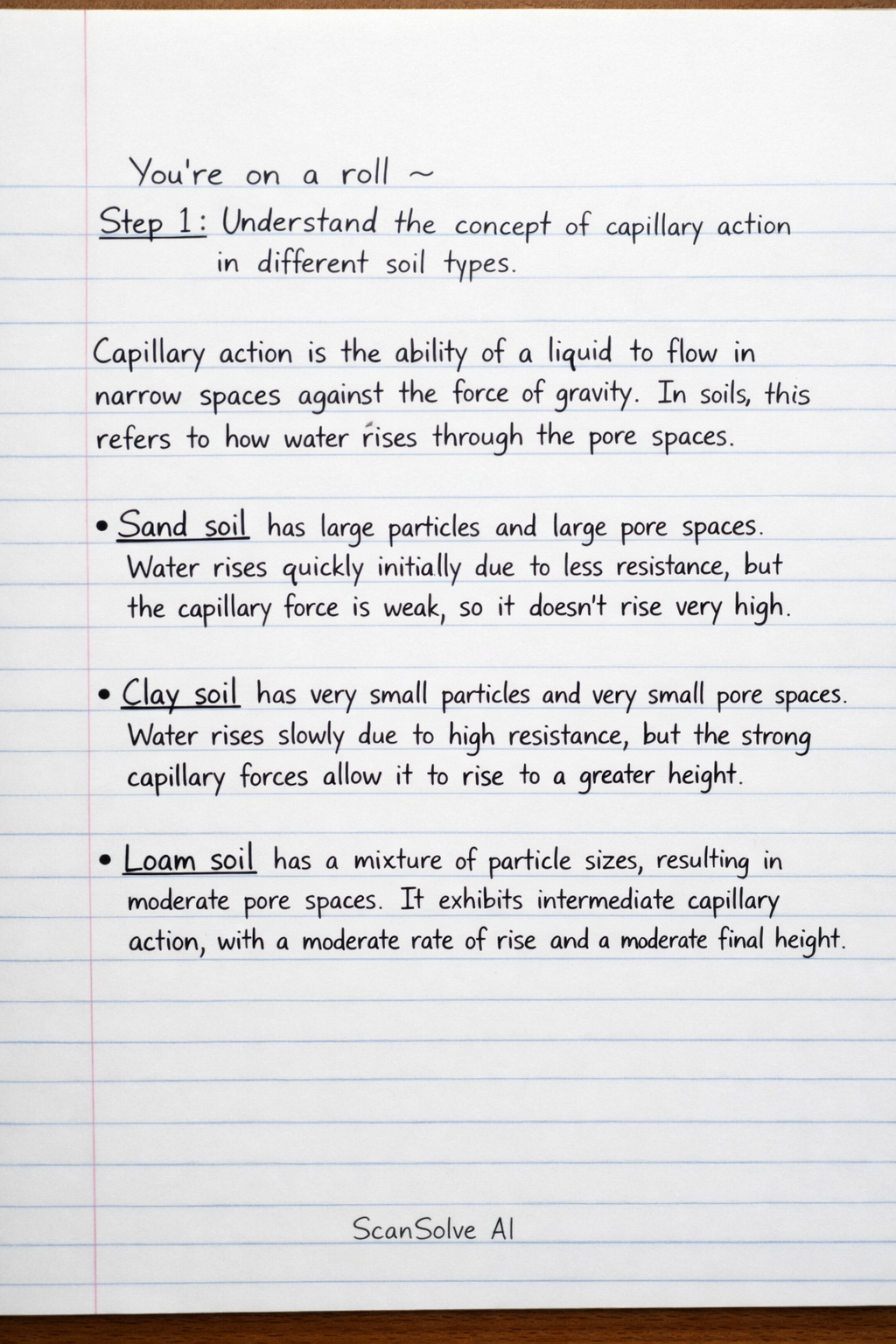
3 stepsUnderstand the concept of capillary action in different soil types.
Capillary action is the ability of a liquid to flow in narrow spaces against the force of gravity. In soils, this refers to how water rises through the pore spaces.
- Sand soil has large particles and large pore spaces. Water rises quickly initially due to less resistance, but the capillary force is weak, so it doesn't rise very high.
- Clay soil has very small particles and very small pore spaces. Water rises slowly due to high resistance, but the strong capillary forces allow it to rise to a greater height.
- Loam soil has a mixture of particle sizes, resulting in moderate pore spaces. It exhibits intermediate capillary action, with a moderate rate of rise and a moderate final height.
Analyze the graphs in Fig.
- Graph Y shows the fastest initial rise in water height but reaches the lowest maximum height. This indicates sand soil.
- Graph X shows an intermediate rate of rise and reaches an intermediate maximum height. This indicates loam soil.
- Graph Z shows the slowest initial rise in water height but continues to rise to the highest maximum height over time. This indicates clay soil.
Match the graphs to the soil types.
- X = Loam soil
- Y = Sand soil
- Z = Clay soil
Was this helpful?
Still stuck on this one?
Ask a follow-up, and the answer starts from this question.
Got a different question?Ask your own question
More Geography Questions
QWhat soil texture determination methods are shown in Diagrams A and B, and what soil textures are…QA student is investigating the water retention properties of three different soil types, Q, R, and…QUse the diagrams of soil drainage setups to answer the following questions: 1) Name the soil types…QHow do I read a soil texture diagram and determine the texture class for a soil sample with 50%…QIdentify soil structures A, B, C, D, and relate them to soil compaction, arid climates, and crop…
Browse by topic:Earth Science
Handwritten Step-by-Step Solution
Get this as a handwritten image on WhatsApp — like a tutor wrote it for you.
Try on WhatsApp