

This geography problem is solved step by step below, with detailed explanations to help you understand the method and arrive at the correct answer.
ScanSolve AI Answer
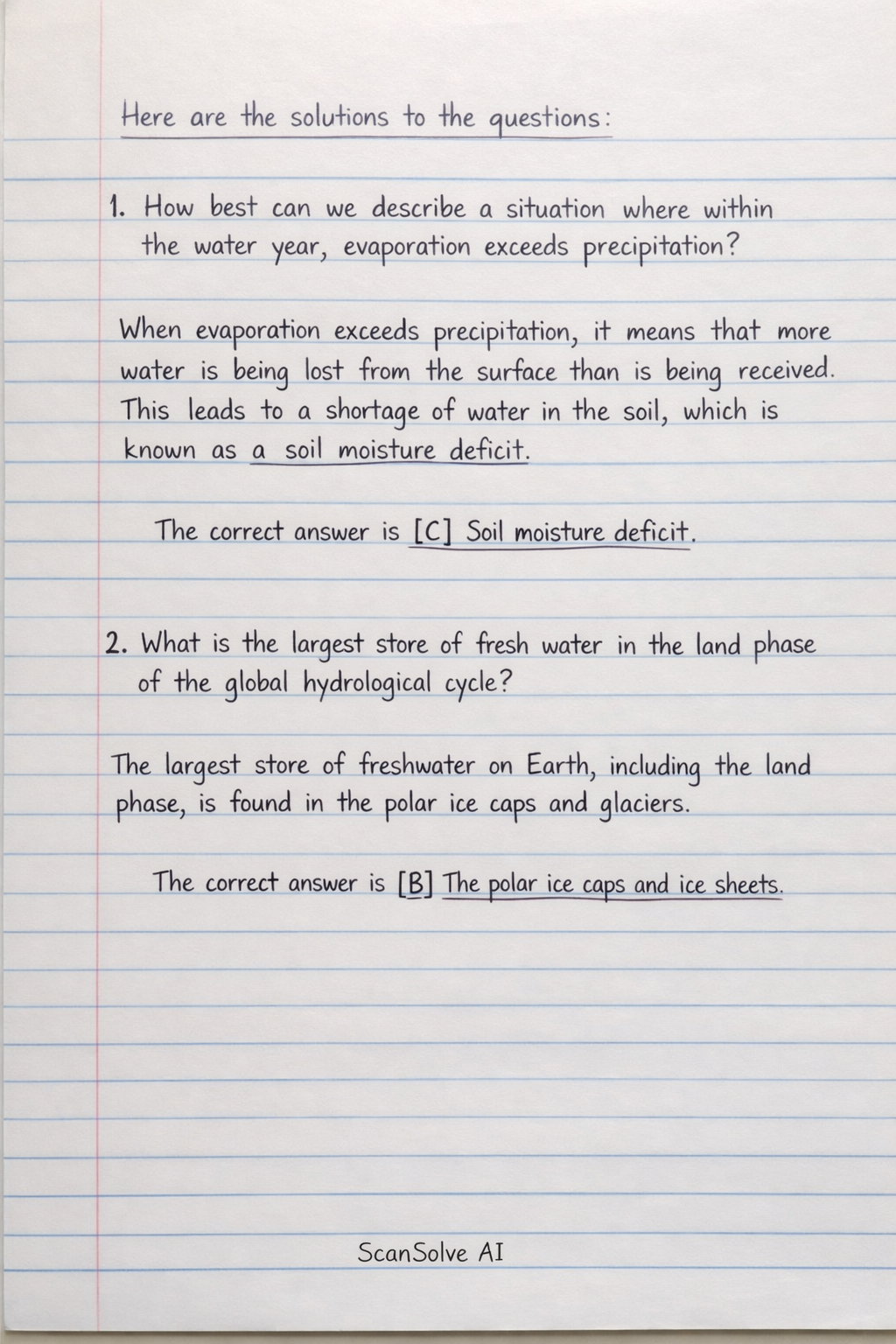
Here are the solutions to the questions: 1. How best can we describe a situation where within the water year, evaporation exceeds precipitation? When evaporation exceeds precipitation, it means that more water is being lost from the surface than is being received. This leads to a shortage of water in the soil, which is known as a soil moisture deficit. The correct answer is [C] Soil moisture deficit. 2. What is the largest store of fresh water in the land phase of the global hydrological cycle? The largest store of freshwater on Earth, including the land phase, is found in the polar ice caps and glaciers. The correct answer is [B] The polar ice caps and ice sheets. 3. After a four month period of dry season from November to February in the Western Highlands, the rains began falling again in March. Precipitation in March however, exceeded the amount of evapotranspiration. Which of the following was the most significant hydrological process occurring in the soil in March? After a prolonged dry season, the soil moisture stores would be depleted. When precipitation exceeds evapotranspiration, the first and most significant process to occur in the soil is the replenishment of this depleted moisture, which is called soil moisture recharge. The correct answer is [B] Soil moisture recharge. 4. One of these is an exception to the factors that account for the variation in pressure difference from one region to another. Isolate the exception. Differences in temperature, humidity, and even slight variations in gravitational force (though less significant for regional weather) can influence air density and thus atmospheric pressure. "Differences in barometric force" is not a distinct factor causing pressure differences; rather, barometric force is atmospheric pressure, so differences in it are what we are trying to explain, not a cause. The correct answer is [B] Differences in barometric force. 5. All of the following factors except one influence the climate of any given place. Pick out the odd factor. Latitude, altitude, and prevailing winds are all major factors that directly influence the climate of a place by affecting temperature, precipitation, and air masses. Longitude primarily determines time zones and does not directly influence climate patterns in the same way. The correct answer is [D] Longitude. 6. The latitudinal zone on the earth's surface which receives the lowest yearly amount of precipitation is: