
We read your photo as:
c) Question 3: Which is the fastest means by which precipitated water can reach the river channel?
ScanSolve AI Answer
Answer
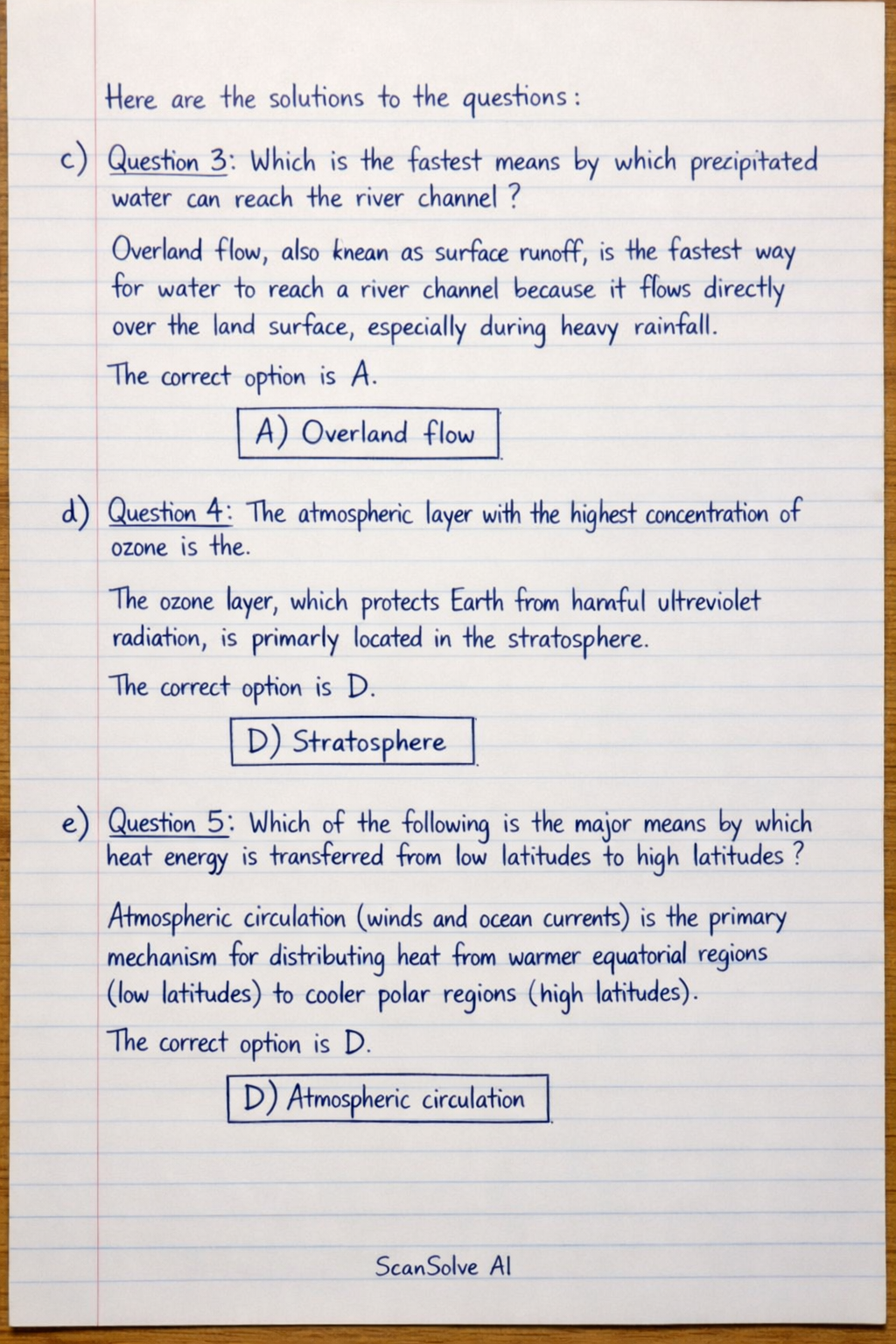
Here are the solutions to the questions:
c) Question 3: Which is the fastest means by which precipitated water can reach the river channel?
Overland flow, also known as surface runoff, is the fastest way for water to reach a river channel because it flows directly over the land surface, especially during heavy rainfall.
The correct option is A.
d) Question 4: The atmospheric layer with the highest concentration of ozone is the
The ozone layer, which protects Earth from harmful ultraviolet radiation, is primarily located in the stratosphere.
The correct option is D.
e) Question 5: Which of the following is the major means by which heat energy is transferred from low latitudes to high latitudes?
Atmospheric circulation (winds and ocean currents) is the primary mechanism for distributing heat from warmer equatorial regions (low latitudes) to cooler polar regions (high latitudes).
The correct option is D.
f) Question 6: Which of the following expresses the correct meaning of dew point?
The dew point is the temperature at which air becomes saturated with water vapor, leading to condensation and the formation of liquid droplets (dew or fog).
The correct option is C.
g) Question 7: Temperatures are higher in cities due to
The urban heat island effect is largely caused by urban surfaces (like concrete and asphalt) absorbing solar radiation and re-emitting it as longwave radiation, which then gets trapped within the urban environment.
The correct option is B.
h) Question 8: The urban heat island can be explained by all of the following except one. Which is the exception.
Urban heat islands are caused by heat retention in building materials, reduced evaporative cooling, and obstructed wind flow. Low cloud cover over cities is not a direct cause; in fact, urban areas can sometimes increase cloudiness due to aerosols.
The correct option is D.
i) Question 9: The occurrence of deserts on western sides of land masses in the sub tropics is related to all of the following conditions but for one. Which is the odd condition?
Subtropical western deserts are typically formed by offshore winds, subtropical high-pressure cells, and cold ocean currents. While rain shadows can create deserts, the specific phrasing "on the lee of mountain ranges situated on the western sides of land masses" is geographically less common for explaining deserts on the western side itself, as the lee side would typically be further inland or east if prevailing winds are from the west.
The correct option is C.
j) Question 10: Which of the following is not a geological hazard?
Geological hazards are phenomena caused by Earth's geological processes. Lahars (volcanic mudflows), pyroclastic falls (volcanic ash), and earthquakes are all geological hazards. Hurricanes are atmospheric phenomena, not geological.
The correct option is D.
k) Question 11: Which layer represents the innermost section of the earth's structure?
The Earth's layers, from outermost to innermost, are the crust, mantle, outer core, and inner core. Therefore, the inner core is the innermost section.
The correct option is C.
l) Question 12: Which type of plate boundary is located between the South American plate and the African plate?
The boundary between the South American plate and the African plate is the Mid-Atlantic Ridge, where new oceanic crust is formed as the plates move apart. This is a divergent plate boundary.
The correct option is D.
Try one yourself
A new problem that tests the same skill.
Still stuck on this one?
Ask a follow-up, and the answer starts from this question.
More Geography Questions
Handwritten Step-by-Step Solution
Get this as a handwritten image on WhatsApp — like a tutor wrote it for you.
Try on WhatsApp