
We read your photo as:
Describe the characteristics of the climate regions X, Y, and Z, and explain how altitude and ocean currents influence climate. Discuss the negative effects of climate change on the physical environme
ScanSolve AI Answer
This answer stops before the end.
It was cut off when it was first written. Ask ScanSolve this question again for the full working.
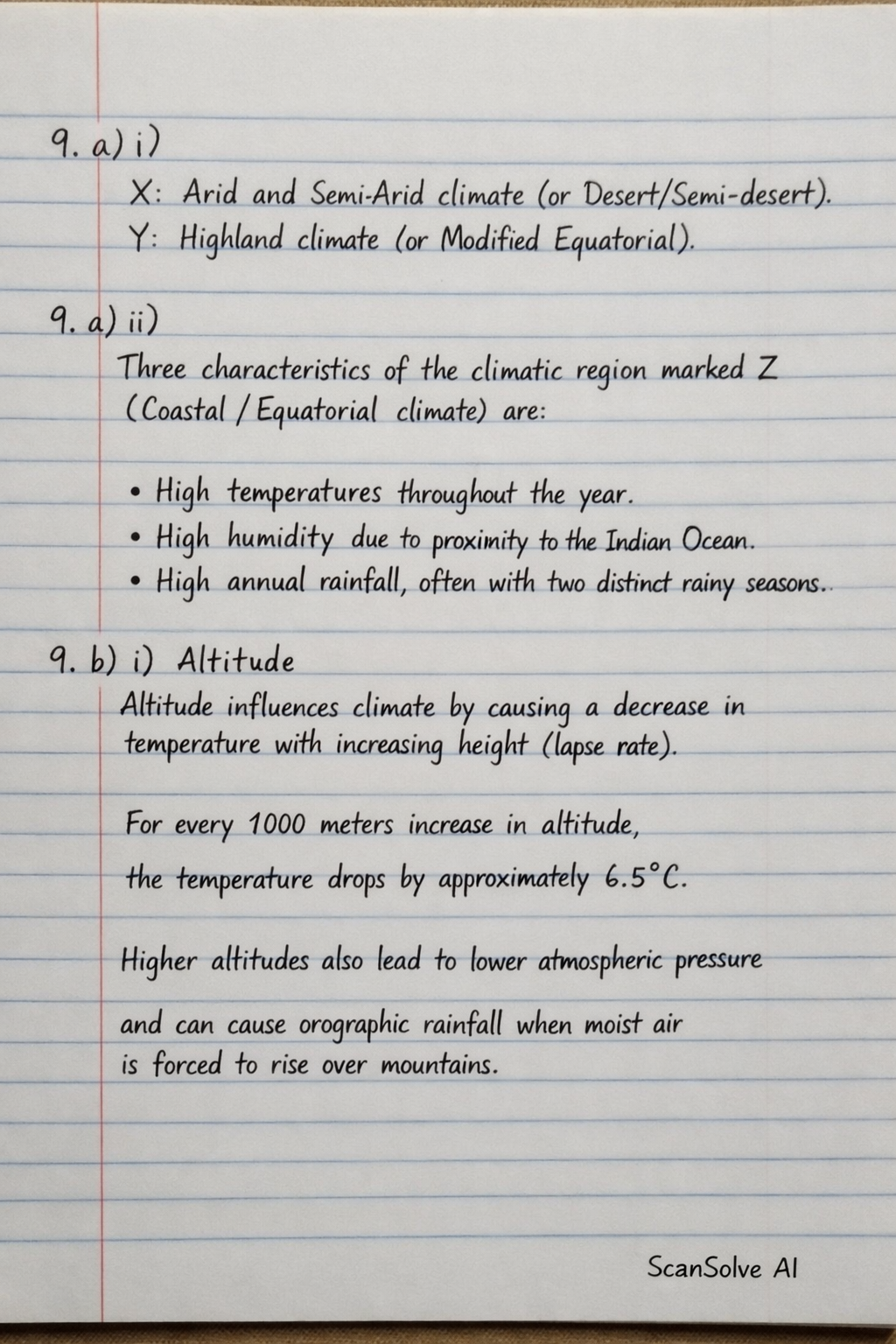
9. a) i)
X: Arid and Semi-Arid climate (or Desert/Semi-desert)
Y: Highland climate (or Modified Equatorial)
9. a) ii) Three characteristics of the climatic region marked Z (Coastal/Equatorial climate) are:
- High temperatures throughout the year.
- High humidity due to proximity to the Indian Ocean.
- High annual rainfall, often with two distinct rainy seasons.
9. b) i) Altitude
Altitude influences climate by causing a decrease in temperature with increasing height (lapse rate). For every 1000 meters increase in altitude, the temperature drops by approximately . Higher altitudes also lead to lower atmospheric pressure and can cause orographic rainfall when moist air is forced to rise over mountains.
9. b) ii) Ocean currents
Ocean currents influence climate by transferring heat around the globe. Warm ocean currents increase the temperature and humidity of coastal areas, leading to higher rainfall. Conversely, cold ocean currents cool the overlying air, reducing evaporation and humidity, which often results in arid or desert conditions along adjacent coastlines.
9. c) Negative effects of climate change on the physical environment include:
- Rising sea levels due to thermal expansion of water and melting glaciers, leading to coastal erosion and inundation.
- Increased frequency and intensity of extreme weather events such as droughts, floods, and heatwaves.
- Desertification and land degradation in arid and semi-arid regions.
- Melting of glaciers and ice caps, reducing freshwater supplies and altering ecosystems.
- Ocean acidification due to increased absorption of carbon dioxide, harming marine life.
- Loss of biodiversity as species struggle to adapt to rapid environmental changes.
9. d) i) Three methods of collecting data students would use at a weather station are:
- Reading instruments: Directly observing and recording measurements from instruments like thermometers, rain gauges, barometers, and anemometers.
- Observation: Visually assessing and recording weather phenomena such as cloud cover, wind direction, and visibility.
- Recording data: Systematically entering collected measurements and observations into logbooks, charts, or digital databases.
9. d) ii) Three qualities in the construction of a Stevenson screen are:
- It is painted white to reflect solar radiation and prevent the interior from heating up.
- It has louvred sides to allow free circulation of air while shielding instruments from direct sunlight and precipitation.
- It is raised above the ground on legs to prevent heat radiation from the ground from affecting temperature readings.
10. a) i) Three types of faults are:
- Normal fault
- Reverse fault (or Thrust fault)
- Strike-slip fault (or Transform fault)
10. a) ii) Apart from compressional forces, two other processes that may cause faulting are:
- Tensional forces: These forces pull rocks apart, causing them to stretch and thin. When the tensional stress exceeds the rock's strength, it fractures, leading to the formation of normal faults where blocks of crust move away from each other.
- Shear forces: These forces cause rocks to slide horizontally past each other in opposite directions. This lateral movement results in strike-slip faults, where there is little to no vertical displacement.
10. b) The Great Rift Valley is primarily formed by tensional forces, not compressional forces. Tensional forces cause the Earth's crust to stretch and thin, leading to the formation of normal faults and the subsidence of a central block, creating a rift valley (graben). Compressional forces typically lead to folding and reverse faulting, forming mountain ranges.
Here's how tensional forces lead to the formation of a rift valley:
Step 1: An initial block of crust is subjected to tensional forces, causing it to stretch and thin.
Step 2: As the crust stretches, it fractures along parallel lines, forming normal faults. The central block between these faults begins to subside.
\begin{array}{c}
Tensional Force \longleftarrow Fault \quad Subsiding BlockStill stuck on this one?
Ask a follow-up, and the answer starts from this question.
More Geography Questions
Handwritten Step-by-Step Solution
Get this as a handwritten image on WhatsApp — like a tutor wrote it for you.
Try on WhatsApp