
We read your photo as:
Describe the characteristics of the three major climatic zones (Polar, Temperate, Tropical) and their associated ecosystems and weather patterns.
ScanSolve AI Answer
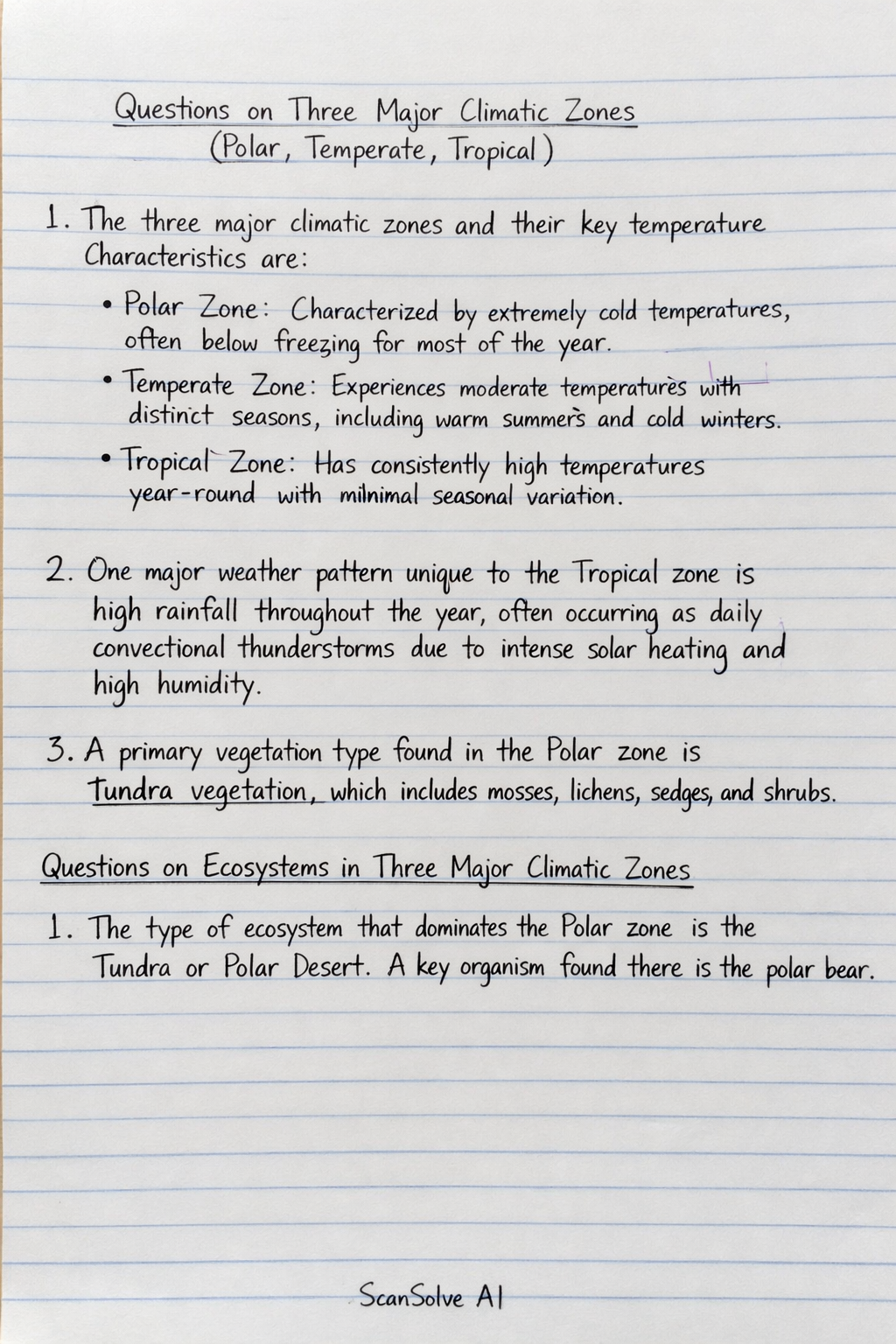
Questions on Three Major Climatic Zones (Polar, Temperate, Tropical)
-
The three major climatic zones and their key temperature characteristics are:
- Polar Zone: Characterized by extremely cold temperatures, often below freezing for most of the year.
- Temperate Zone: Experiences moderate temperatures with distinct seasons, including warm summers and cold winters.
- Tropical Zone: Has consistently high temperatures year-round with minimal seasonal variation.
-
One major weather pattern unique to the Tropical zone is high rainfall throughout the year, often occurring as daily convectional thunderstorms due to intense solar heating and high humidity.
-
A primary vegetation type found in the Polar zone is tundra vegetation, which includes mosses, lichens, sedges, and dwarf shrubs.
Questions on Ecosystems in Three Major Climatic Zones
-
The type of ecosystem that dominates the Polar zone is the Tundra or Polar Desert. A key organism found there is the polar bear.
-
A common Temperate zone ecosystem is the Temperate Deciduous Forest. Its seasonal change involves trees shedding their leaves in autumn, remaining bare through winter, and regrowing leaves in spring.
-
A Tropical zone ecosystem with high species diversity is the Tropical Rainforest. It is characterized by consistently high temperatures and rainfall, supporting a dense, multi-layered canopy and an immense variety of plant and animal species.
Question on Biodiversity in the Tropical Zone
The Tropical zone supports greater biodiversity than the Polar or Temperate zones primarily due to its stable, warm temperatures and high, consistent rainfall throughout the year. These conditions provide an ideal environment for plant growth, leading to high primary productivity. This abundance of resources supports a complex food web, a wide array of ecological niches, and promotes speciation, resulting in a vast diversity of life forms.
Questions on Abiotic Factors Affecting Plant and Animal Life
-
Temperature significantly affects the distribution of plant species because each species has an optimal temperature range for its metabolic processes, photosynthesis, and reproduction. Temperatures outside this range can inhibit growth or be lethal, thus limiting where a species can survive and thrive.
-
Sunlight is a crucial abiotic factor in aquatic ecosystems as it is the primary energy source for photosynthesis by phytoplankton, algae, and aquatic plants. Sunlight penetrates only to a certain depth (the photic zone), limiting the distribution of photosynthetic organisms and, consequently, the entire food web in deeper waters.
-
Soil pH influences plant growth by affecting the availability of nutrients. Different nutrients are soluble and accessible to plants within specific pH ranges. Extreme pH levels can make essential nutrients insoluble or release toxic elements, hindering plant uptake and overall growth.
-
Wind impacts animal behavior in open habitats by affecting thermoregulation (increasing heat loss), foraging efficiency (making it harder to detect prey or predators), and movement (hindering flight or locomotion). Animals may respond by seeking shelter, altering their activity times, or changing migration patterns to conserve energy and avoid adverse conditions.
Questions on Biotic Factors Affecting Plant and Animal Life
-
Competition between plants for light shapes forest structure by leading to stratification. Taller plants or those with broader leaves that can reach more sunlight will outcompete shorter plants, forming distinct layers (canopy, understory, forest floor). This competition drives the evolution of different growth forms and influences species composition within the forest.
-
Predation is a biotic factor where one organism (the predator) hunts and consumes another (the prey). It directly controls prey population sizes by reducing their numbers and acts as a strong selective pressure, driving natural selection for adaptations in both predator (e.g., hunting skills) and prey (e.g., camouflage, speed).
-
Mutualism is a form of symbiosis where both interacting species benefit from the relationship. An example is the relationship between bees and flowering plants: bees obtain nectar (food), while plants are pollinated, facilitating reproduction.
-
Disease acts as a biotic factor in ecosystems by causing illness or death, which can significantly reduce population sizes of affected species. This can alter community structure, impact food webs by removing or weakening key species, and affect the overall health and resilience of the ecosystem.
Still stuck on this one?
Ask a follow-up, and the answer starts from this question.
More Geography Questions
Handwritten Step-by-Step Solution
Get this as a handwritten image on WhatsApp — like a tutor wrote it for you.
Try on WhatsApp