
We read your photo as:
Compare and contrast geomorphic and geological forces, providing examples of each.
ScanSolve AI Answer
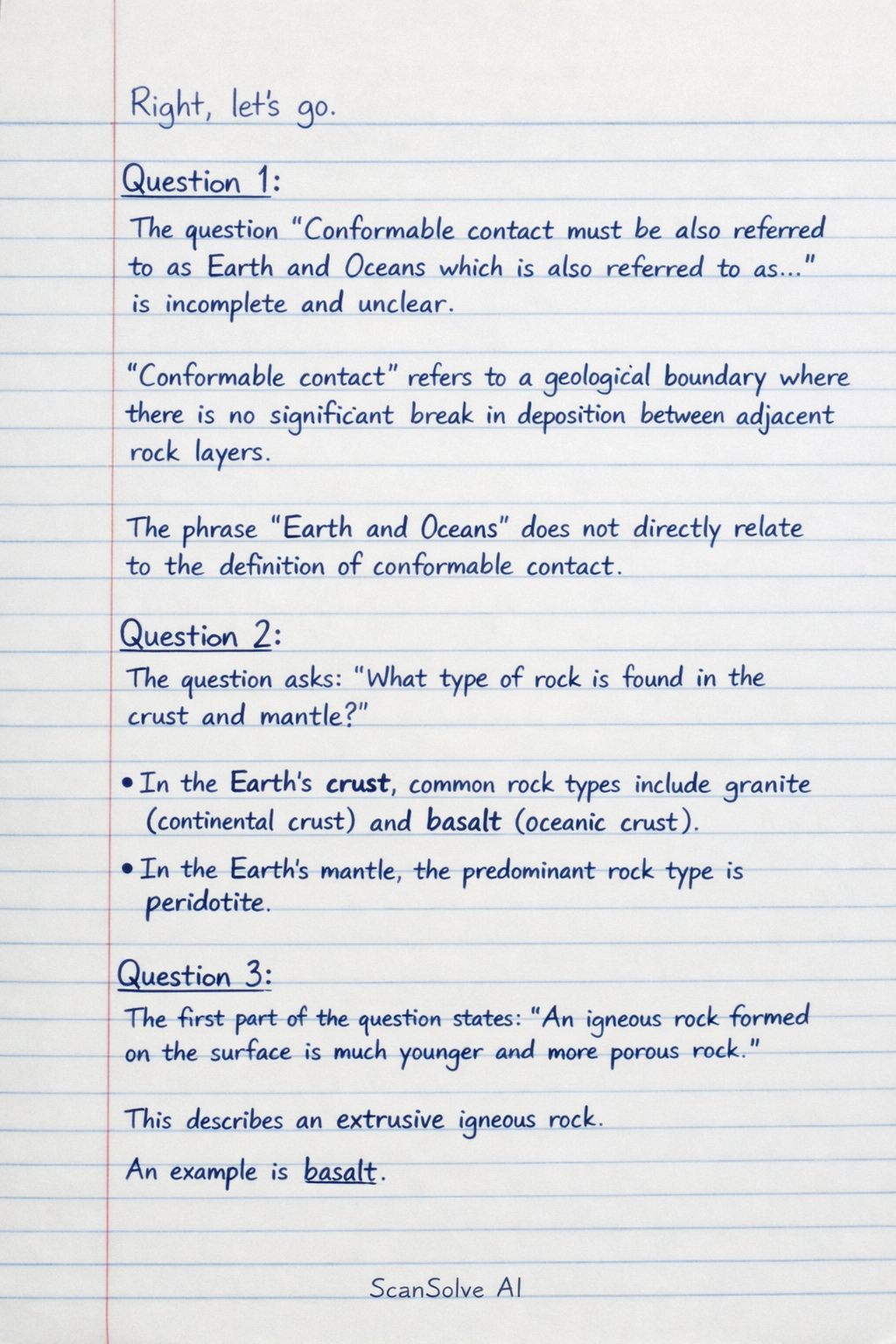
Question 1: The question "Conformable contact must be also referred to as Earth and Oceans which is also referred to as..." is incomplete and unclear. "Conformable contact" refers to a geological boundary where there is no significant break in deposition between adjacent rock layers. The phrase "Earth and Oceans" does not directly relate to the definition of conformable contact.
Question 2:
The question asks: "What type of rock is found in the crust and mantle?"
- In the Earth's crust, common rock types include granite (continental crust) and basalt (oceanic crust).
- In the Earth's mantle, the predominant rock type is peridotite.
Question 3:
The first part of the question states: "An igneous rock formed on the surface is much younger and more porous rock."
This describes an extrusive igneous rock. An example is basalt.
Question 4:
- Geomorphic forces are external processes that originate on or above the Earth's surface and are responsible for shaping landforms. Examples include weathering, erosion, and deposition.
- Geological forces (also known as endogenic forces) are internal processes that originate within the Earth and cause large-scale changes to the Earth's crust. Examples include plate tectonics, volcanism, and earthquakes. An example of a geological process is volcanism, where molten rock erupts onto the Earth's surface.
Question 5:
- Endogenic processes are internal forces originating within the Earth that lead to the creation and uplift of landforms. They are constructive forces.
- Example: Volcanism (formation of volcanoes), mountain building (orogeny), earthquakes.
- Exogenic processes are external forces acting on the Earth's surface that lead to the degradation and leveling of landforms. They are destructive forces.
- Example: Weathering (breakdown of rocks), erosion (transport of weathered material by wind, water, ice), deposition.
Question 6.1:
Lithosphere is the outer solid part of the earth, including the crust and uppermost mantle.
The student's answer is ✅ Correct.
Question 7:
The place where two plates meet is called a plate boundary.
The student's answer is ✅ Correct.
Question 8:
The diagram mentioned in the question is not visible, so this question cannot be answered.
Still stuck on this one?
Ask a follow-up, and the answer starts from this question.
More Geography Questions
Handwritten Step-by-Step Solution
Get this as a handwritten image on WhatsApp — like a tutor wrote it for you.
Try on WhatsApp