
We read your photo as:
Compare and contrast shifting cultivation and crop rotation, explaining the importance and disadvantages of shifting cultivation.
Geography
ScanSolve AI Answer
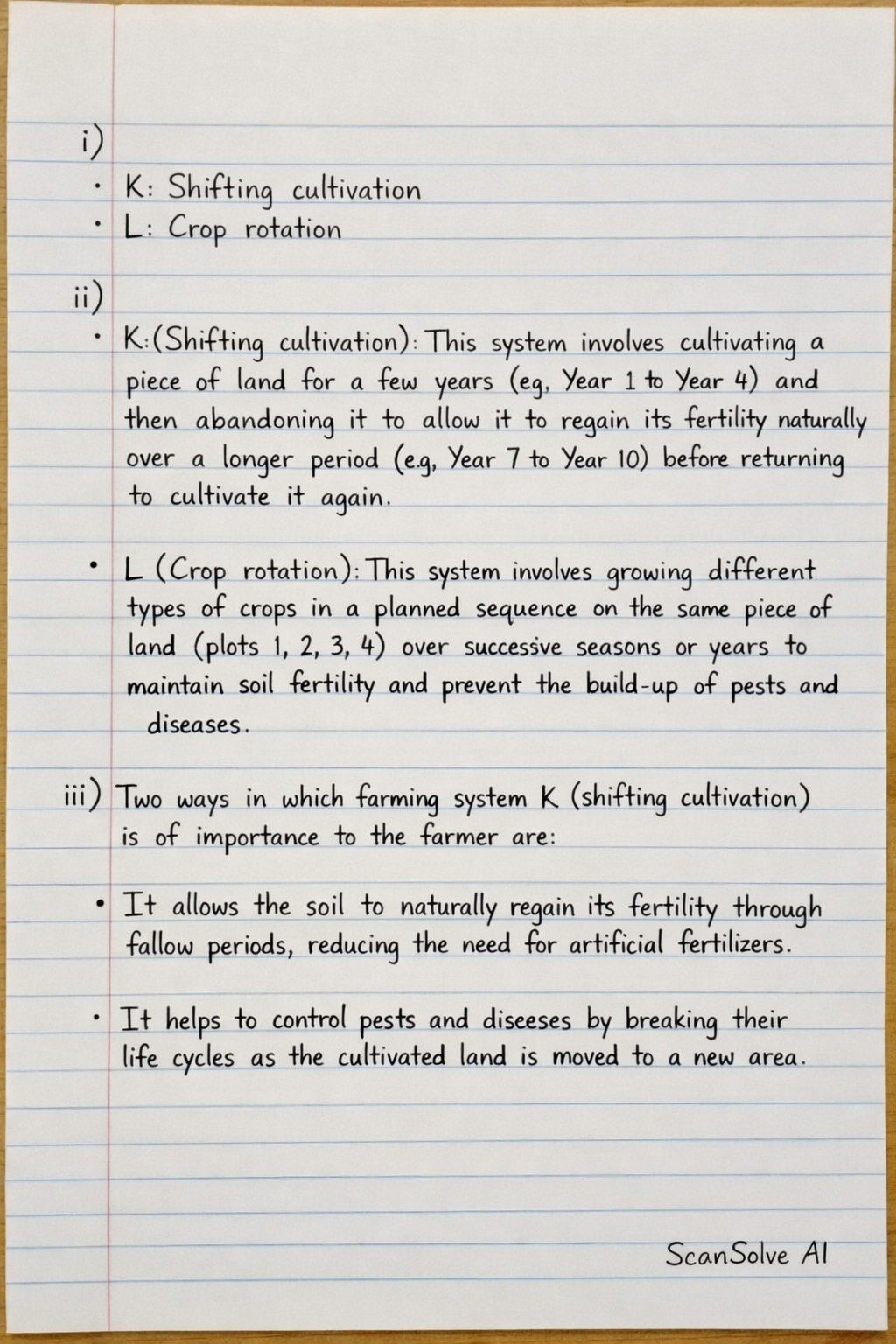
i)
- K: Shifting cultivation
- L: Crop rotation
ii)
- K (Shifting cultivation): This system involves cultivating a piece of land for a few years (e.g., Year 1 to Year 4) and then abandoning it to allow it to regain its fertility naturally over a longer period (e.g., Year 7 to Year 10) before returning to cultivate it again.
- L (Crop rotation): This system involves growing different types of crops in a planned sequence on the same piece of land (plots 1, 2, 3, 4) over successive seasons or years to maintain soil fertility and prevent the build-up of pests and diseases.
iii) Two ways in which farming system K (shifting cultivation) is of importance to the farmer are:
- It allows the soil to naturally regain its fertility through fallow periods, reducing the need for artificial fertilizers.
- It helps to control pests and diseases by breaking their life cycles as the cultivated land is moved to a new area.
iv) Three reasons why farming system K (shifting cultivation) is not being encouraged in recent times are:
- It requires large tracts of land, which are becoming scarce due to increasing population and demand for land.
- It often leads to deforestation and habitat destruction as new areas are cleared for cultivation.
- It results in low yields per unit area, making it inefficient for feeding a growing population.
v) One type of crop that could be included in the farmland L (crop rotation) to improve the fertility of the soil is a leguminous crop (e.g., groundnuts, beans, cowpeas).
Was this helpful?
Still stuck on this one?
Ask a follow-up, and the answer starts from this question.
Got a different question?Ask your own question
More Geography Questions
QDescribe the characteristics and impacts of shifting cultivation and rainforest clearing based on…QWhat is soil erosion and what are its causes? What is crop rotation and what are its benefits?QSubsistence form of crop cultivation has been replaced by modern ways of agriculture in different…QWhat is the reason for rotating the kinds of crops on the same piece of landQThe homework questions are: 5. Which of the following is a disadvantage of shifting cultivation? 11…
Handwritten Step-by-Step Solution
Get this as a handwritten image on WhatsApp — like a tutor wrote it for you.
Try on WhatsApp