
We read your photo as:
Explain the concept of transform plate boundaries, using the San Andreas Fault as an example.
ScanSolve AI Answer
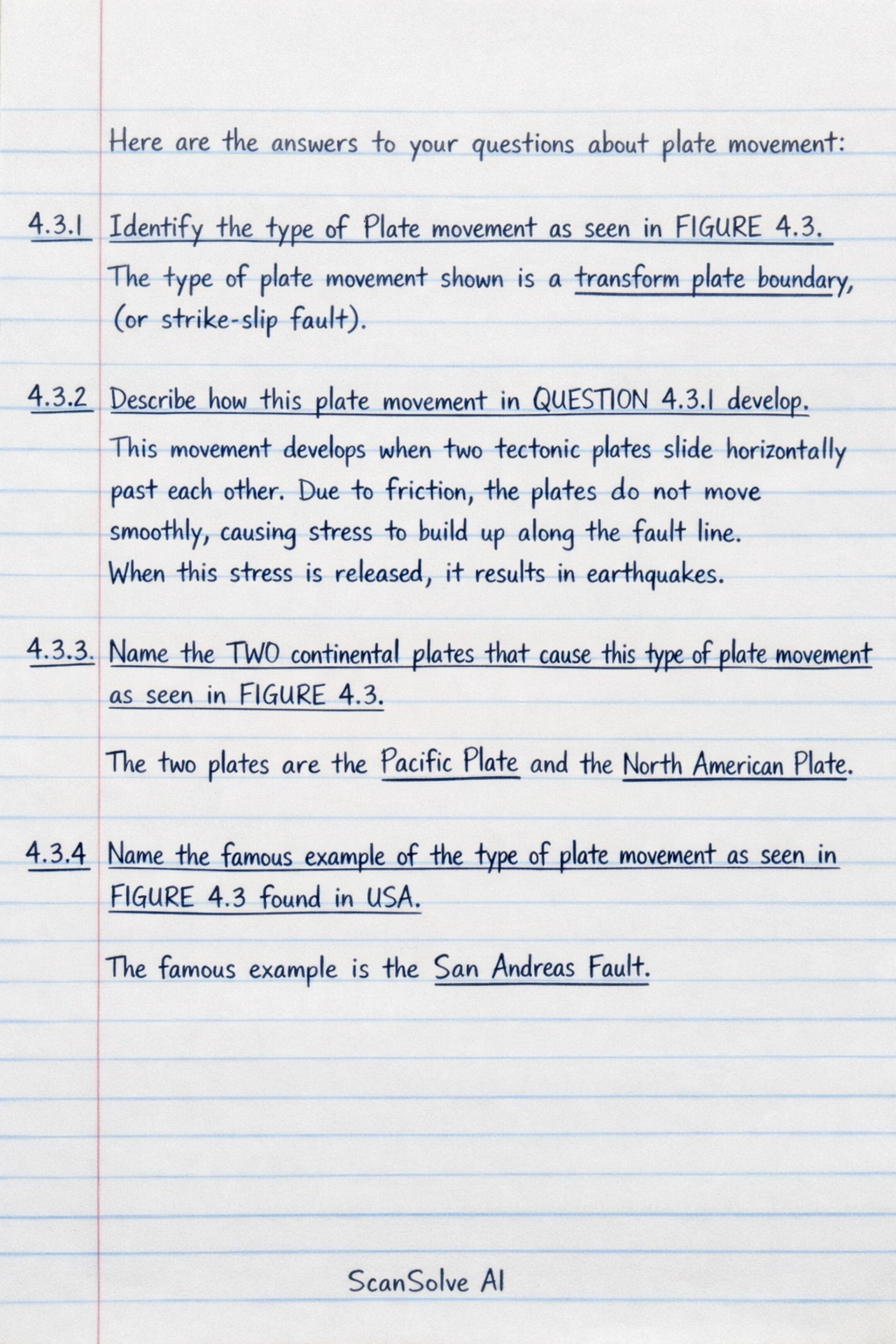
Here are the answers to your questions about plate movement:
4.3.1 Identify the type of Plate movement as seen in the FIGURE 4.3.
The type of plate movement shown is a transform plate boundary (or strike-slip fault).
4.3.2 Describe how this plate movement in QUESTION 4.3.1 develop.
This movement develops when two tectonic plates slide horizontally past each other. Due to friction, the plates do not move smoothly, causing stress to build up along the fault line. When this stress is released, it results in earthquakes.
4.3.3 Name the TWO continental plates that cause this type of plate movement as seen in FIGURE 4.3.
The two plates are the Pacific Plate and the North American Plate.
4.3.4 Name the famous example of the type of plate movement as seen in FIGURE 4.3 found in USA.
The famous example is the San Andreas Fault.
4.3.5 Why is the plate movement in QUESTION 4.3.4 so dangerous?
This plate movement is dangerous because the plates grinding past each other cause frequent and powerful earthquakes. These earthquakes can lead to widespread destruction of buildings and infrastructure, landslides, and loss of life.
4.3.6 Discuss possible precautions that can be implemented to reduce the effect of the plate movement described in QUESTION 4.3.4.
Possible precautions include:
- Implementing strict building codes to ensure structures are earthquake-resistant, using flexible materials and reinforced foundations.
- Developing and maintaining early warning systems to provide a few seconds or minutes of notice before an earthquake hits, allowing people to take cover.
- Educating the public on earthquake preparedness, including "drop, cover, and hold on" procedures, and having emergency kits ready.
- Implementing land-use planning to avoid constructing critical infrastructure directly on active fault lines or unstable ground.
Still stuck on this one?
Ask a follow-up, and the answer starts from this question.
More Geography Questions
Handwritten Step-by-Step Solution
Get this as a handwritten image on WhatsApp — like a tutor wrote it for you.
Try on WhatsApp