
We read your photo as:
Explain the concepts of Great Circles and Time Zones, differentiate between lines of longitude and latitude, describe orographic rainfall, and list four stores of the hydrological cycle.
ScanSolve AI Answer
Here are the answers to your questions:
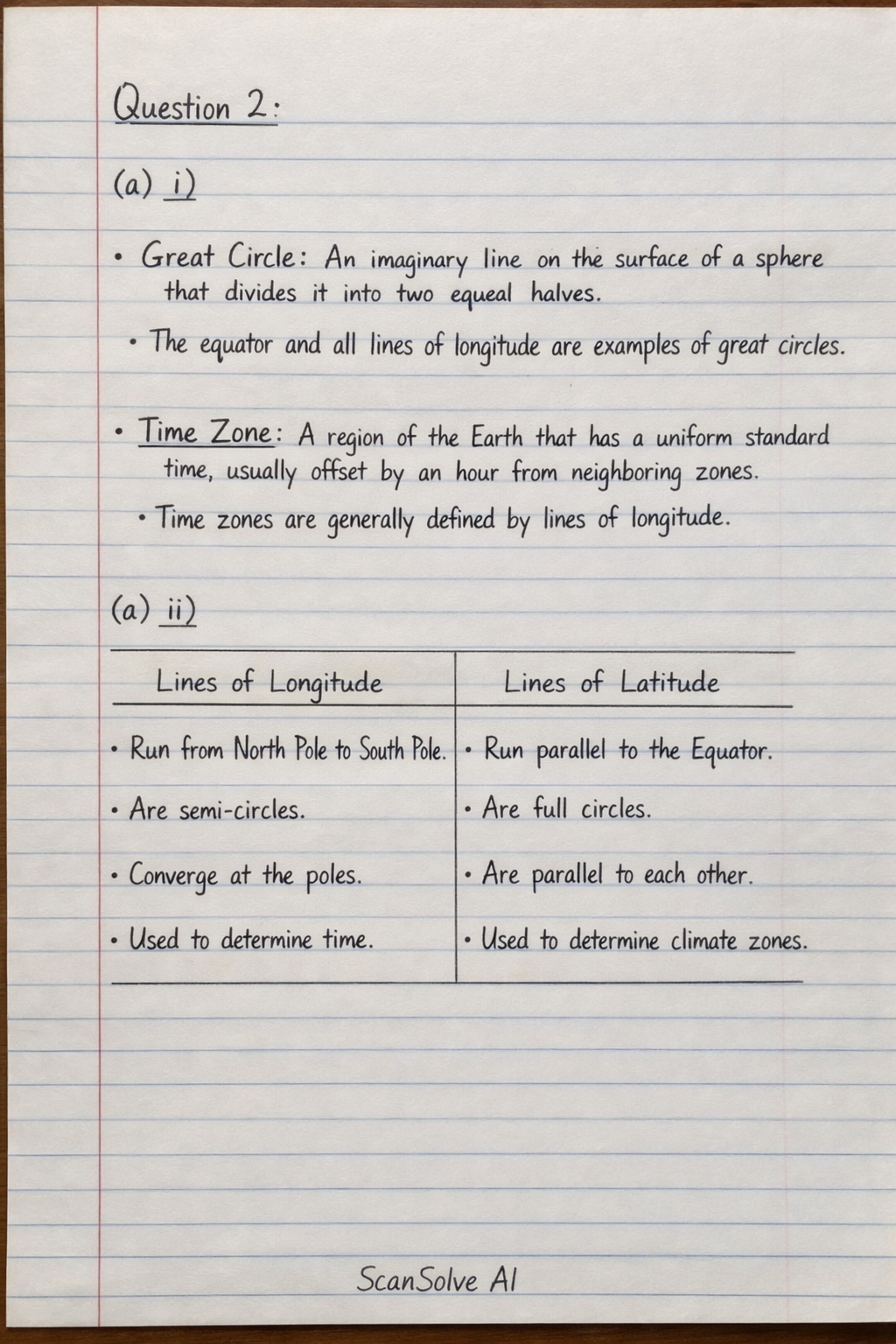
Question 2:
a) i)
- Great Circle: An imaginary line on the surface of a sphere that divides it into two equal halves. The equator and all lines of longitude are examples of great circles.
- Time Zone: A region of the Earth that has a uniform standard time, usually offset by an hour from neighboring zones. Time zones are generally defined by lines of longitude.
a) ii)
b)
Orographic rainfall occurs when moist air is forced to rise over a mountain barrier. As the air ascends, it cools due to adiabatic expansion. This cooling causes the water vapor in the air to condense, forming clouds and leading to precipitation on the windward side of the mountain. The air then descends on the leeward side, warming and becoming drier, creating a rain shadow effect.
c) i)
Four stores of the hydrological cycle are:
- Oceans
- Lakes and Rivers
- Glaciers and Ice Caps
- Groundwater
c) ii)
The climatic element that powers the hydrological cycle is solar energy (or sunlight).
d)
Two benefits of flood plains to man are:
- Fertile soils: Floodwaters deposit nutrient-rich silt, making floodplains highly fertile for agriculture.
- Water supply: Floodplains often have abundant groundwater resources and are close to rivers, providing a readily available water supply for irrigation and domestic use.
Still stuck on this one?
Ask a follow-up, and the answer starts from this question.
More Geography Questions
Handwritten Step-by-Step Solution
Get this as a handwritten image on WhatsApp — like a tutor wrote it for you.
Try on WhatsApp