
We read your photo as:
Discuss five ways of how knowledge in Social Studies can be used in promoting National Development in Ghana.
ScanSolve AI Answer
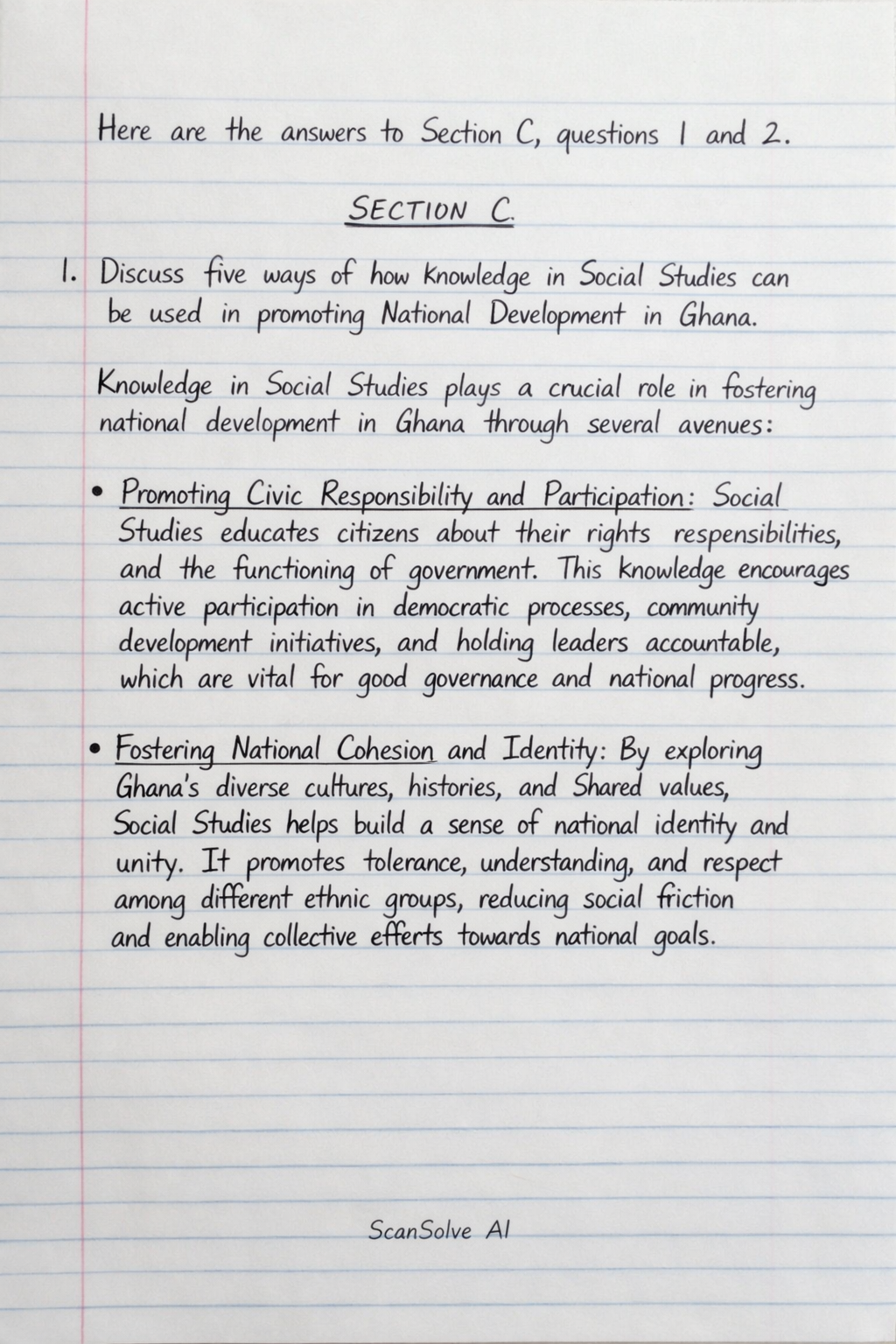
Here are the answers to Section C, questions 1 and 2.
SECTION C
1. Discuss five ways of how knowledge in Social Studies can be used in promoting National Development in Ghana.
Knowledge in Social Studies plays a crucial role in fostering national development in Ghana through several avenues:
- Promoting Civic Responsibility and Participation: Social Studies educates citizens about their rights, responsibilities, and the functioning of government. This knowledge encourages active participation in democratic processes, community development initiatives, and holding leaders accountable, which are vital for good governance and national progress.
- Fostering National Cohesion and Identity: By exploring Ghana's diverse cultures, histories, and shared values, Social Studies helps build a sense of national identity and unity. It promotes tolerance, understanding, and respect among different ethnic groups, reducing social friction and enabling collective efforts towards national goals.
- Developing Critical Thinking and Problem-Solving Skills: The subject encourages students to analyze complex societal issues, evaluate information, and propose solutions. This equips future leaders and citizens with the ability to critically assess national challenges (e.g., poverty, environmental degradation) and contribute to effective, sustainable development strategies.
- Enhancing Economic Literacy and Entrepreneurship: Social Studies provides an understanding of economic principles, resource management, and the importance of productive labor. This knowledge can inspire entrepreneurial ventures, promote responsible consumption, and encourage sound economic decision-making at individual and national levels, contributing to economic growth.
- Promoting Environmental Stewardship: Social Studies often includes topics on human-environment interaction, resource conservation, and sustainable development. By understanding the impact of human activities on the environment, citizens are encouraged to adopt practices that protect natural resources, mitigate climate change, and ensure a healthy environment for future generations, which is fundamental to long-term national development.
2. A. Explain the term fieldtrip.
A fieldtrip is an educational excursion undertaken by students and teachers to a location outside the regular classroom environment. Its primary purpose is to provide firsthand observation, investigation, and practical experience related to a specific subject or topic, allowing learners to connect theoretical knowledge with real-world contexts.
B. Discuss five steps or activities that will guide you to conduct a fieldwork in the actual fieldwork stage.
During the actual fieldwork stage, the following five steps or activities are crucial for effective data collection and learning:
- Systematic Observation: This involves carefully watching and noting specific phenomena, behaviors, or features relevant to the study's objectives. Students should use their senses to gather information, paying attention to details and patterns in the environment or among the subjects being studied.
- Data Collection (e.g., Interviews, Surveys, Measurements): This step involves actively gathering specific information. This could include conducting structured or unstructured interviews with local residents or experts, administering surveys or questionnaires to collect opinions or demographic data, or taking physical measurements (e.g., temperature, distance, population counts) using appropriate tools.
- Detailed Note-taking and Sketching: As observations and data are collected, it is essential to record them accurately and comprehensively. This includes writing detailed notes, drawing sketches or diagrams of important features, and labeling them clearly. Good note-taking ensures that information is not forgotten and can be referred to later for analysis.
- Photography and Videography: Using cameras or video recorders to document the fieldwork site, specific observations, activities, and interactions. Visual documentation provides a rich record that can be used for later analysis, presentations, and to refresh memory, capturing details that might be missed in written notes.
- Interaction and Engagement: Actively engaging with the environment, local community members, or relevant personnel. This involves asking clarifying questions, participating in local activities (where appropriate), and seeking deeper insights into the context of the study. This interaction helps to validate observations and gain perspectives that might not be apparent through passive observation alone.
Still stuck on this one?
Ask a follow-up, and the answer starts from this question.
More Geography Questions
Handwritten Step-by-Step Solution
Get this as a handwritten image on WhatsApp — like a tutor wrote it for you.
Try on WhatsApp