
We read your photo as:
Discuss responsible citizenship, how a Grade 12 learner can demonstrate it, reasons for youth hesitation, and the impact of human rights violations.
ScanSolve AI Answer
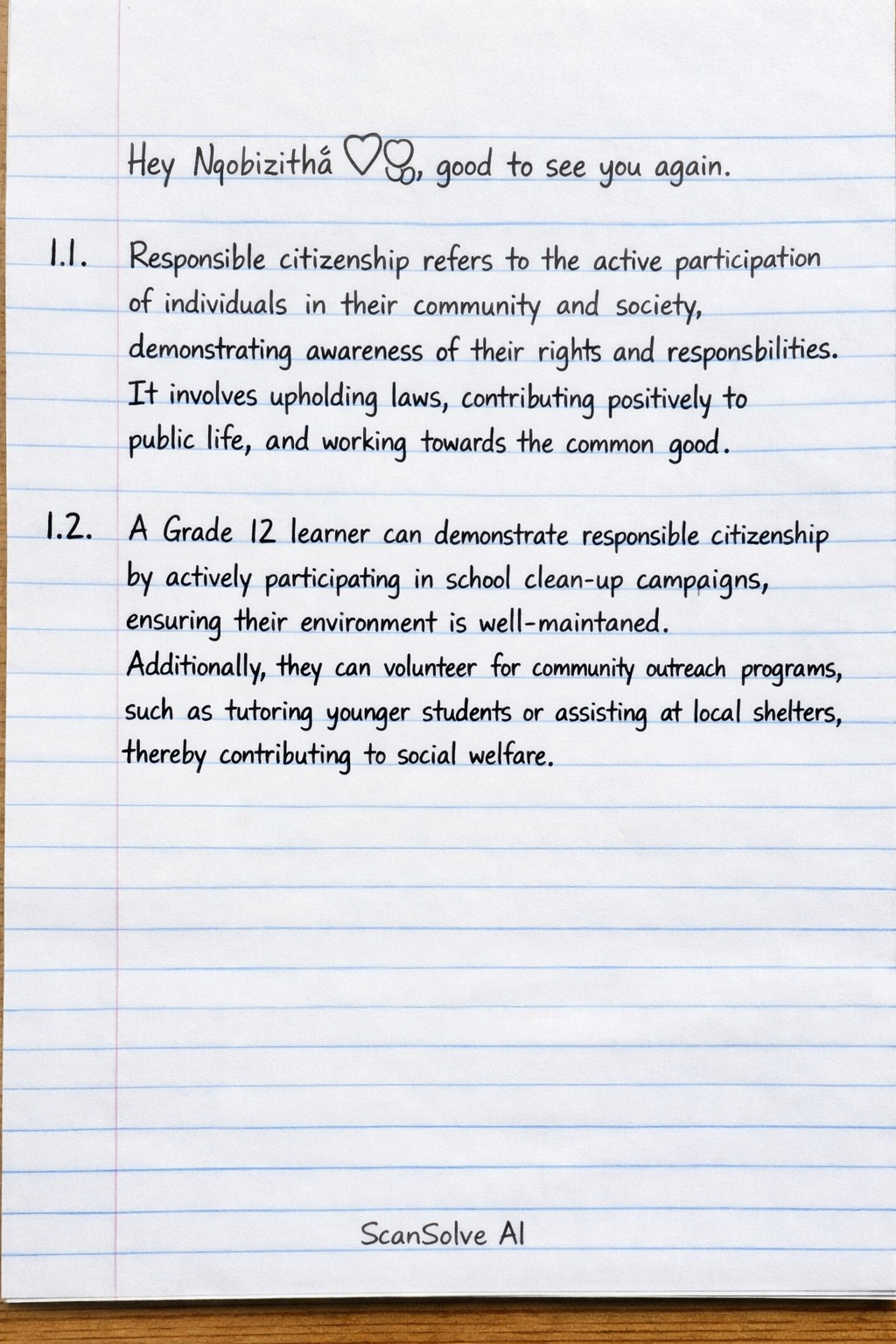
1.1 Responsible citizenship refers to the active participation of individuals in their community and society, demonstrating awareness of their rights and responsibilities. It involves upholding laws, contributing positively to public life, and working towards the common good.
1.2 A Grade 12 learner can demonstrate responsible citizenship by actively participating in school clean-up campaigns, ensuring their environment is well-maintained. Additionally, they can volunteer for community outreach programs, such as tutoring younger students or assisting at local shelters, thereby contributing to social welfare.
1.3 Youth may be hesitant to act as responsible citizens due to a lack of civic education, which limits their understanding of societal issues and their role in addressing them. Furthermore, feelings of political apathy or disillusionment with current leadership can discourage engagement. Economic hardships and a focus on personal survival often overshadow civic duties, while peer pressure or fear of judgment can also deter active participation.
1.4 A high prevalence of human rights violations can severely erode trust within a community, leading to social instability and fear. It can also hinder economic development as investors are deterred by an unstable environment, and individuals may be unable to contribute fully due to trauma or oppression. Ultimately, such violations undermine the rule of law and can perpetuate cycles of violence and injustice, fragmenting the social fabric.
1.5 A lack of responsible citizenship can create an an environment where human rights violations flourish because individuals may not challenge injustice or hold perpetrators accountable. When citizens are apathetic or unwilling to report abuses, it emboldens those who violate rights, as they face little opposition. This absence of collective vigilance and action allows harmful practices to become normalized, leading to a breakdown of societal norms that protect human dignity and rights.
2.1 Child marriage is formally defined as any marriage where at least one of the parties is under the age of 18. This practice often involves a child, typically a girl, being married to an adult or another child, and it is recognized globally as a violation of human rights.
2.2 Child marriage remains prevalent in modern society due to deeply entrenched cultural and traditional practices that view early marriage as a norm. Poverty also plays a significant role, as families may marry off their daughters to reduce economic burdens or secure financial stability through dowries. Additionally, a lack of access to education for girls often limits their opportunities and makes early marriage seem like the only viable path.
2.3 Societal attitudes that contribute to sexual assault and rape often include victim-blaming, where survivors are held responsible for the violence they experience, rather than the perpetrator. A culture of toxic masculinity, which normalizes male aggression and entitlement over women's bodies, also plays a significant role. Furthermore, the trivialization of sexual violence and a lack of comprehensive sex education can perpetuate harmful stereotypes and reduce empathy for survivors.
2.4 Survivors of gender-based violence are often reluctant to report violations due to fear of retaliation from the perpetrator or their family, which can put their safety at further risk. Societal stigma and shame associated with being a survivor can also deter reporting, as individuals fear judgment or ostracization from their community. Additionally, a lack of trust in the justice system, coupled with concerns about re-victimization during legal processes, can make survivors hesitant to come forward.
Still stuck on this one?
Ask a follow-up, and the answer starts from this question.
More Geography Questions
Handwritten Step-by-Step Solution
Get this as a handwritten image on WhatsApp — like a tutor wrote it for you.
Try on WhatsApp