
We read your photo as:
Define drought and desertification
Geography
ScanSolve AI Answer
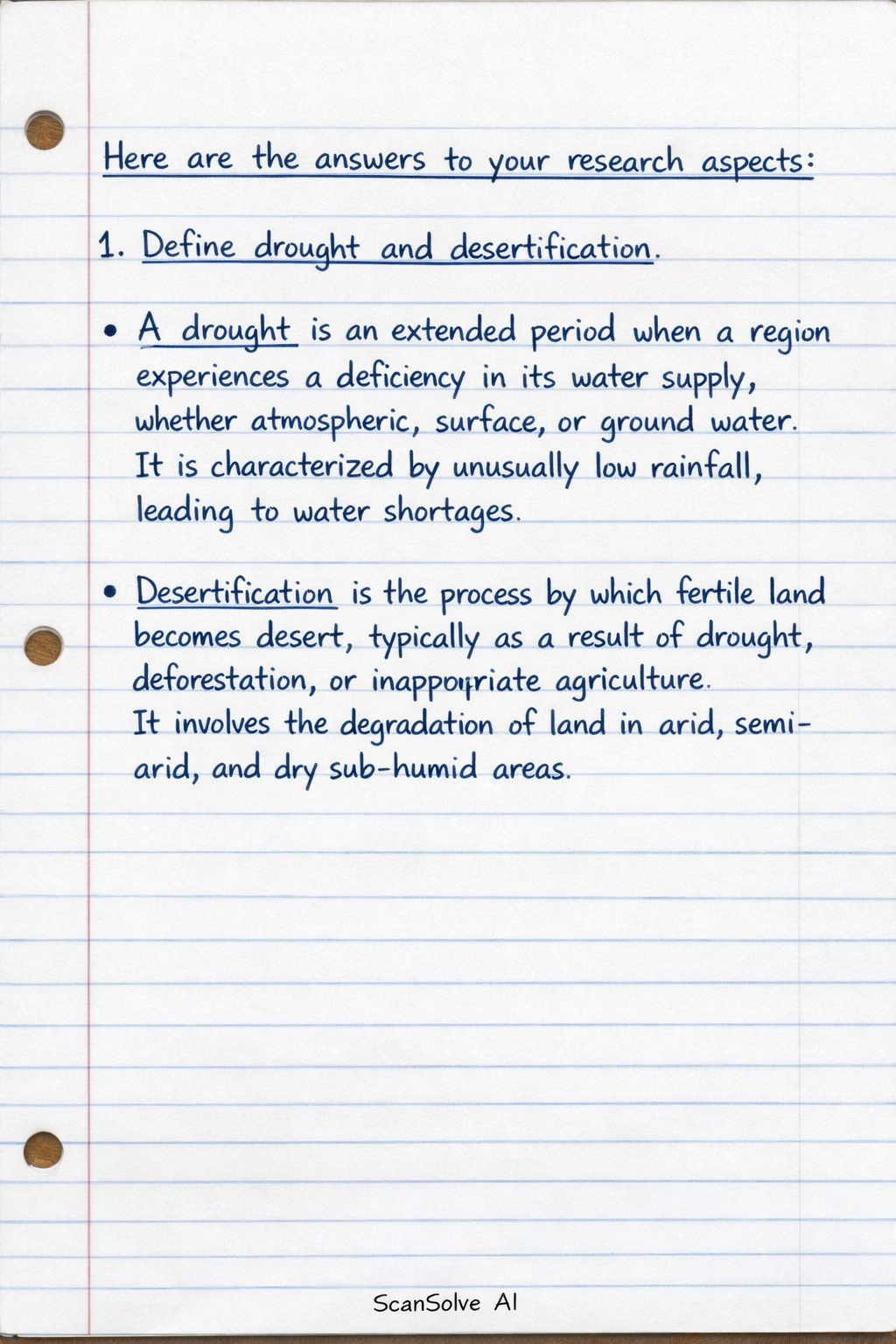
Here are the answers to your research aspects:
-
Define drought and desertification
- A drought is an extended period when a region experiences a deficiency in its water supply, whether atmospheric, surface, or ground water. It is characterized by unusually low rainfall, leading to water shortages.
- Desertification is the process by which fertile land becomes desert, typically as a result of drought, deforestation, or inappropriate agriculture. It involves the degradation of land in arid, semi-arid, and dry sub-humid areas.
-
GIS: Using an atlas, draw/design where the risk of drought and desertification is in Africa. Based on your drawing, explain in your research why these areas are at risk by analysing the causes and consequences of droughts and desertification.
- Areas at high risk of drought and desertification in Africa include the Sahel region (south of the Sahara Desert, stretching from Senegal to Sudan), parts of Southern Africa (like the Kalahari and Karoo regions mentioned in the prompt, and the Horn of Africa (e.g., Somalia, Ethiopia, Kenya).
- These areas are at risk due to a combination of natural and human factors. Causes include naturally low and erratic rainfall patterns, high temperatures leading to increased evaporation, and climate change intensifying these conditions. Human activities such as overgrazing, deforestation for fuel and agriculture, unsustainable farming practices, and poor water management exacerbate land degradation. The consequences of drought, like crop failure and water scarcity, directly contribute to desertification by stressing ecosystems and forcing unsustainable land use.
-
Evaluate the negative impact that droughts and desertification has on people, economy and the environment.
- Impact on people: Leads to food insecurity, malnutrition, displacement, increased poverty, and conflicts over scarce resources. Health issues arise from lack of clean water and sanitation.
- Impact on economy: Causes significant losses in agriculture, livestock, and related industries. Reduces economic productivity, increases food prices, and strains national budgets due to disaster relief and recovery efforts.
- Impact on environment: Results in loss of biodiversity, soil erosion, reduced soil fertility, degradation of ecosystems, and depletion of water sources. It also contributes to climate change through reduced carbon sequestration.
-
Suggest Management strategies for droughts and desertification.
- Sustainable land management: Implementing practices like agroforestry, terracing, contour plowing, and rotational grazing to protect soil and vegetation.
- Water conservation and management: Developing efficient irrigation systems, rainwater harvesting, wastewater treatment, and building dams or reservoirs.
- Afforestation and reforestation: Planting trees to stabilize soil, improve water retention, and create microclimates.
- Early warning systems: Establishing systems to predict droughts, allowing communities to prepare and mitigate impacts.
- Policy and governance: Developing and enforcing policies that promote sustainable resource use, land tenure security, and community involvement in management.
Was this helpful?
Still stuck on this one?
Ask a follow-up, and the answer starts from this question.
Got a different question?Ask your own question
More Geography Questions
Handwritten Step-by-Step Solution
Get this as a handwritten image on WhatsApp — like a tutor wrote it for you.
Try on WhatsApp