
We read your photo as:
Explain the Earth's internal layers and their role in causing volcanic eruptions and earthquakes, using East Africa as an example.
ScanSolve AI Answer
Here is an article clarifying the phenomenon of how Earth's internal layers influence natural hazards like volcanic eruptions and earthquakes, especially in East Africa.
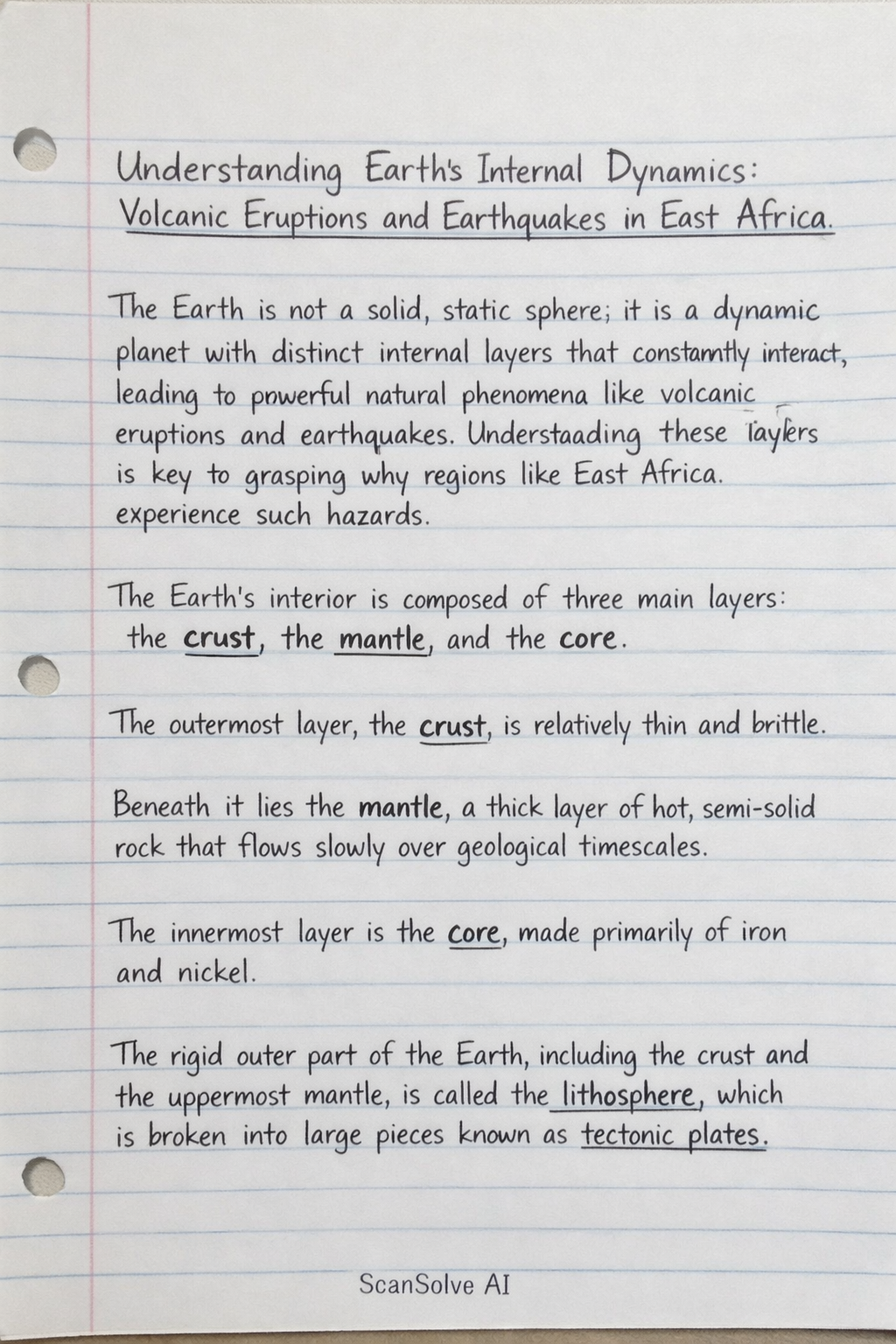
Understanding Earth's Internal Dynamics: Volcanic Eruptions and Earthquakes in East Africa
The Earth is not a solid, static sphere; it is a dynamic planet with distinct internal layers that constantly interact, leading to powerful natural phenomena like volcanic eruptions and earthquakes. Understanding these layers is key to grasping why regions like East Africa experience such hazards.
The Earth's interior is composed of three main layers: the crust, the mantle, and the core. The outermost layer, the crust, is relatively thin and brittle. Beneath it lies the mantle, a thick layer of hot, semi-solid rock that flows slowly over geological timescales. The innermost layer is the core, made primarily of iron and nickel. The rigid outer part of the Earth, including the crust and the uppermost mantle, is called the lithosphere, which is broken into large pieces known as tectonic plates.
These tectonic plates are not stationary; they are in constant motion, driven by convection currents within the semi-fluid mantle. Heat from the Earth's core causes mantle material to rise, spread, cool, and then sink, creating a slow but powerful circulation. This movement drags the overlying lithospheric plates, causing them to collide, pull apart, or slide past each other at their boundaries.
When plates pull apart, known as a divergent plate boundary, magma from the mantle rises to fill the gap, forming new crust. This process often results in volcanic eruptions and frequent, shallow earthquakes. When plates collide, one plate can be forced beneath another in a process called subduction, leading to intense pressure, deep earthquakes, and explosive volcanic activity. Plates sliding past each other at transform boundaries also generate significant earthquakes.
The East African region, including Uganda, is a prime example of a divergent plate boundary in action, forming the East African Rift Valley. Here, the African plate is slowly splitting apart, causing the land to stretch, thin, and subside. This rifting process is accompanied by significant geological activity: magma rises close to the surface, leading to volcanic activity, and the stretching and fracturing of the crust result in numerous earthquakes. These geological forces are actively shaping the landscape, creating new mountains and valleys, and influencing the distribution of natural resources and hazards across the region.
Still stuck on this one?
Ask a follow-up, and the answer starts from this question.
More Geography Questions
Handwritten Step-by-Step Solution
Get this as a handwritten image on WhatsApp — like a tutor wrote it for you.
Try on WhatsApp