
We read your photo as:
Elek's Gel Precipitation Test
Geography
ScanSolve AI Answer
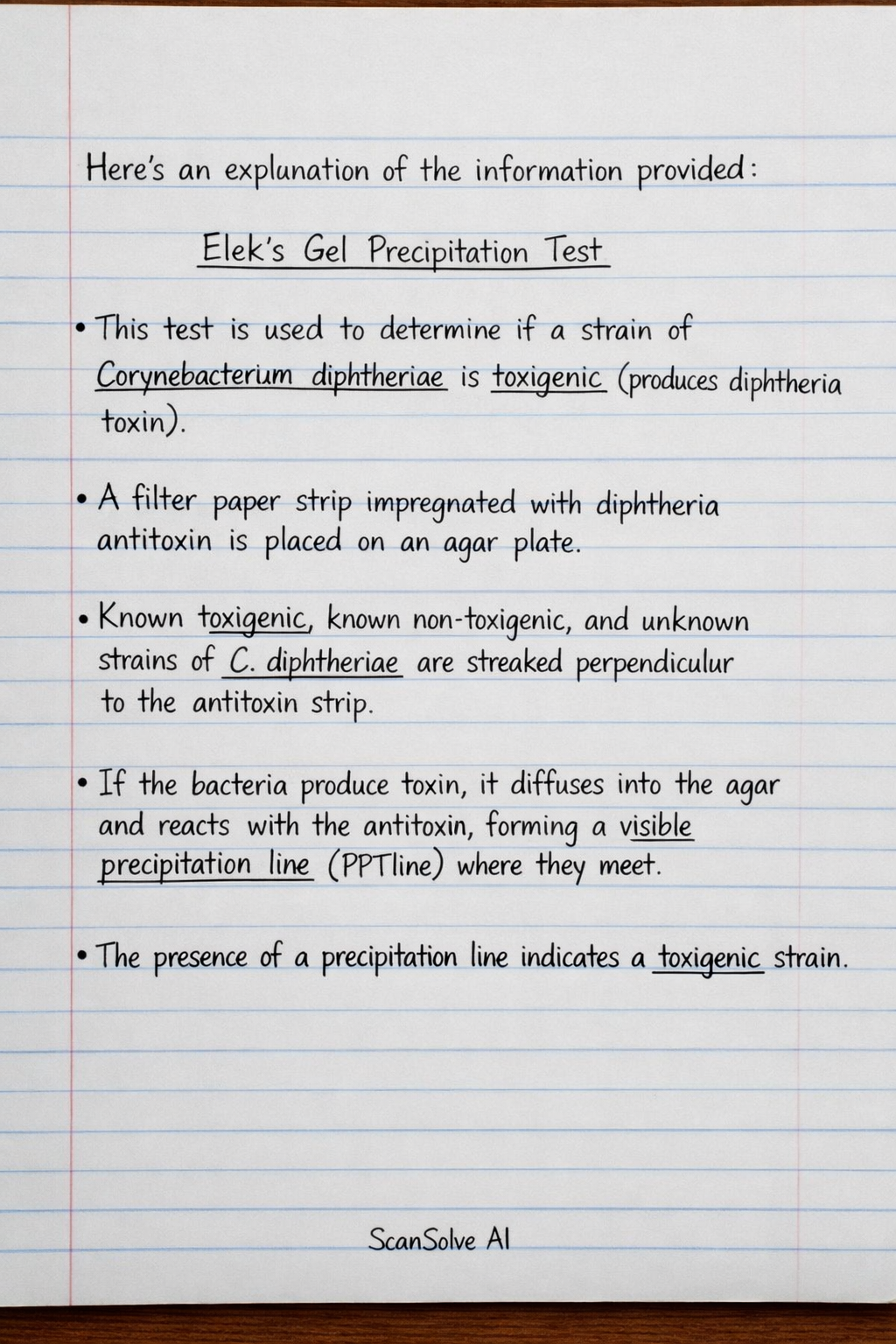
Here's an explanation of the information provided:
Elek's Gel Precipitation Test
This test is used to determine if a strain of Corynebacterium diphtheriae is toxigenic (produces diphtheria toxin).
- A filter paper strip impregnated with diphtheria antitoxin is placed on an agar plate.
- Known toxigenic, known non-toxigenic, and unknown strains of C. diphtheriae are streaked perpendicular to the antitoxin strip.
- If the bacteria produce toxin, it diffuses into the agar and reacts with the antitoxin, forming a visible precipitation line (PPT line) where they meet.
- The presence of a precipitation line indicates a toxigenic strain.
Schick Test
The Schick test determines an individual's susceptibility to diphtheria.
- A small amount of diphtheria toxin is injected intradermally.
- Positive result: Indicates the individual is susceptible to diphtheria, meaning they lack sufficient protective antibodies. A localized inflammatory reaction occurs.
- Negative result: Indicates the individual is immune to diphtheria, meaning they have protective antibodies. No significant reaction occurs.
Pathogenesis of Diphtheria
- Diphtheria is primarily a toxigenic disease, meaning the symptoms are caused by the toxin, not widespread bacterial invasion.
- The Corynebacterium diphtheriae bacilli are non-invasive and typically remain localized at the site of infection (e.g., throat).
- The bacteria secrete a potent exotoxin that is absorbed and transmitted via the bloodstream.
- This toxin is responsible for all the systemic manifestations and complications of diphtheria.
Treatment and Management of Diphtheria
The treatment involves diphtheria antitoxin (DAT), antibiotics, and adjunctive measures.
-
Diphtheria Antitoxin (DAT) Dosage:
- Pharyngeal/Laryngeal Diphtheria: 20,000-40,000 IU or 2 Mors Units (DU).
- Nasopharyngeal Diphtheria: 40,000-60,000 IU or 2 Mors Units (DU).
- Extensive Disease with Neck Swelling: Half intramuscular (IM) and half intravenous (IV) administration (specific dosage not provided, but implies higher severity).
-
Antibiotics:
- Penicillin or Erythromycin are typically used for all types of diphtheria to eliminate the bacteria and prevent further toxin production.
-
Adjunctive Measures:
- Droplet precautions are essential for all patients with diphtheria to prevent transmission of the bacteria.
Was this helpful?
Still stuck on this one?
Ask a follow-up, and the answer starts from this question.
Got a different question?Ask your own question
More Geography Questions
QThe electrolyte lab and functionQInvestigate electrical conductivity in liquidsQList 5 equipment used in carrying out normal consistency testQYou are required to use the Solutions A, B, C, D and E provided as test Solutions. You will also use…QAn electroscope has a sharp pin attached to its top. Part (b) asks for observations and explanations…
Handwritten Step-by-Step Solution
Get this as a handwritten image on WhatsApp — like a tutor wrote it for you.
Try on WhatsApp