
We read your photo as:
An electroscope has a sharp pin attached to its top. Part (b) asks for observations and explanations of what happens when the electroscope is charged. Part (c) involves calculating the charge on a cap
ScanSolve AI Answer
Answer
Step-by-step solution
3 stepsPart b
Observation: The leaves of the electroscope will gradually collapse.
Explanation: A sharp pin on a highly charged electroscope creates a very strong electric field at its tip. This strong field ionizes the air molecules around the pin. If the electroscope is positively charged, it attracts electrons from the air, neutralizing its charge. If it is negatively charged, it repels electrons from the air, causing positive ions to be attracted to the pin, also neutralizing its charge. This process, known as corona discharge or point discharge, causes the electroscope to lose its charge to the surrounding air over time, leading to the collapse of its leaves.
Part c(i)
Determine the charge on when both switch A is closed and switch B is open.
Given:
Battery e.m.f.,
Capacitance of ,
Capacitance of ,
Analyze the circuit configuration.
When switch A is closed and switch B is open, capacitor is connected directly across the battery. Capacitor is not connected to the circuit. Therefore, the voltage across is equal to the battery's e.m.f.
Use the formula for charge on a capacitor, .
Substitute the values and calculate the charge.
The charge on is .
Try one yourself
A new problem that tests the same skill.
Still stuck on this one?
Ask a follow-up, and the answer starts from this question.
More Physics Questions
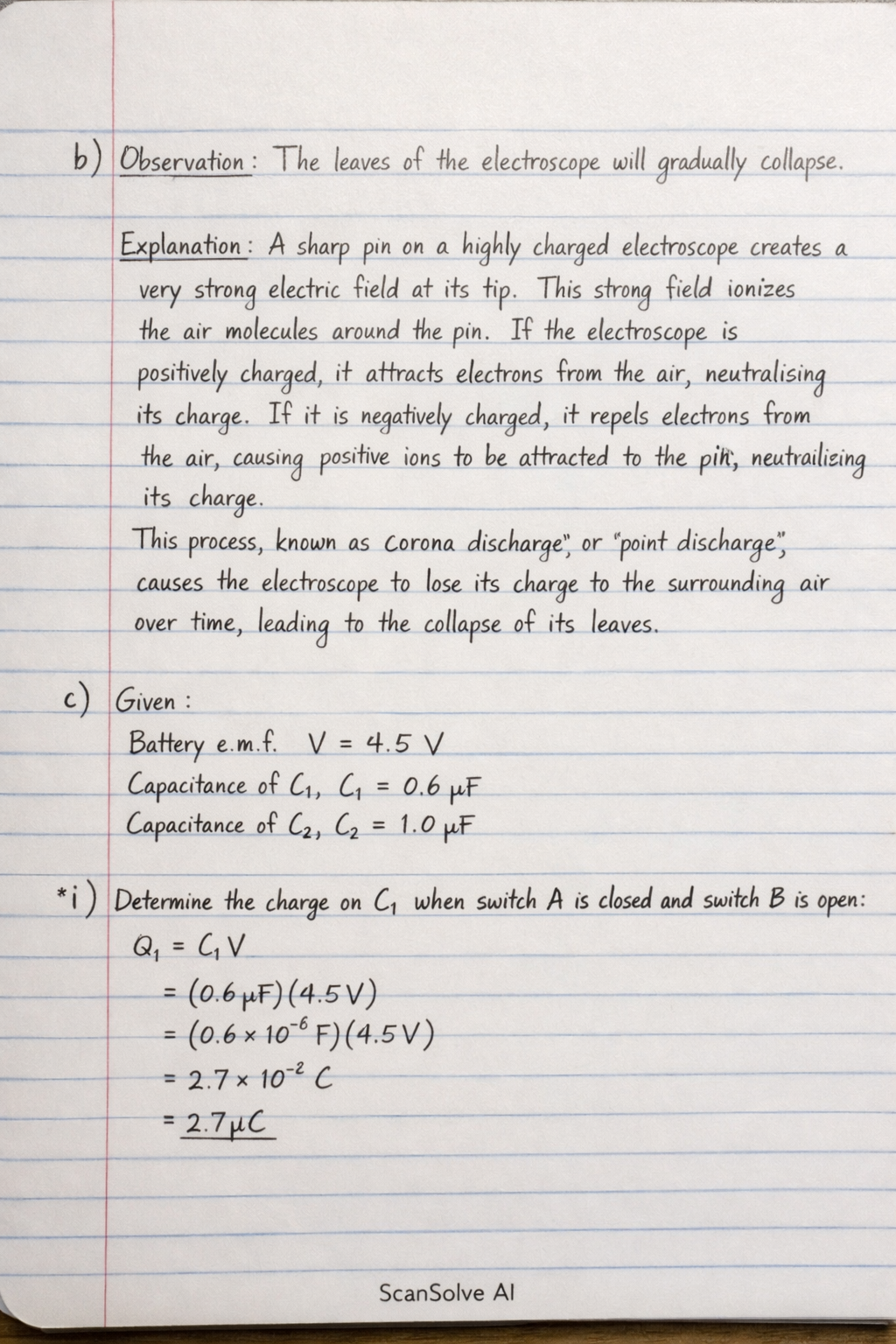
Handwritten Step-by-Step Solution
Get this as a handwritten image on WhatsApp — like a tutor wrote it for you.
Try on WhatsApp