
We read your photo as:
Define engineering geology and its branches, and briefly explain plate tectonics and the structure of the Earth.
ScanSolve AI Answer
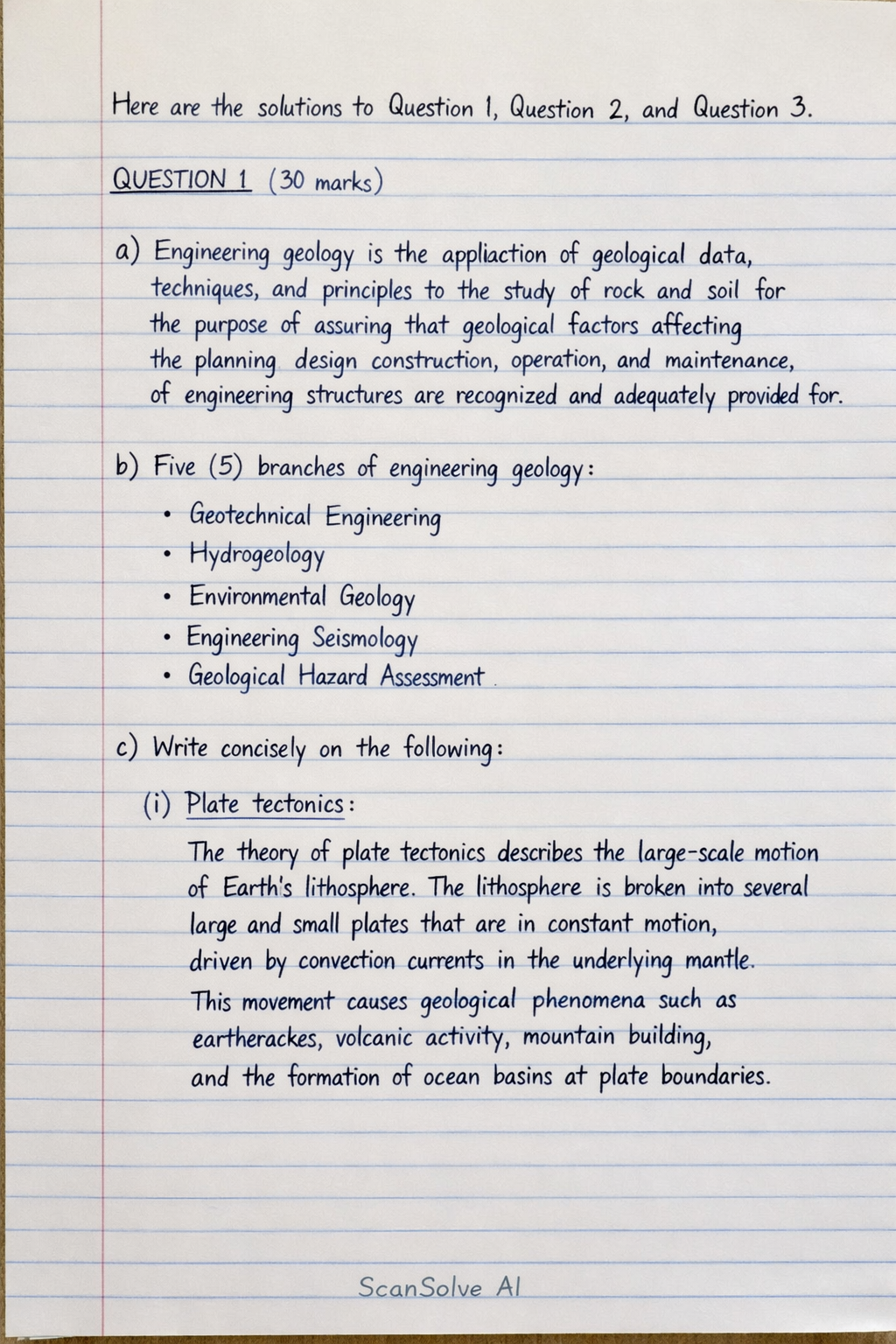
Here are the solutions to Question 1, Question 2, and Question 3.
QUESTION 1 (30 marks)
a) Engineering geology is the application of geological data, techniques, and principles to the study of rock and soil for the purpose of assuring that geological factors affecting the planning, design, construction, operation, and maintenance of engineering structures are recognized and adequately provided for.
b) Five (5) branches of engineering geology:
- Geotechnical Engineering
- Hydrogeology
- Environmental Geology
- Engineering Seismology
- Geological Hazard Assessment
c) Write concisely on the following:
i) Plate tectonics: The theory of plate tectonics describes the large-scale motion of Earth's lithosphere. The lithosphere is broken into several large and small plates that are in constant motion, driven by convection currents in the underlying mantle. This movement causes geological phenomena such as earthquakes, volcanic activity, mountain building, and the formation of ocean basins at plate boundaries.
ii) The structure of the earth: The Earth is composed of several concentric layers. The outermost layer is the crust, a thin, solid shell. Beneath the crust is the mantle, a thick layer of solid rock that behaves plastically over long periods. The innermost part is the core, which consists of a liquid outer core and a solid inner core, primarily made of iron and nickel.
iii) Earthquakes: An earthquake is the sudden shaking of the Earth's surface resulting from the rapid release of energy in the Earth's lithosphere that creates seismic waves. This energy release is typically caused by the sudden movement of blocks of rock along a fault plane, often due to the buildup of stress from tectonic plate movements.
d) Key points to discuss on the importance of geoscience in engineering:
- Site Investigation: Understanding subsurface conditions (soil, rock, groundwater) for foundation design and stability.
- Hazard Assessment: Identifying and mitigating geological hazards like landslides, earthquakes, and floods that could impact infrastructure.
- Resource Management: Locating and managing geological resources such as aggregates, water, and energy for construction and development.
- Environmental Impact: Assessing and minimizing the environmental impact of engineering projects on geological systems.
- Material Properties: Characterizing the engineering properties of geological materials for their use in construction.
e) Faults are fractures in rocks along which there has been significant displacement or movement of the rock masses relative to each other. Joints, on the other hand, are fractures or cracks in rocks where there has been no significant displacement or movement parallel to the fracture surface.
f) Causes of joint patterns:
- Tectonic Stresses: Regional compressive or tensional forces associated with plate movements can cause rocks to fracture in predictable patterns.
- Cooling and Contraction: As igneous rocks cool and solidify, or as sedimentary rocks dry and shrink, they can develop systematic joint patterns (e.g., columnar jointing in basalt).
- Unloading (Exfoliation): The removal of overlying rock material reduces confining pressure, causing underlying rocks to expand and fracture parallel to the surface, forming sheet joints.
- Weathering: Chemical and mechanical weathering processes can exploit existing weaknesses or create new fractures, contributing to joint development and patterns.
- Folding and Faulting: The stresses associated with folding and faulting can induce jointing in the surrounding rock mass, often in orientations related to the principal stress directions.
QUESTION 2 (20 marks)
a) Write short notes on:
i) Ferromagnetism: This is a strong form of magnetism exhibited by certain materials, such as iron, nickel, and cobalt, and their alloys. Ferromagnetic materials are strongly attracted to magnetic fields and can retain their magnetism even after the external magnetic field is removed, becoming permanent magnets. This property arises from the alignment of atomic magnetic moments within domains.
ii) Paramagnetism: This is a weak form of magnetism where materials are only slightly attracted to an external magnetic field. Unlike ferromagnetic materials, paramagnetic materials do not retain any magnetism once the external field is removed. This property occurs in materials with unpaired electrons, where the individual atomic magnetic moments align weakly with the external field.
b) The difference between ferromagnetic and paramagnetic minerals is that ferromagnetic minerals are strongly attracted to magnetic fields and can become permanently magnetized, retaining their magnetism after the external field is removed. In contrast, paramagnetic minerals are only weakly attracted to magnetic fields and lose their magnetism immediately once the external field is removed.
c) Define the following in terms of weathering process:
i) Unloading: Also known as exfoliation or pressure release, unloading is a mechanical weathering process where overlying rock or sediment is removed by erosion. This reduction in confining pressure causes the underlying rock to expand and fracture parallel to the surface, leading to the formation of sheet-like layers that peel off.
ii) Spalling: Spalling refers to the breaking off of rock fragments, flakes, or layers from a larger rock mass. It can be caused by various weathering processes, including thermal expansion and contraction (where differential heating and cooling cause stresses), frost wedging, or the release of internal stresses due to unloading.
d) Five parts of a normal fault and explain three:
Parts of a normal fault include:
- Hanging Wall
- Footwall
- Fault Plane
- Fault Scarp
- Throw
- Heave
Explanation of three parts:
- Hanging Wall: This is the block of rock that lies above the fault plane. In a normal fault, the hanging wall moves downward relative to the footwall.
- Footwall: This is the block of rock that lies below the fault plane. In a normal fault, the footwall moves upward relative to the hanging wall.
- Fault Plane: This is the planar surface along which the movement or displacement of rock masses occurs. It represents the actual fracture surface within the Earth's crust.
QUESTION 3 (20 marks)
a) List and explain five processes involved in chemical weathering:
- Dissolution: This process involves the dissolving of soluble minerals in water, often enhanced by the presence of acids. For example, halite (rock salt) readily dissolves in water.
- Oxidation: This is a reaction where minerals lose electrons, typically to oxygen. Iron-bearing minerals are particularly susceptible, leading to the formation of iron oxides (rust), which weakens the rock.
- Hydrolysis: This is a chemical reaction between water and a mineral, where hydrogen ions (H+) or hydroxyl ions (OH-) from water replace ions in the mineral's crystal structure, forming new minerals (e.g., feldspar weathering to clay minerals).
- Carbonation: This process involves the reaction of carbonic acid (formed when carbon dioxide dissolves in water) with minerals, especially carbonates like calcite. This leads to the dissolution of the mineral and the formation of caves and karst topography.
- Hydration: This is the absorption of water molecules into the crystal structure of a mineral, causing it to expand and become weaker. For example, anhydrite can hydrate to form gypsum.
b) List and explain five processes involved in mechanical weathering:
- Frost Wedging (Freeze-Thaw): Water seeps into cracks in rocks, freezes, and expands by about 9%. This expansion exerts pressure on the crack walls, widening them. Repeated freezing and thawing cycles eventually break the rock apart.
- Salt Crystal Growth (Salt Wedging): In arid and coastal environments, saline water penetrates rock pores and cracks. As the water evaporates, salt crystals grow, exerting pressure on the rock and causing it to disintegrate.
- Abrasion: This is the physical wearing away of rocks by friction and impact caused by the movement of sediment particles carried by wind, water, or ice. This process smooths, grinds, and polishes rock surfaces.
- Exfoliation (Unloading): As overlying rock material is removed by erosion, the confining pressure on the underlying rock decreases. This causes the rock to expand and fracture in concentric, sheet-like layers parallel to the surface, which then peel off.
- Thermal Expansion and Contraction: Extreme temperature changes, especially in deserts, cause the outer layers of rocks to expand when heated and contract when cooled. Differential expansion and contraction between the surface and interior, or between different minerals, can create stresses that lead to fracturing and spalling.
c) Uniformity refers to a continuous sequence of sedimentary layers that were deposited without significant interruption, erosion, or deformation. In contrast, a disconformity is a type of unconformity where there is an erosional surface between parallel layers of sedimentary rock, indicating a period of erosion or non-deposition without tilting or folding of the older strata.
d) Mention and explain four parts of a fold:
- Hinge: The hinge is the line of maximum curvature on a folded surface. It represents the tightest part of the bend in the rock layers.
- Limb: The limbs are the relatively planar sides of a fold that connect the hinges. They are the less curved portions of the fold.
- Axial Plane: The axial plane is an imaginary plane that connects the hinges of successive folded layers and divides the fold as symmetrically as possible. It can be vertical, inclined, or horizontal.
- Fold Axis: The fold axis is an imaginary line formed by the intersection of the axial plane with a bedding surface. It represents the general trend or orientation of the fold.
Still stuck on this one?
Ask a follow-up, and the answer starts from this question.
More Geography Questions
Handwritten Step-by-Step Solution
Get this as a handwritten image on WhatsApp — like a tutor wrote it for you.
Try on WhatsApp