
We read your photo as:
How does this bidirectional relationship change the way you think about privacy, agency, and trust? What new responsibilities do we have when we're both consumers and creators of geographical knowledge?
Geography
ScanSolve AI Answer
Answer
The bidirectional relationship where a map tracks and learns from your movements while you use it to navigate significantly alters perspectives on privacy, agency, and trust.
- Privacy: It shifts from a static boundary (what you explicitly choose to share) to a dynamic transaction. Your location data is continuously collected, making privacy a constant negotiation between convenience/safety and personal data exposure. As Peter notes, you might be kept visible for safety, trading some privacy for protection.
- Agency: Your sense of independent action is affected. While you use the map to make choices, your movements are simultaneously observed and analyzed, potentially influencing future suggestions or even revealing patterns you weren't aware of. This can reduce your perceived control over your own digital footprint.
- Trust: It becomes paramount. You must trust the map providers to handle your sensitive location data responsibly, securely, and ethically. Any perceived misuse or breach of this trust can severely undermine the utility and acceptance of such mapping services.
As both consumers and creators of geographical knowledge, we have new responsibilities:
- As consumers: We must be informed users, understanding data collection policies, managing privacy settings, and critically evaluating the information presented by maps.
- As creators: Our movements and contributions (e.g., reporting traffic, adding points of interest) enrich the map. We have a responsibility to contribute accurate data and be mindful of the privacy of others when our actions contribute to the collective geographical knowledge.
Was this helpful?
Still stuck on this one?
Ask a follow-up, and the answer starts from this question.
Got a different question?Ask your own question
More Geography Questions
QDiscuss the ethical challenges in digital work culture concerning employee privacy and work-life…QWhat are the benefits of knowing your rights and responsibilities on social media?QDiscuss the roles and impacts of social media platforms in communication, privacy, and online…QBased on the principles of the SECI model and the concept of ‘Ba’ as outlined by Attard et al…QDiscuss various ways you can use the knowledge to support life in your community.
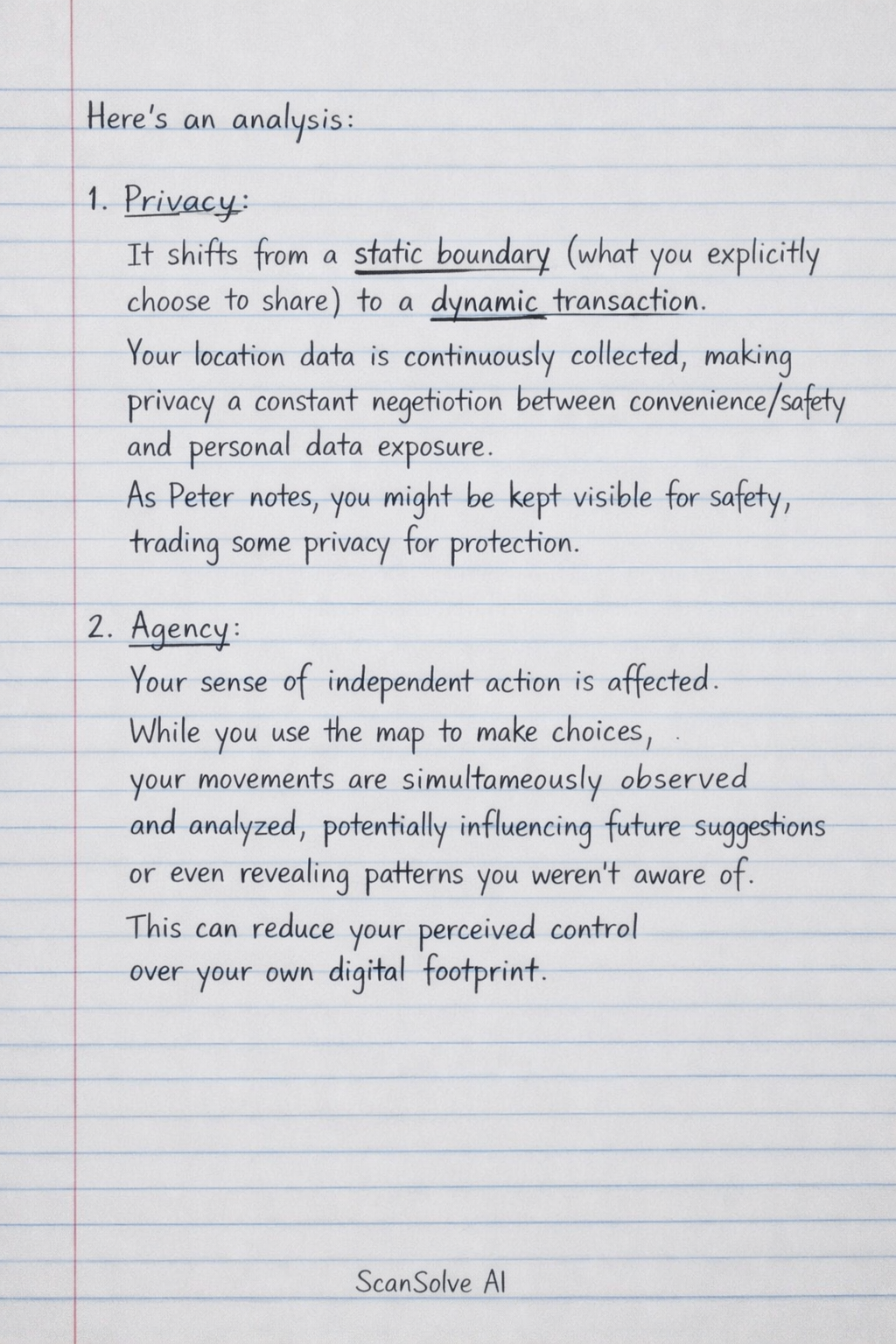
Handwritten Step-by-Step Solution
Get this as a handwritten image on WhatsApp — like a tutor wrote it for you.
Try on WhatsApp