
Based on the principles of the SECI model and the concept of ‘Ba’ as outlined by Attard et al. (2022), knowledge creation at Imbokodo Innovations occurs through dynamic interactions between tacit and explicit knowledge, but this process is constrained due to limited shared spaces for person-centered dialogue. Socialization (Tacit → Tacit): Senior engineers share unarticulated expertise, problem-solving heuristics, and innovation instincts through apprenticeship or informal mentoring. This relies on shared experience and observation, aligning with “emotions, feelings, and mental images” (Attard et al., 2022, p. 2). However, at Imbokodo, this is uneven, suggesting weak peer-level social interaction. Externalization (Tacit → Explicit): Critical know-how held by senior engineers should be articulated into documented procedures or digital knowledge systems. Attard et al. (2022) note that externalization requires dialogue and collective reflection. Imbokodo’s existing digital systems are present but likely underutilized because engineers lack a ‘Ba’—a physical or mental shared space “open to the sharing of practices, values, processes and culture” (Attard et al., 2022, p. 3). Combination (Explicit → Explicit): Explicit knowledge from digital systems could be recombined to create new solutions for expansion into African markets. But because “learning is uneven,” junior staff cannot systematically access or synthesize existing explicit knowledge, limiting organisational-level innovation. Internalization (Explicit → Tacit): Learning by doing, where explicit guidelines become individual know-how. This is constrained as there is no person-centered environment “where healthful relationships… are formed” (Attard et al., 2022, p. 3), leaving junior engineers without guided practice. The core problem is the absence of effective ‘Ba’—a shared platform for knowledge creation that “focuses mainly on the individual as a person who holds the knowledge rather than just on the knowledge itself” (Attard et al., 2022, p. Knowledge is concentrated, meaning there is no collective space for senior and junior engineers to share values, beliefs, and emotions—critical for converting tacit knowledge. · Without ‘Ba’, socialization is sporadic, externalization is superficial, and internalization fails. · As the firm expands into other African markets, this constraint threatens sustainability because new practices cannot be developed “with others rather than to others” (Attard et al., 2022, p. 3). While the primary theoretical resource is Attard et al. (2022), the analysis also implicitly draws on: · Nonaka’s original SECI theory (as cited in Attard et al., 2022) for the distinction between tacit/explicit knowledge and the four conversion modes. · Person-centered practice literature (referenced in Attard et al., 2022) to diagnose why Imbokodo’s management sees knowledge loss as a human, relational issue—not just a technical one. Paraphrase this paragraph with simple grade 4 English, including the intext referencing
ScanSolve AI Answer
Answer
Imbokodo Innovations struggles to create new ideas because people don't have enough shared places to talk and learn from each other. This is based on the SECI model and the idea of 'Ba' (Attard et al., 2022).
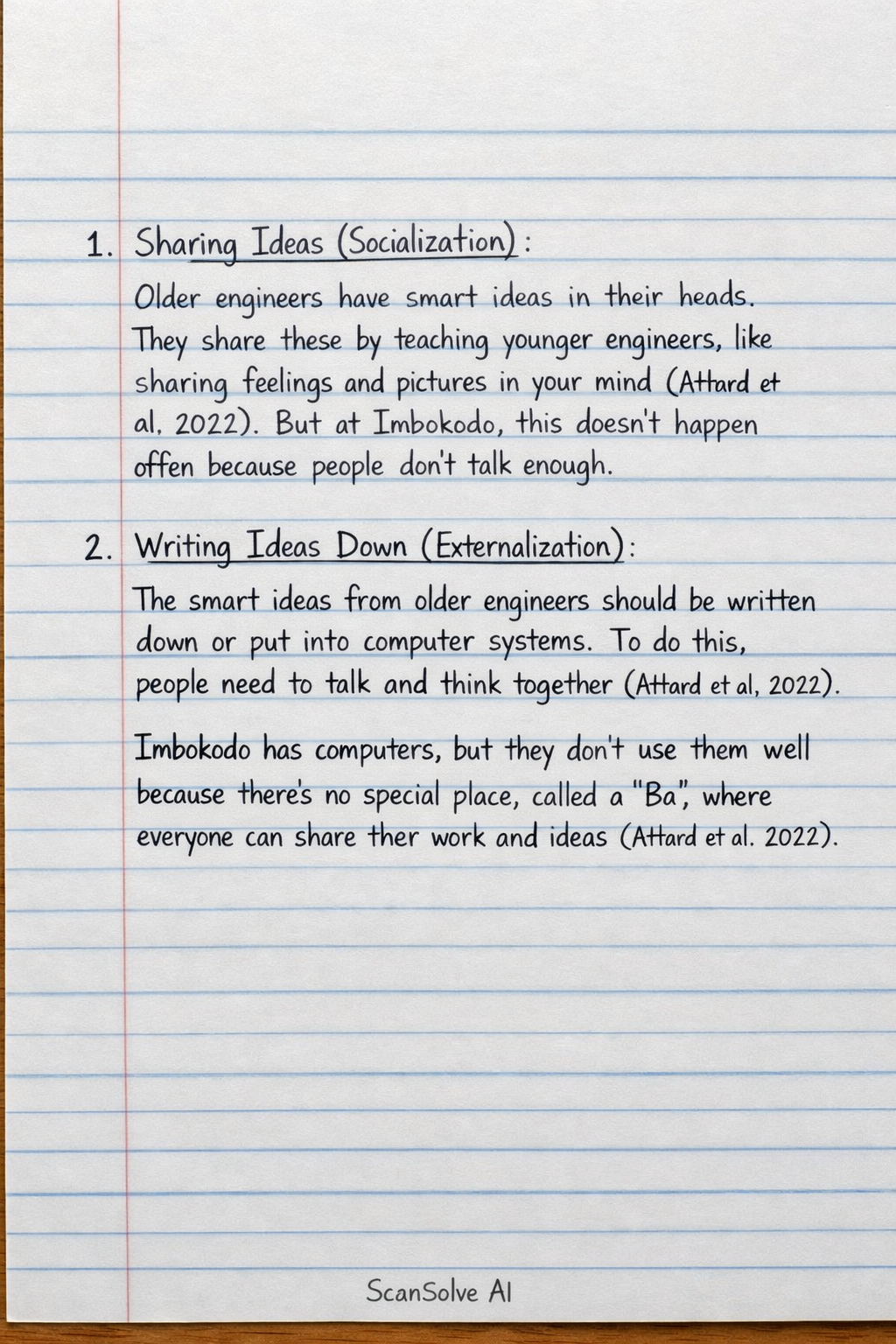
- Sharing Ideas (Socialization): Older engineers have smart ideas in their heads. They share these by teaching younger engineers, like sharing feelings and pictures in your mind (Attard et al., 2022). But at Imbokodo, this doesn't happen often because people don't talk enough.
- Writing Ideas Down (Externalization): The smart ideas from older engineers should be written down or put into computer systems. To do this, people need to talk and think together (Attard et al., 2022). Imbokodo has computers, but they don't use them well because there's no special place, called a 'Ba', where everyone can share their work and ideas (Attard et al., 2022).
- Mixing Written Ideas (Combination): The written-down ideas could be mixed to make new solutions. But because younger staff don't learn evenly, they can't find or use these ideas easily. This stops the company from making new things.
- Learning by Doing (Internalization): When people learn by doing, the written rules become their own smart ideas. But this is hard at Imbokodo because there's no good place where people can build strong relationships and learn together (Attard et al., 2022). So, younger engineers don't get enough help to practice.
The main problem is that Imbokodo doesn't have a good 'Ba'. This 'Ba' is a special place where people can share their ideas and feelings, not just facts (Attard et al., 2022). Because of this, older and younger engineers don't share their ideas.
- Without 'Ba', sharing ideas is rare, writing them down isn't deep enough, and learning by doing doesn't work.
- As the company grows, this problem could stop it from lasting a long time because they can't learn new ways of doing things with each other (Attard et al., 2022).
This idea mostly comes from Attard et al. (2022). It also uses ideas from Nonaka (mentioned in Attard et al., 2022) about different kinds of knowledge and how they change. It also uses ideas about how people work together (from Attard et al., 2022) to show why Imbokodo's leaders think losing knowledge is about people, not just computers.
Still stuck on this one?
Ask a follow-up, and the answer starts from this question.
More English Questions
Handwritten Step-by-Step Solution
Get this as a handwritten image on WhatsApp — like a tutor wrote it for you.
Try on WhatsApp