
We read your photo as:
Explain the formation, features, and significance of Karst scenery, and define a glacier.
ScanSolve AI Answer
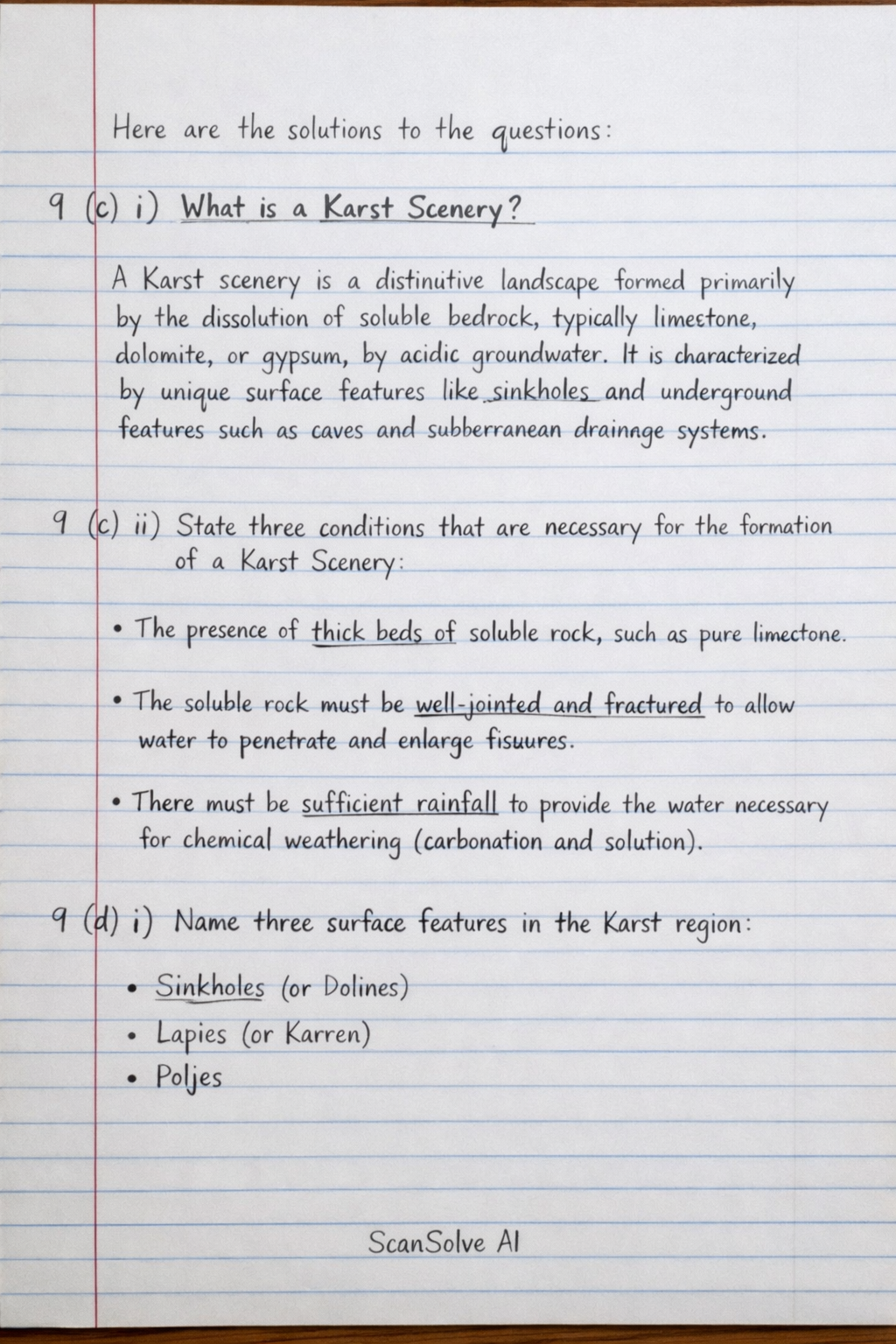
Here are the solutions to the questions:
9 (c) i) What is a Karst Scenery?
A Karst scenery is a distinctive landscape formed primarily by the dissolution of soluble bedrock, typically limestone, dolomite, or gypsum, by acidic groundwater. It is characterized by unique surface features like sinkholes and underground features such as caves and subterranean drainage systems.
9 (c) ii) State three conditions that are necessary for the formation of a Karst Scenery.
- The presence of thick beds of soluble rock, such as pure limestone.
- The soluble rock must be well-jointed and fractured to allow water to penetrate and enlarge fissures.
- There must be sufficient rainfall to provide the water necessary for chemical weathering (carbonation and solution).
9 (d) i) Name three surface features in the Karst region.
- Sinkholes (or Dolines)
- Lapies (or Karren)
- Poljes
9 (d) ii) State two significances of the Karst scenery.
- Karst regions with their caves and unique formations are significant for tourism and recreation.
- Underground rivers and aquifers in karst areas can serve as important sources of water supply.
10 (a) i) Define the term glacier.
A glacier is a large, persistent body of dense ice that forms from the accumulation and compaction of snow over many years. It moves slowly under its own weight and gravity.
10 (a) ii) List three types of glaciers.
- Valley glaciers (or Alpine glaciers)
- Continental glaciers (or Ice sheets)
- Cirque glaciers
10 (b) describe how the following features found in glaciated landscapes are formed.
-
U-shaped valley: These valleys are formed when a pre-existing river valley is modified by a moving glacier. The glacier, through processes of abrasion (grinding action of embedded rock fragments) and plucking (freezing onto and pulling away rock blocks), widens and deepens the valley floor and steepens its sides, transforming the original V-shaped river valley into a characteristic U-shaped cross-section.
-
Roche moutonnee: A roche moutonnee is an elongated, asymmetrical bedrock knob formed by glacial erosion. The stoss side (upstream side) is smoothed and polished by glacial abrasion as the ice flows over it. The lee side (downstream side) is steep, rough, and often jagged, formed by glacial plucking as the ice pulls away blocks of rock due to pressure release and freeze-thaw action.
10 (c) Explain three significances of upland glaciated features to human activities.
- Hydroelectric power generation: Glacial lakes (e.g., tarns, ribbon lakes) and steep-sided U-shaped valleys provide ideal sites for dam construction, which can be used to generate hydroelectric power.
- Tourism and recreation: The dramatic and scenic landscapes of glaciated uplands, featuring arêtes, cirques, and horns, attract tourists for activities such as hiking, skiing, and mountaineering.
- Water supply: Glacial meltwater and the numerous lakes found in glaciated regions serve as crucial sources of fresh water for domestic, agricultural, and industrial use in surrounding areas.
10 (d) Suppose you were to carry out a field study of glaciated lowlands.
i) State two advantages of using oral interviews to collect information during the study.
- Oral interviews can provide rich, qualitative data and local knowledge from residents, offering insights into historical changes or specific local conditions not available from other sources.
- They allow for immediate clarification and follow-up questions, enabling the researcher to delve deeper into interesting points or ambiguous responses.
ii) Name two features of deposition found in glaciated lowlands that you are likely to study.
- Drumlins
- Eskers
Still stuck on this one?
Ask a follow-up, and the answer starts from this question.
More Geography Questions
Handwritten Step-by-Step Solution
Get this as a handwritten image on WhatsApp — like a tutor wrote it for you.
Try on WhatsApp