

This geography problem is solved step by step below, with detailed explanations to help you understand the method and arrive at the correct answer.
ScanSolve AI Answer
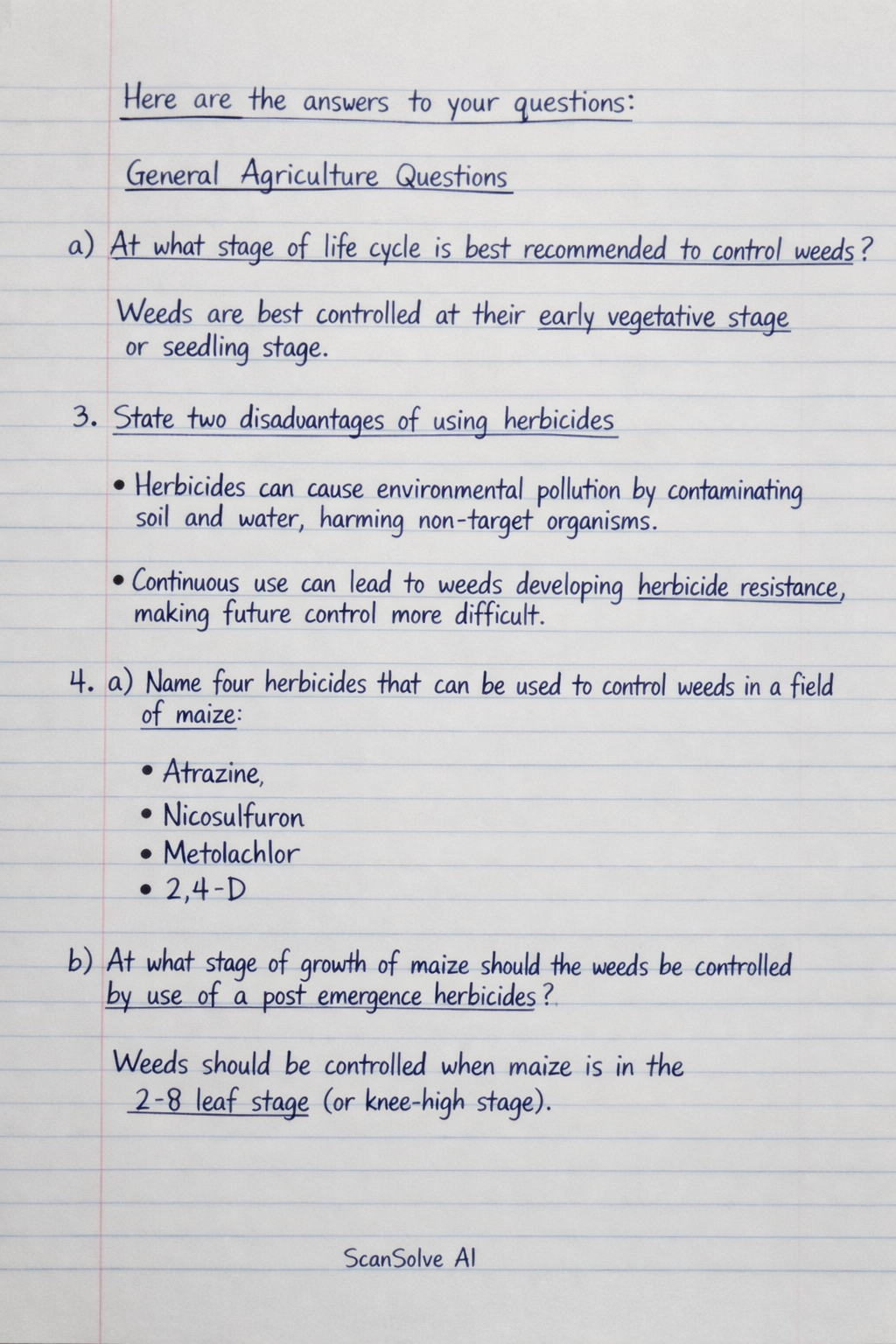
Here are the answers to your questions: General Agriculture Questions a) At what stage of life cycle is best recommended to control weeds? Weeds are best controlled at their early vegetative stage or seedling stage. 3. State two disadvantages of using herbicides • Herbicides can cause environmental pollution by contaminating soil and water, harming non-target organisms. • Continuous use can lead to weeds developing herbicide resistance, making future control more difficult. 4. a) Name four herbicides that can be used to control weeds in a field of maize • Atrazine • Nicosulfuron • Metolachlor • 2,4-D b) At what stage of growth of maize should the weeds be controlled by use of a post emergence herbicides Weeds should be controlled when maize is in the 2-8 leaf stage (or knee-high stage). 5. (b) Give an account of economic importance of weeds Weeds reduce crop yields by competing with crops for essential resources like nutrients, water, and sunlight. They also increase production costs due to the labor and materials required for their control (e.g., manual weeding, herbicides). Additionally, weeds can harbor pests and diseases, acting as alternative hosts, and can reduce the quality of harvested produce by contaminating it. 6. a) mention two factors that affect selectivity of herbicides • The crop species or variety being grown, as different crops have varying tolerance levels to specific herbicides. • The weed species and their growth stage, as herbicides are often more effective on certain weed types and at particular developmental stages. 7. Listing specific examples of weeds describe their harmful effects in agricultural production • Striga (witchweed): This parasitic weed attaches to the roots of cereal crops like maize and sorghum, drawing water and nutrients directly from the host, leading to severe stunting and significant yield losses. • Blackjack (Bidens pilosa): It competes aggressively with crops for resources and its barbed seeds can contaminate harvested produce, reducing its market value and quality. CROP PESTS AND DISEASES 1. State two possible causes of swelling on the roots of legume crops • Root nodules: These are beneficial swellings formed by symbiotic Rhizobium bacteria for nitrogen fixation. • Nematode galls: These are abnormal swellings caused by parasitic root-knot nematodes (e.g., Meloidogyne species), which impair the plant's ability to absorb water and nutrients. 2. Discuss the various cultural methods of controlling pests in crops Cultural methods involve modifying farming practices to make the environment less favorable for pests. These include crop rotation (alternating crops to break pest life cycles), timely planting and harvesting (to avoid peak pest periods), field hygiene (removing crop residues and weeds that harbor pests), use of resistant varieties (planting crops genetically less susceptible to pests), and intercropping (growing different crops together to confuse pests or attract natural enemies). 3. What does the term 'close season' mean in crop production? 'Close season' refers to a period when a particular crop is not grown in a specific area. This practice is implemented to break the life cycle of pests and diseases associated with that crop, thereby reducing their populations for the subsequent planting season. 4. Explain five cultural methods of pest control in stored grains • Cleaning storage facilities: Thoroughly cleaning bins and stores before introducing new grain removes residual pests and infested grain. • Drying grains adequately: Reducing grain moisture content to below 13% inhibits the growth of most storage pests and molds. • Airtight storage: Storing grains in hermetic (airtight) containers suffocates pests by depleting oxygen. • Use of inert dusts: Mixing inert materials like diatomaceous earth with grain abrades the cuticles of insects, causing dehydration and death. • Timely harvesting: Harvesting grains at physiological maturity reduces the chances of field infestation being carried into storage. 5. Name four symptoms of viral infections in plants • Mosaic patterns on leaves (patches of light and dark green). • Leaf curling or distortion. • Stunting or reduced overall plant growth. • Yellowing (chlorosis) or purpling of leaves. 6. Define the term 'economic injury level of a pest and integrated pest control management • Economic Injury Level (EIL): The lowest pest population density that causes economic damage, meaning the cost of controlling the pest is equal to the value of