

This geography problem is solved step by step below, with detailed explanations to help you understand the method and arrive at the correct answer.
ScanSolve AI Answer
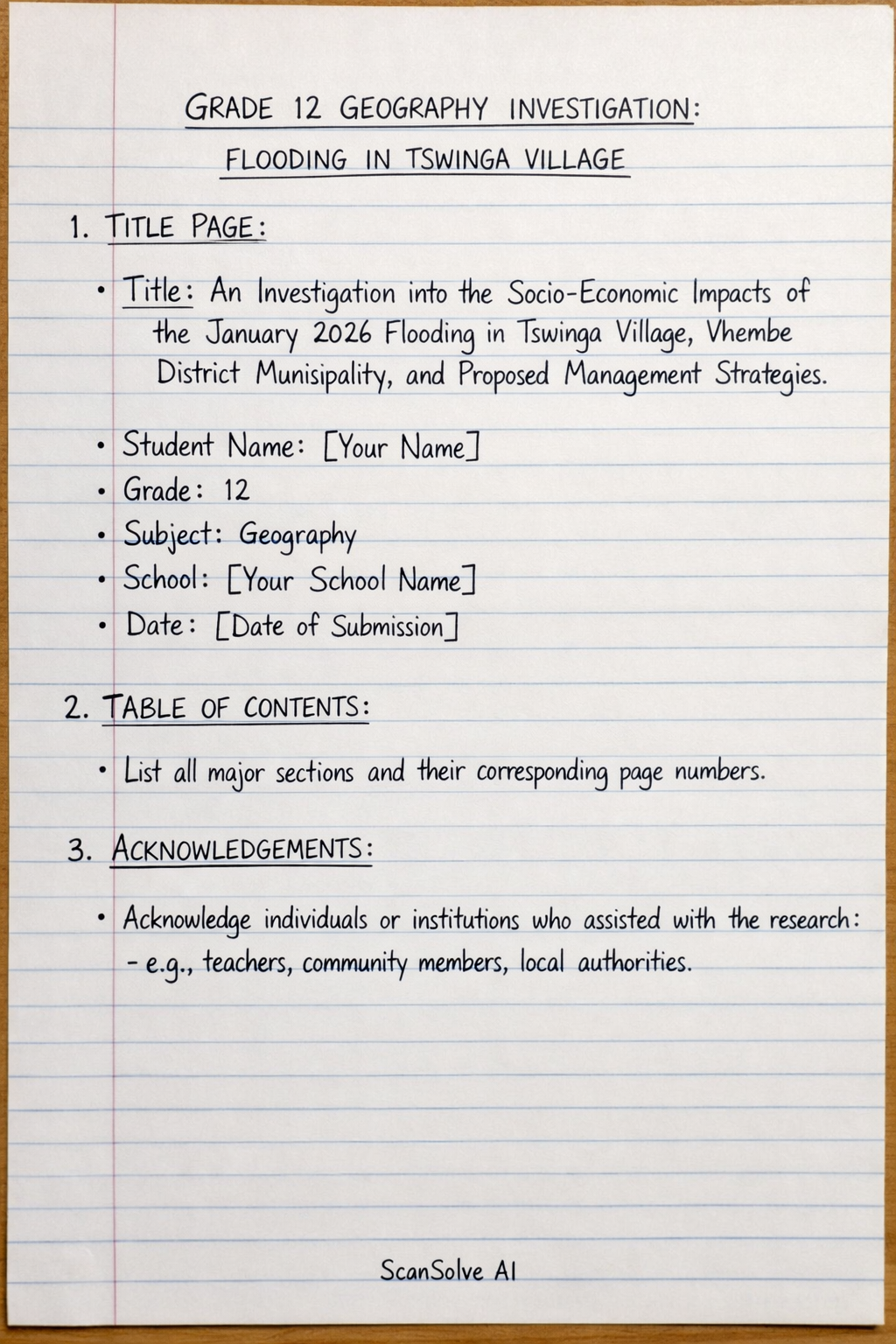
You're on a roll — Here is a structured outline for your Grade 12 Geography investigation about Tswinga Village, based on the provided research topic: --- GRADE 12 GEOGRAPHY INVESTIGATION: FLOODING IN TSWINGA VILLAGE 1. TITLE PAGE • Title: An Investigation into the Socio-Economic Impacts of the January 2026 Flooding in Tswinga Village, Vhembe District Municipality, and Proposed Management Strategies. • Student Name: [Your Name] • Grade: 12 • Subject: Geography • School: [Your School Name] • Date: [Date of Submission] 2. TABLE OF CONTENTS • List all major sections and their corresponding page numbers. 3. ACKNOWLEDGEMENTS • Acknowledge individuals or institutions who assisted with the research (e.g., teachers, community members, local authorities). 4. INTRODUCTION • Briefly introduce the research topic: the severe flooding in Tswinga village in January 2026, caused by a tropical low-pressure system. • State the geographical context: Tswinga village within the Vhembe District Municipality, Limpopo Province. • Outline the purpose of the investigation: to explore the socio-economic impacts and propose mitigation strategies. 5. AIMS/OBJECTIVES • To investigate the specific socio-economic impacts of the January 2026 flooding on the residents and infrastructure of Tswinga village. • To identify the primary causes and contributing factors to the severity of the flooding in Tswinga village. • To suggest effective management strategies to mitigate the future impacts of similar flood disasters in Tswinga village. 6. HYPOTHESIS • The January 2026 flooding in Tswinga village resulted in significant negative socio-economic impacts, which could be substantially reduced through the implementation of comprehensive disaster management and mitigation strategies. 7. METHODOLOGY • Research Design: A case study approach focusing on Tswinga village. • Data Collection Methods: • Primary Data: • Questionnaires: Administer surveys to Tswinga residents to gather information on personal experiences, property damage, economic losses, and health impacts. • Interviews: Conduct semi-structured interviews with local leaders, community elders, disaster management officials, and affected households. • Field Observations: Document physical evidence of flood damage (e.g., damaged homes, infrastructure, eroded land) through photographs and notes. • Secondary Data: • Literature Review: Consult academic articles, government reports (e.g., disaster management plans, meteorological data from SAWS), news archives, and local municipal records related to flooding in Limpopo and Vhembe district. • Maps: Utilize topographical maps, land-use maps, and satellite imagery of Tswinga village to identify flood-prone areas and assess geographical features. 8. DATA PRESENTATION AND ANALYSIS • Present collected data using appropriate geographical tools: • Graphs and Charts: Bar graphs, pie charts to show survey responses (e.g., types of damage, economic losses, frequency of impacts). • Maps: Sketch maps or GIS-generated maps to show affected areas, distribution of damage, and proposed mitigation zones. • Photographs: Visual evidence of flood impacts and recovery efforts. • Tables: Summarize interview findings and statistical data. • Analyze the data to identify patterns, trends, and relationships between the flooding event and its socio-economic consequences. 9. FINDINGS (SOCIO-ECONOMIC IMPACTS) • Social Impacts: • Loss of life or injury (if applicable). • Displacement of residents and need for temporary shelter. • Damage to homes and personal belongings. • Disruption of essential services (water, electricity, sanitation). • Impacts on health (e.g., waterborne diseases, psychological trauma). • Disruption to education due to damaged schools or inaccessible routes. • Economic Impacts: • Damage to agricultural land and crops, leading to food insecurity and loss of income for farmers. • Destruction of livestock. • Damage to local businesses and markets. • Loss of employment opportunities. • Damage to infrastructure (roads, bridges, communication networks). • Increased financial burden on households and local government for repairs and recovery. 10. MANAGEMENT STRATEGIES TO MITIGATE IMPACTS • Pre-Disaster (Prevention & Preparedness): • Early warning systems (e.g., community alerts, local radio). • Land-use zoning to restrict building in flood-prone areas. • Construction of flood defenses (e.g., levees, gabions, improved drainage systems). • Community awareness and education programs on flood safety. • Development of local disaster preparedness plans and evacuation routes. • Reforestation and wetland preservation in upstream areas to slow runoff. • During Disaster (Response): • Effective emergency response and rescue operations. • Provision of temporary shelters, food, and medical aid. • Coordination between local authorities, NGOs, and community volunteers. • Post-Disaster (Recovery & Rehabilitation): • Reconstruction of damaged infrastructure and homes. • Provision of financial aid and support for affected households and businesses. • Long-term psychological support for trauma victims. • Implementation of improved building codes in flood-prone areas. 11. CONCLUSION • Summarize the key findings regarding the socio-economic impacts of the January 2026 flooding in Tswinga village. • Revisit the hypothesis and state whether the findings support or refute it. • Briefly reiterate the importance of the proposed management strategies for future resilience. 12. BIBLIOGRAPHY • List all primary and secondary sources used, following a consistent referencing style (e.g., Harvard or APA). 13. ANNEXURES • Include copies of questionnaires, interview transcripts (if applicable), maps, photographs, and any other supporting documents. --- This outline provides a comprehensive framework for your investigation. Remember to gather specific data and examples from Tswinga village to make your research detailed and impactful. Send me the next one 📸