
We read your photo as:
Horticulture is the branch of agriculture that deals with the cultivation of plants, primarily for food, medicinal purposes, or aesthetic value. It encompasses the growing of fruits, vegetables, f
ScanSolve AI Answer
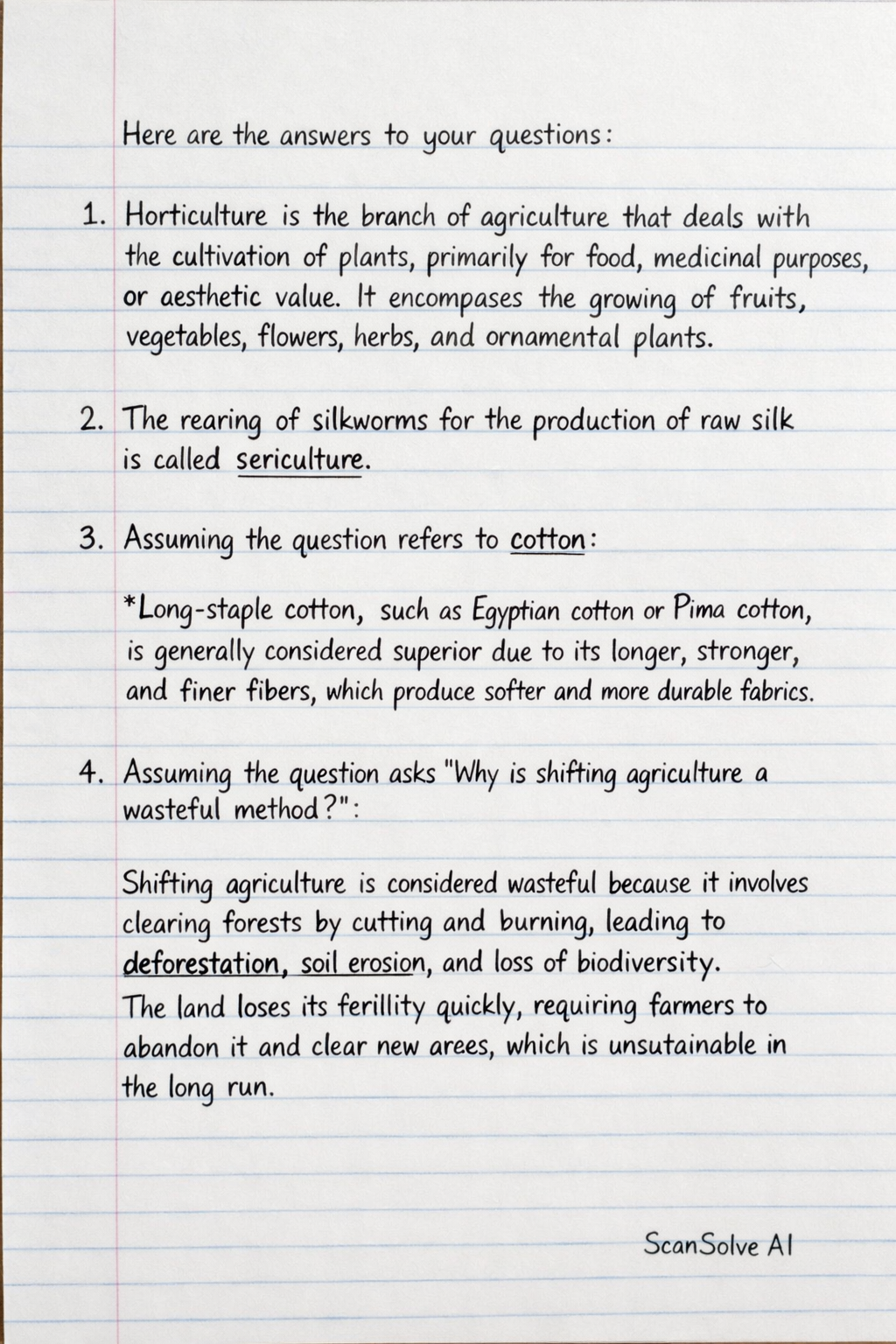
Here are the answers to your questions:
-
Horticulture is the branch of agriculture that deals with the cultivation of plants, primarily for food, medicinal purposes, or aesthetic value. It encompasses the growing of fruits, vegetables, flowers, herbs, and ornamental plants.
-
The rearing of silkworms for the production of raw silk is called sericulture.
-
Assuming the question refers to cotton: Long-staple cotton, such as Egyptian cotton or Pima cotton, is generally considered superior due to its longer, stronger, and finer fibers, which produce softer and more durable fabrics.
-
Assuming the question asks "Why is shifting agriculture a wasteful method?": Shifting agriculture is considered wasteful because it involves clearing forests by cutting and burning, leading to deforestation, soil erosion, and loss of biodiversity. The land loses its fertility quickly, requiring farmers to abandon it and clear new areas, which is unsustainable in the long run.
-
Assuming the question asks "Explain the concept of mixed farming": Mixed farming is an agricultural system where a farmer conducts both crop cultivation and livestock rearing on the same farm. This integration provides mutual benefits, such as using animal manure as fertilizer for crops and crop residues as feed for livestock, leading to increased efficiency and diversified income.
-
Assuming the question asks "What is the importance of agriculture?": Agriculture is crucial as it provides food for human consumption and livestock, raw materials for industries (like cotton for textiles, sugarcane for sugar), and employment for a significant portion of the global population. It also contributes significantly to a country's economy through trade and exports.
-
Commercial crops are crops grown primarily for sale in the market rather than for personal consumption by the farmer. These crops are cultivated on a large scale with the aim of generating profit. Examples include coffee, tea, cotton, sugarcane, and tobacco.
-
Assuming the question asks "What factors influence crop cultivation?": Crop cultivation is influenced by several factors, including climatic conditions (temperature, rainfall, sunlight), soil type and fertility, topography (land relief), availability of water for irrigation, and economic factors such as market demand, labor availability, and technological advancements.
Still stuck on this one?
Ask a follow-up, and the answer starts from this question.
More Geography Questions
Handwritten Step-by-Step Solution
Get this as a handwritten image on WhatsApp — like a tutor wrote it for you.
Try on WhatsApp