
We read your photo as:
What data is required to draw a compound bar graph for exports from 2010-2012? (ii) State three advantages of using a compound bar graph to represent statistical data. 6. (b) Calculate the percent
ScanSolve AI Answer
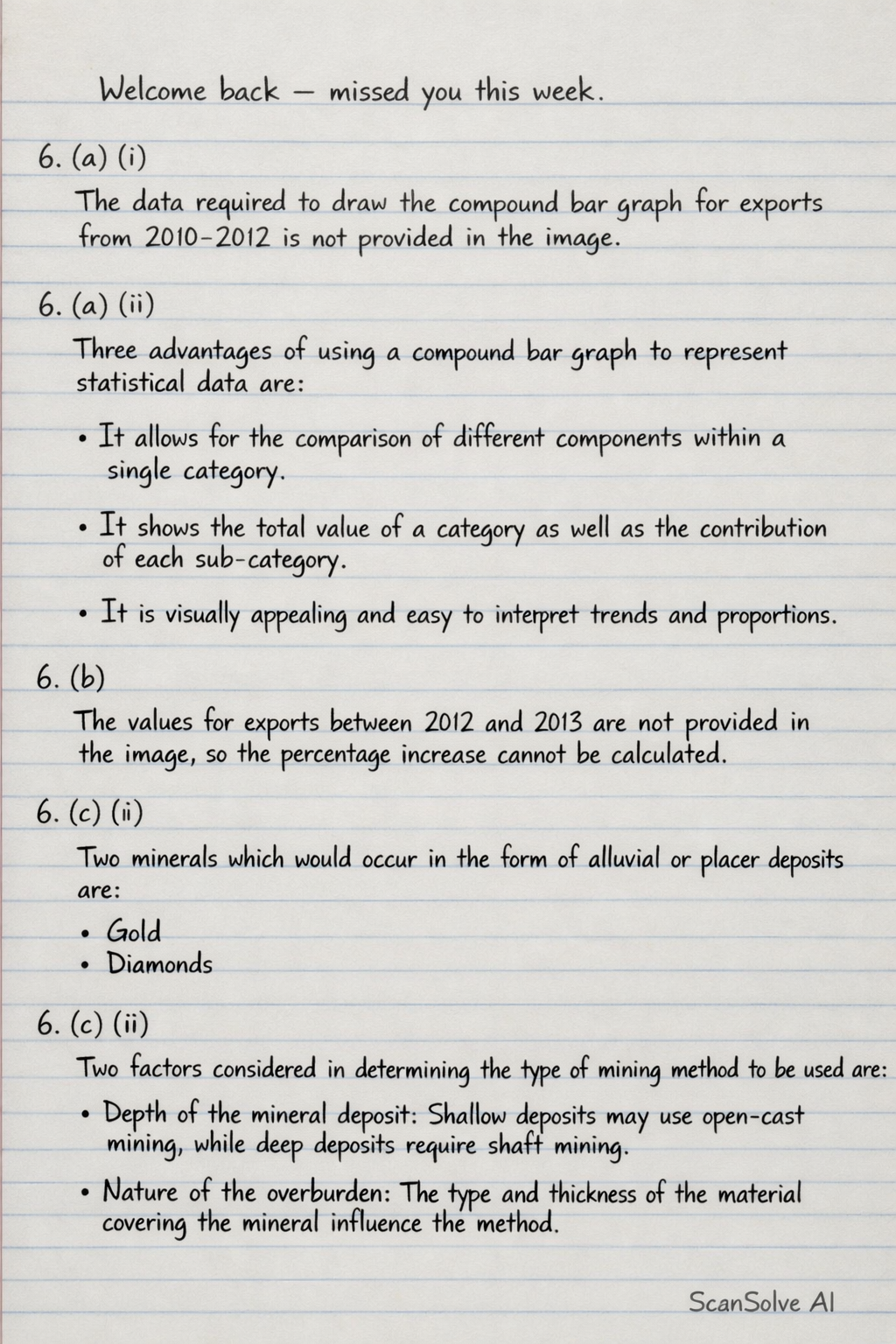
6. (a) (i)
The data required to draw the compound bar graph for exports from 2010-2012 is not provided in the image.
6. (a) (ii)
Three advantages of using a compound bar graph to represent statistical data are:
- It allows for the comparison of different components within a single category.
- It shows the total value of a category as well as the contribution of each sub-category.
- It is visually appealing and easy to interpret trends and proportions.
6. (b)
The values for exports between 2012 and 2013 are not provided in the image, so the percentage increase cannot be calculated.
6. (c) (i)
Two minerals which would occur in the form of alluvial or placer deposits are:
- Gold
- Diamonds
6. (c) (ii)
Two factors considered in determining the type of mining method to be used are:
- Depth of the mineral deposit: Shallow deposits may use open-cast mining, while deep deposits require shaft mining.
- Nature of the overburden: The type and thickness of the material covering the mineral influence the method.
6. (d) (i)
Shaft mining is an underground mining method used to extract minerals that are deep below the Earth's surface. It involves sinking vertical shafts from the surface down to the mineral deposit. Horizontal tunnels (adits) are then dug from the shafts to reach the ore body. The ore is extracted, loaded onto wagons, and hoisted to the surface through the shafts. This method is complex and expensive but allows access to deep, high-grade deposits.
6. (d) (ii)
One area where the cement industry is located in Kenya is Athi River.
7. (a) (i)
Agro-forestry is a land-use system that integrates trees and shrubs with crops and/or livestock on the same land. This combination aims to create more diverse, productive, profitable, healthy, and sustainable land-use systems.
7. (a) (ii)
Five reasons why afforestation is being encouraged in Kenya are:
- To combat deforestation and restore degraded land.
- To enhance biodiversity by providing habitats for various species.
- To mitigate climate change by absorbing carbon dioxide from the atmosphere.
- To prevent soil erosion and improve soil fertility.
- To provide timber and non-timber forest products for economic benefits.
7. (b)
Characteristics of a natural forest include:
- High biodiversity: A wide variety of plant and animal species.
- Multi-layered structure: Different canopy levels, from tall trees to undergrowth.
- Self-sustaining ecosystem: Natural regeneration and nutrient cycling.
- Presence of indigenous species: Dominated by native plant species.
7. (c) (i)
Comparison of Tree Harvesting:
- Kenya: Often involves selective logging, sometimes illegal, with less advanced technology. Harvesting may be less regulated, leading to unsustainable practices in some areas.
- Canada: Employs highly mechanized and large-scale harvesting methods, including clear-cutting and selective logging, with strict regulations and sustainable forest management practices.
7. (c) (ii)
Comparison of Transportation:
- Kenya: Relies heavily on manual labor and trucks for transporting logs, often over poor road networks.
- Canada: Utilizes extensive road networks, railways, and waterways (river drives) for efficient, large-scale transportation of timber from remote areas to processing mills.
7. (d)
Four problems that affect forestry in Canada are:
- Forest fires: Large-scale wildfires, often exacerbated by climate change, destroy vast areas of forest.
- Pest and disease outbreaks: Insect infestations (e.g., mountain pine beetle) and tree diseases cause significant damage and economic losses.
- Climate change impacts: Changes in temperature and precipitation patterns affect tree growth, species distribution, and increase the frequency of extreme weather events.
- Market fluctuations: Global demand and prices for timber products can impact the profitability and sustainability of the forestry industry.
8. (a) (i)
Beef farming is the raising of cattle specifically for meat production. It involves breeding, rearing, and fattening cattle to be slaughtered for human consumption.
8. (a) (ii)
Three exotic breeds of beef cattle reared in Kenya are:
- Hereford
- Aberdeen Angus
- Charolais
8. (b)
Beef production is higher in Argentina than Kenya due to several reasons:
- Vast grasslands (Pampas): Argentina has extensive, fertile natural grasslands ideal for large-scale cattle grazing.
- Favorable climate: The temperate climate in Argentina supports year-round grazing and pasture growth.
- Advanced breeding and management: Argentina has a long history of selective breeding and modern ranching techniques.
- Strong export market: A well-developed infrastructure and market for beef exports drive large-scale production.
8. (c)
Four measures taken by the government of Kenya to improve beef cattle farming are:
- Disease control and vaccination programs: To reduce livestock mortality and improve animal health.
- Provision of extension services: Educating farmers on modern husbandry practices, nutrition, and breeding.
- Improvement of pasture and fodder production: Promoting better grazing management and cultivation of high-quality feed.
- Genetic improvement programs: Introducing and promoting superior beef cattle breeds through artificial insemination and breeding centers.
8. (d)
Beef farming plays a significant role in the economy of Kenya by:
- Providing food security: Supplying a major source of protein for the population.
- Generating income and employment: Creating jobs for farmers, butchers, transporters, and related industries.
- Earning foreign exchange: Through the export of beef and beef products.
- Supporting allied industries: Such as leather production, animal feed manufacturing, and veterinary services.
9. (a)
Land rehabilitation is the process of restoring degraded land to a productive and healthy state. This involves implementing measures to improve soil fertility, control erosion, restore vegetation, and enhance biodiversity, often after environmental damage or unsustainable land use.
9. (b) (i)
Two rivers that supply water to the Mwea irrigation scheme are:
- River Thiba
- River Nyamindi
9. (b) (ii)
Two methods of irrigation used in the Mwea Teberre irrigation scheme are:
- Furrow irrigation
- Basin irrigation
Still stuck on this one?
Ask a follow-up, and the answer starts from this question.
More Geography Questions
Handwritten Step-by-Step Solution
Get this as a handwritten image on WhatsApp — like a tutor wrote it for you.
Try on WhatsApp