
We read your photo as:
Identify a conventional tourism destination in your region and discuss why it fits the definition of mass tourism, focusing on iconic attractions, infrastructure, and commercialized activities.
ScanSolve AI Answer
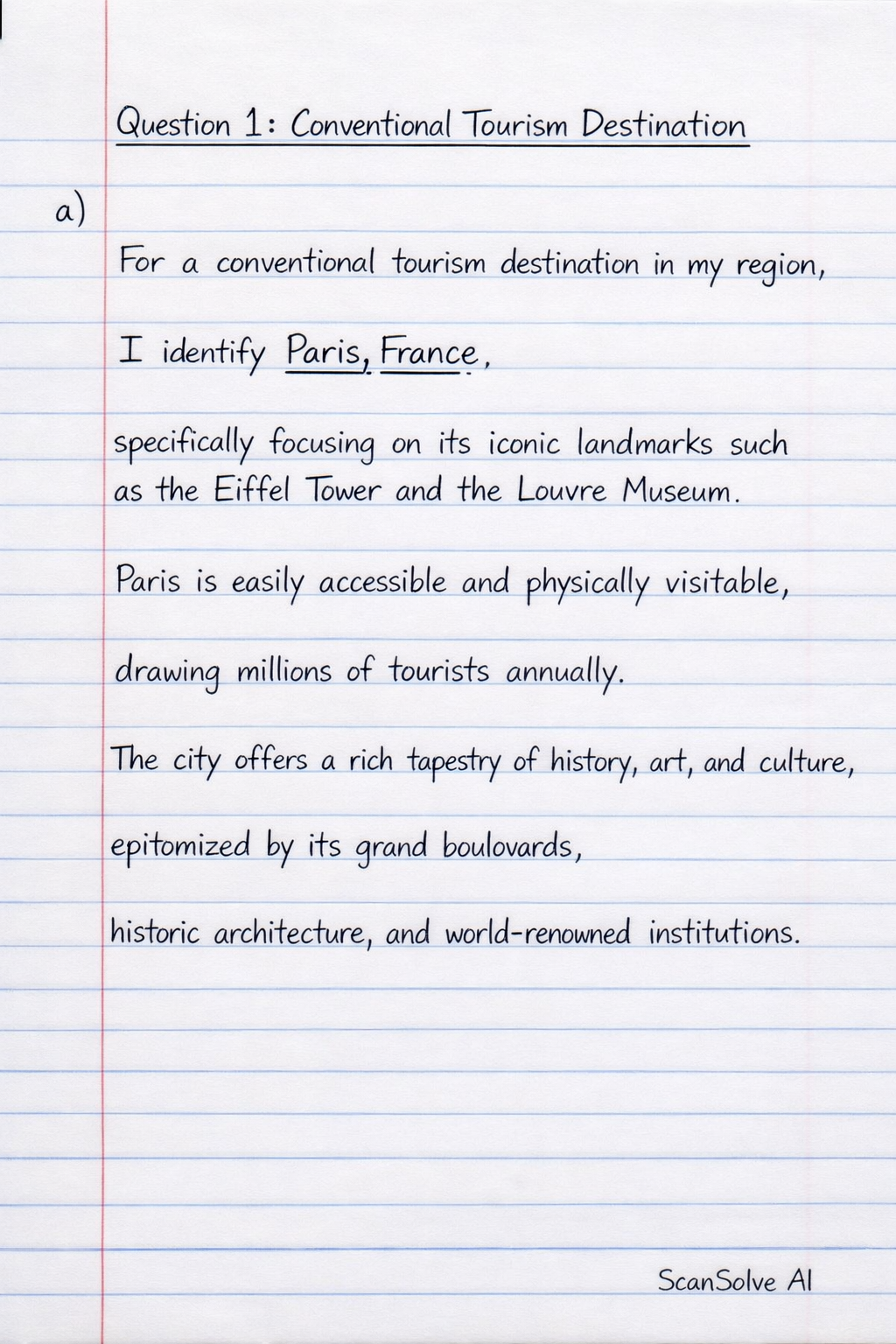
Question 1: Conventional Tourism Destination
a)
For a conventional tourism destination in my region, I identify Paris, France, specifically focusing on its iconic landmarks such as the Eiffel Tower and the Louvre Museum. Paris is easily accessible and physically visitable, drawing millions of tourists annually. The city offers a rich tapestry of history, art, and culture, epitomized by its grand boulevards, historic architecture, and world-renowned institutions.
b)
I have chosen Paris as a conventional tourism destination due to its embodiment of characteristics that define mass tourism. Firstly, it possesses globally recognized iconic attractions like the Eiffel Tower, Notre Dame Cathedral, and the Louvre, which serve as primary motivators for international travel. These sites are heavily marketed and attract a diverse demographic, from first-time visitors to repeat travelers. Secondly, Paris boasts a highly developed and extensive tourism infrastructure, including a vast network of hotels, restaurants, transportation systems (metro, RER, international airports), and tour operators, all designed to accommodate large volumes of tourists efficiently. This infrastructure supports the high demand and ensures a comfortable, albeit often crowded, visitor experience. Thirdly, the city offers a wide array of commercialized tourism activities, ranging from guided tours and souvenir shops to luxury shopping districts and entertainment venues, catering to a broad spectrum of tourist preferences and spending habits. The economic model of Parisian tourism heavily relies on these commercial aspects. Finally, Paris represents a destination where the cultural experience is often curated and consumed in a standardized manner, with popular routes and attractions dominating itineraries, sometimes leading to a less authentic or localized interaction for visitors. This conventional approach prioritizes accessibility and familiarity over unique, off-the-beaten-path experiences.
Question 2: Ecotourism Destination
a)
For an ecotourism destination in my region, I identify the Chamonix-Mont-Blanc Valley in the French Alps. This region is renowned for its stunning natural landscapes, including glaciers, alpine meadows, and the highest peak in Western Europe, Mont Blanc. It is physically visitable, offering numerous trails, cable cars, and facilities that allow visitors to experience its natural beauty responsibly.
b)
I have chosen the Chamonix-Mont-Blanc Valley as an ecotourism destination because it actively promotes responsible travel to natural areas that conserves the environment and improves the well-being of local people. The region emphasizes activities such as hiking, mountaineering, and skiing, which inherently connect visitors with nature. Crucially, Chamonix has implemented various initiatives to mitigate the environmental impact of tourism, such as promoting public transport, developing sustainable energy solutions, and managing waste effectively. Local operators often engage in conservation efforts, educating visitors about the fragile alpine ecosystem and encouraging adherence to "leave no trace" principles. Furthermore, the community benefits directly from tourism through local employment and the sale of regional products, fostering a sense of ownership and responsibility towards preserving their natural heritage. Many accommodations and activity providers in Chamonix are committed to sustainable practices, such as using renewable energy, sourcing local food, and minimizing water consumption. This commitment ensures that the economic benefits of tourism contribute to the long-term ecological and social health of the valley, distinguishing it from conventional tourism that might prioritize volume over environmental and social stewardship.
Question 3: Sustainable Tourism Destination
In my opinion, the Chamonix-Mont-Blanc Valley is more sustainable in the long term compared to Paris.
The justification for this opinion lies in the fundamental principles guiding each destination's tourism model. Chamonix, as an ecotourism destination, is inherently designed around environmental conservation and community well-being. Its success is directly tied to the preservation of its natural assets (mountains, glaciers, biodiversity), which necessitates proactive management of visitor impact, resource consumption, and waste. The local economy is integrated with these conservation efforts, creating a symbiotic relationship where tourism revenue supports environmental protection and local livelihoods. In contrast, Paris, as a conventional mass tourism destination, faces significant challenges related to overtourism, including strain on infrastructure, increased pollution, commodification of culture, and displacement of local residents. While efforts are made to manage these issues, the sheer volume of visitors and the commercial nature of its tourism often lead to a higher ecological footprint and social pressures that are harder to mitigate sustainably in the long run. The Chamonix model, with its focus on smaller visitor numbers, educational experiences, and direct community benefits, is better positioned to adapt to environmental changes and maintain its appeal without compromising its core resources or local quality of life.
Still stuck on this one?
Ask a follow-up, and the answer starts from this question.
More Geography Questions
Handwritten Step-by-Step Solution
Get this as a handwritten image on WhatsApp — like a tutor wrote it for you.
Try on WhatsApp