
We read your photo as:
Identify four types of resources accessible in a community and provide an example for each. Outline steps to complete a community resource assessment.
ScanSolve AI Answer
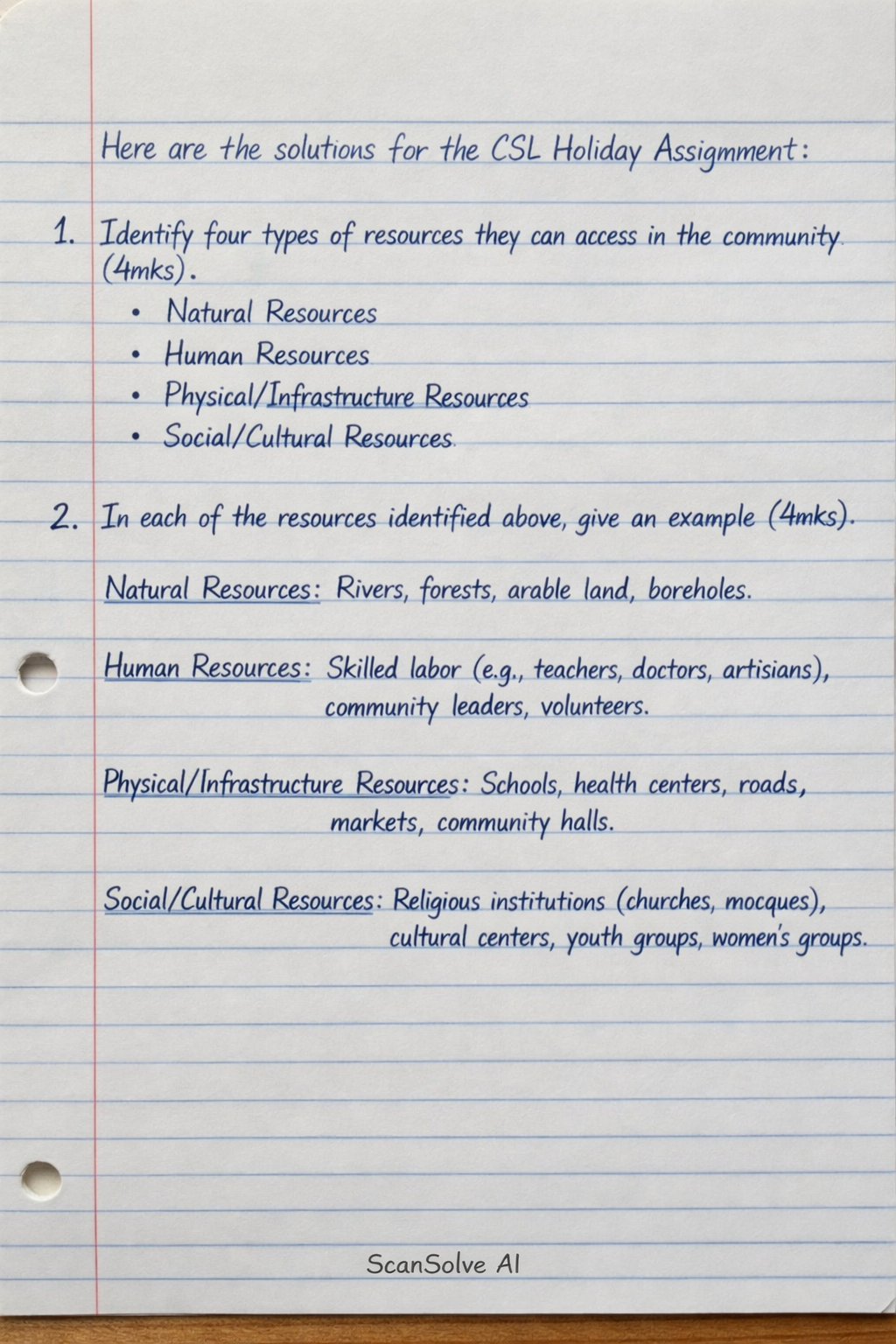
Here are the solutions for the CSL Holiday Assignment:
1. Identify four types of resources they can access in the community (4mks)
- Natural Resources
- Human Resources
- Physical/Infrastructure Resources
- Social/Cultural Resources
2. In each of the resources identified above, give an example (4mks)
- Natural Resources: Rivers, forests, arable land, boreholes.
- Human Resources: Skilled labor (e.g., teachers, doctors, artisans), community leaders, volunteers.
- Physical/Infrastructure Resources: Schools, health centers, roads, markets, community halls.
- Social/Cultural Resources: Religious institutions (churches, mosques), cultural centers, youth groups, women's groups.
3. Give steps the student shall follow to complete the assessment (7mks)
- Define Objectives and Scope: Clearly state what resources will be mapped and the geographical boundaries of the community.
- Develop Data Collection Tools: Design questionnaires, interview guides, or observation checklists to gather relevant information.
- Identify Respondents: Determine who to interview or observe (e.g., community leaders, residents, local business owners).
- Data Collection: Conduct interviews, surveys, focus group discussions, and direct observation within the community.
- Data Organization: Systematically record and categorize the collected information based on resource type, location, and accessibility.
- Data Analysis: Review and interpret the organized data to identify patterns, strengths, and gaps in community resources.
- Reporting: Compile the findings into a comprehensive report or presentation.
4. Using the steps above, write a brief proposal on the following (20mks)
A. Objectives of the study
The primary objectives of this resource mapping exercise are:
- To identify and categorize all available resources within the Njoro Boys High School community.
- To map the geographical location of these identified resources.
- To assess the accessibility of each resource to community members.
- To create a comprehensive inventory that can inform future community development initiatives.
B. Population (respondents)
The study will target a diverse group of respondents to ensure a holistic understanding of community resources. This will include:
- Community leaders (e.g., village elders, chiefs, religious leaders).
- Local residents from various households and demographic groups.
- Representatives of local institutions (e.g., school principals, health workers, business owners).
- Local government officials involved in community planning and resource management.
C. The research tools/ methods
A mixed-methods approach will be employed to gather comprehensive data:
- Surveys/Questionnaires: Structured questionnaires will be administered to a sample of community members to collect quantitative data on resource availability, usage, and perceived importance.
- Key Informant Interviews (KIIs): In-depth interviews will be conducted with community leaders and experts to gather qualitative insights and detailed information on specific resources.
- Focus Group Discussions (FGDs): Group discussions with selected community members will facilitate the sharing of collective knowledge and perceptions about resources and their accessibility.
- Direct Observation/Transect Walk: Students will physically walk through the community to identify visible resources, infrastructure, and their conditions, noting geographical locations.
- Secondary Data Review: Existing community maps, local government reports, and other relevant documents will be reviewed to supplement primary data.
D. Collecting data/analysis of the data
- Data Collection: Students will be organized into teams, each assigned specific areas or resource categories. They will use the developed tools (questionnaires, interview guides, observation checklists) to systematically collect information. For physical resources, geographical descriptions or GPS coordinates will be recorded. All data will be meticulously documented.
- Data Analysis:
- Qualitative data from interviews and FGDs will be transcribed and analyzed thematically to identify common patterns, challenges, and opportunities related to resources.
- Quantitative data from surveys will be compiled, tabulated, and analyzed using descriptive statistics (e.g., frequencies, percentages) to summarize resource distribution and characteristics.
- A community resource map will be developed, either physically or digitally, to visually represent the location of identified resources.
- Findings from both qualitative and quantitative analyses will be synthesized to provide a comprehensive overview of the community's resource landscape.
E. Summarize the information collected under:
-
categorize the resources/ The collected information will be categorized into distinct resource types for clarity and ease of analysis. These categories will include:
- Natural Resources: e.g., water sources (rivers, boreholes), agricultural land, forests, quarries.
- Human Resources: e.g., skilled professionals (teachers, doctors), youth groups, women's groups, community-based organizations.
- Physical/Infrastructure Resources: e.g., schools, health clinics, roads, markets, electricity grids, communication towers.
- Financial Resources: e.g., SACCOs (Savings and Credit Co-operative Societies), microfinance institutions, local businesses, informal savings groups.
- Social/Cultural Resources: e.g., community halls, cultural sites, religious centers, social welfare programs.
-
where the resources are located/ found The location of each identified resource will be precisely documented. This will involve:
- Providing descriptive geographical locations (e.g., "2 km east of Njoro market," "along River Njoro," "next to the chief's office").
- Using landmarks for easy identification (e.g., "opposite St. Paul's Church").
- Recording GPS coordinates where feasible, to enable accurate mapping.
- Developing a visual community map that plots all identified resources, showing their spatial distribution.
-
how they can be accessed For each resource, detailed information on its accessibility will be recorded, covering:
- Physical Access: Whether the resource is publicly accessible, privately owned, or requires specific permission.
- Cost of Access: If there are any fees, charges, or membership requirements to utilize the resource.
- Eligibility Criteria: Any specific conditions or requirements for individuals or groups to access the resource (e.g., "for registered members only," "for residents of a specific age group").
- Operating Hours/Availability: The times or periods when the resource is available for use (e.g., "daily 8 am - 5 pm," "seasonal," "on weekends only").
F. create a database to store the information. (4mks)
A simple relational database can be created using software like Microsoft Access or a spreadsheet program like Google Sheets/Microsoft Excel. The database would consist of at least one main table, Resources, with the following fields:
ResourceID(Primary Key, unique identifier for each resource)ResourceName(Name of the resource, e.g., "Njoro River," "Njoro Health Centre")ResourceType(Category, e.g., "Natural," "Physical," "Human")Description(Brief details about the resource)LocationDescription(Textual description of where it's found)GPS_Latitude(Numerical value for latitude, if collected)GPS_Longitude(Numerical value for longitude, if collected)AccessMethod(How it can be accessed, e.g., "Public," "Private, requires permission")CostOfAccess(e.g., "Free," "Fee-based," "Membership")ContactPerson(Name of a contact person, if applicable)ContactInfo(Phone number or email for contact)
This structure allows for efficient storage, retrieval, and analysis of the collected resource mapping data.
Still stuck on this one?
Ask a follow-up, and the answer starts from this question.
More Geography Questions
Handwritten Step-by-Step Solution
Get this as a handwritten image on WhatsApp — like a tutor wrote it for you.
Try on WhatsApp