

This mathematics problem involves applying core mathematical principles and formulas. Below you will find a complete step-by-step solution with detailed explanations for each step, helping you understand not just the answer but the method behind it.
ScanSolve AI Answer
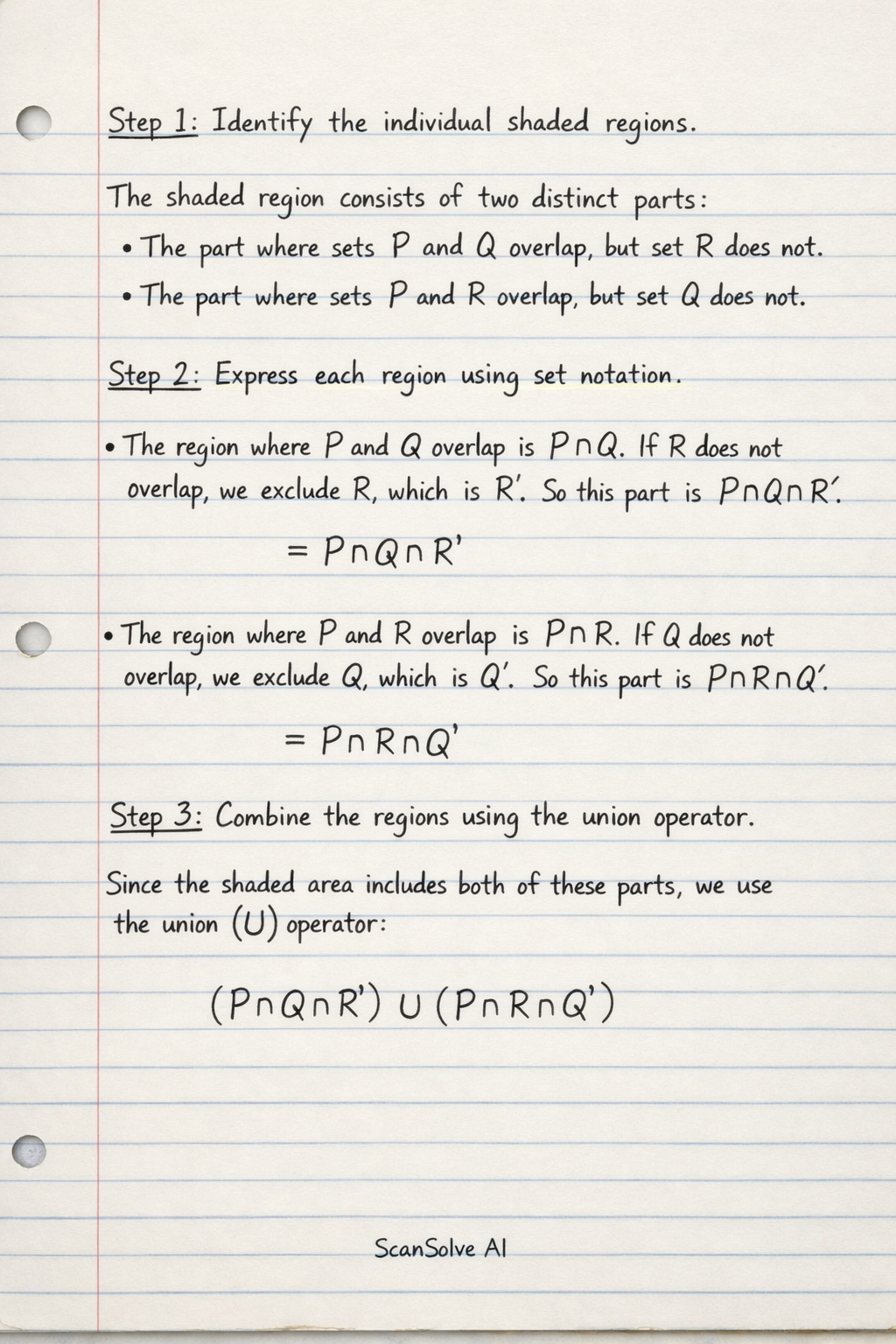
Step 1: Identify the individual shaded regions. The shaded region consists of two distinct parts: • The part where sets P and Q overlap, but set R does not. • The part where sets P and R overlap, but set Q does not. Step 2: Express each region using set notation. • The region where P and Q overlap is P Q. If R does not overlap, we exclude R, which is R'. So this part is P Q R'. • The region where P and R overlap is P R. If Q does not overlap, we exclude Q, which is Q'. So this part is P R Q'. Step 3: Combine the regions using the union operator. Since the shaded area includes both of these parts, we use the union () operator: (P Q R') (P R Q') Step 4: Simplify the expression (optional, but often preferred for conciseness). We can factor out P from the expression: P ((Q R') (R Q')) The expression (Q R') (R Q') represents the symmetric difference between sets Q and R, often denoted as Q R. Therefore, the shaded region can also be described as: P (Q R) The final answer is (P Q R') (P R Q') or P (Q R).