
We read your photo as:
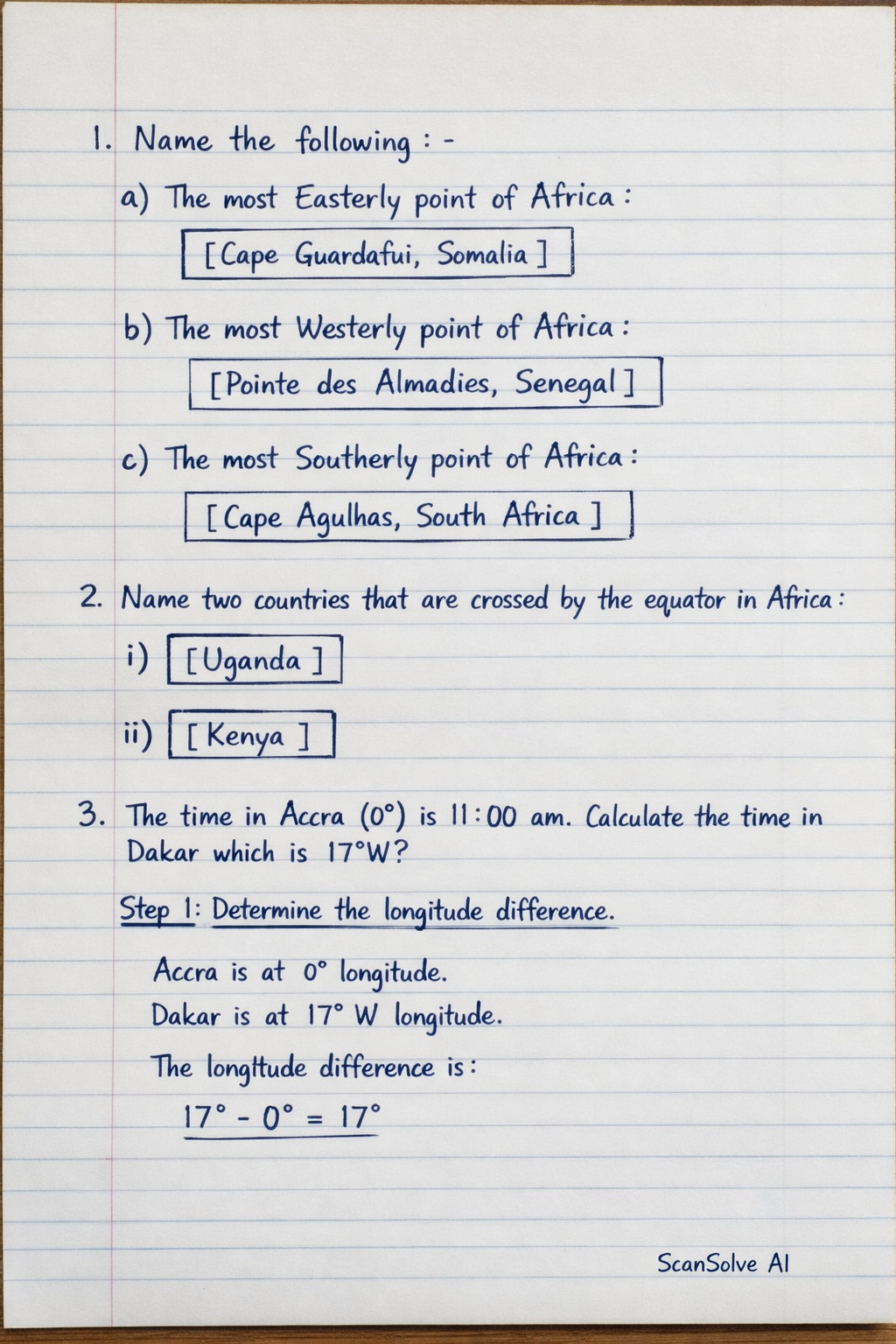
Name the following :- a) The most Easterly point of Africa. b) The most Westerly point of Africa. c) The most Southerly point of Africa. Name two countries that are crossed by the equator in Africa.
ScanSolve AI Answer
Step-by-step solution
3 stepsHere are the answers to the questions from the image:
1. Name the following :-
a) The most Easterly point of Africa.
b) The most Westerly point of Africa.
c) The most Southerly point of Africa.
2. Name two countries that are crossed by the equator in Africa.
i)
ii)
3. The time in Accra (0°) is 11:00 am. Calculate the time in Dakar which is 17°W?
Determine the longitude difference.
Accra is at longitude. Dakar is at longitude.
The longitude difference is .Calculate the time difference.
The Earth rotates per hour.
Time difference .
Convert the decimal part to minutes: .
So, the time difference is 1 hour and 8 minutes.Calculate the time in Dakar.
Since Dakar is west of Accra, the time in Dakar will be earlier.
Time in Dakar
Time in Dakar .4. State two theories of the origin of the solar system.
i)
ii)
5. Shantel wants to be a civil engineer. However, her family wants his brother to be the engineer and not her. Describe five strategies that can be used to address gender stereotypes in the society.
6. Identify three types of fieldwork in Social Studies.
7. Explain four methods of data collection and recording in fieldwork.
8. Name crops grown and animals kept in Egypt, Nubia and Rift Valley of Eastern Africa regions during early agriculture.
a) (Image of cucumber)
b) (Image of wheat)
c) (Image of grapes)
d) (Image of cow)
e) (Image of sheep)
Still stuck on this one?
Ask a follow-up, and the answer starts from this question.
More Geography Questions
Handwritten Step-by-Step Solution
Get this as a handwritten image on WhatsApp — like a tutor wrote it for you.
Try on WhatsApp