
We read your photo as:
Outline a research plan for a Grade 12 project on the socio-economic impacts of the January 2026 floods in Vhembe district municipality, Limpopo.
ScanSolve AI Answer
Step-by-step solution
7 stepsHere's how to approach the Grade 12 Research Topic using the provided Learners Guide:
Formulation of hypothesis
Your hypothesis should be a testable statement about the socio-economic impacts or mitigation strategies.
Example: "The January 2026 flooding in Vhembe district municipality significantly increased unemployment and food insecurity, and effective early warning systems could mitigate these impacts."Mapping of Geographical research area
Create a map of Limpopo Province, specifically highlighting the Vhembe district municipality and the areas most affected by the 2026 floods. Ensure the map is A4 size or smaller and includes a title, scale, legend, north arrow, coordinates, and a buffer zone around the study area.
Background Information
Write an eight-line paragraph describing the geographical location of the Vhembe district municipality, its typical socio-economic conditions, and any historical context of flooding or similar weather events in the region. This sets the stage for the 2026 flood event.
Data Collection
Identify specific primary and secondary data sources.
- Primary data: Conduct interviews with affected residents, local government officials, or NGOs; distribute questionnaires (online or in person) to gather information on personal experiences and economic losses.
- Secondary data: Collect information from newspaper articles, government reports on disaster management, meteorological data on the tropical low-pressure system, academic studies on flood impacts in the region, and social media posts related to the event.
Data Presentation
Present the collected data clearly. Use:
- Graphs: To show trends in economic losses, number of displaced people, or changes in employment rates.
- Tables: To summarize survey responses, types of damage, or aid distribution.
- Written responses: Summarize key findings from interviews and secondary sources.
Data Analysis
Interpret the presented data to identify the specific socio-economic impacts of the flooding. Analyze how the flood affected livelihoods, infrastructure, health, education, and local economy. Provide clear insights into the severity and nature of these impacts.
Recommendations, possible solutions and conclusion
Based on your analysis:
- Recommendations: Suggest practical management strategies to mitigate future flood impacts, such as improved infrastructure, early warning systems, community preparedness programs, or economic diversification.
- Conclusion: State whether your initial hypothesis (from Step 1) is accepted or rejected, providing evidence from your data analysis. Summarize the key findings and their implications.
Bibliography
Compile a comprehensive list of all sources used (interviews, reports, articles, websites), ensuring consistent application of a referencing style, such as Harvard.Final Presentation
Ensure your research task is professionally presented with a clear structure, logical flow, and appropriate headings. Design a cover page that includes the research topic and your stated hypothesis.
Still stuck on this one?
Ask a follow-up, and the answer starts from this question.
More Geography Questions
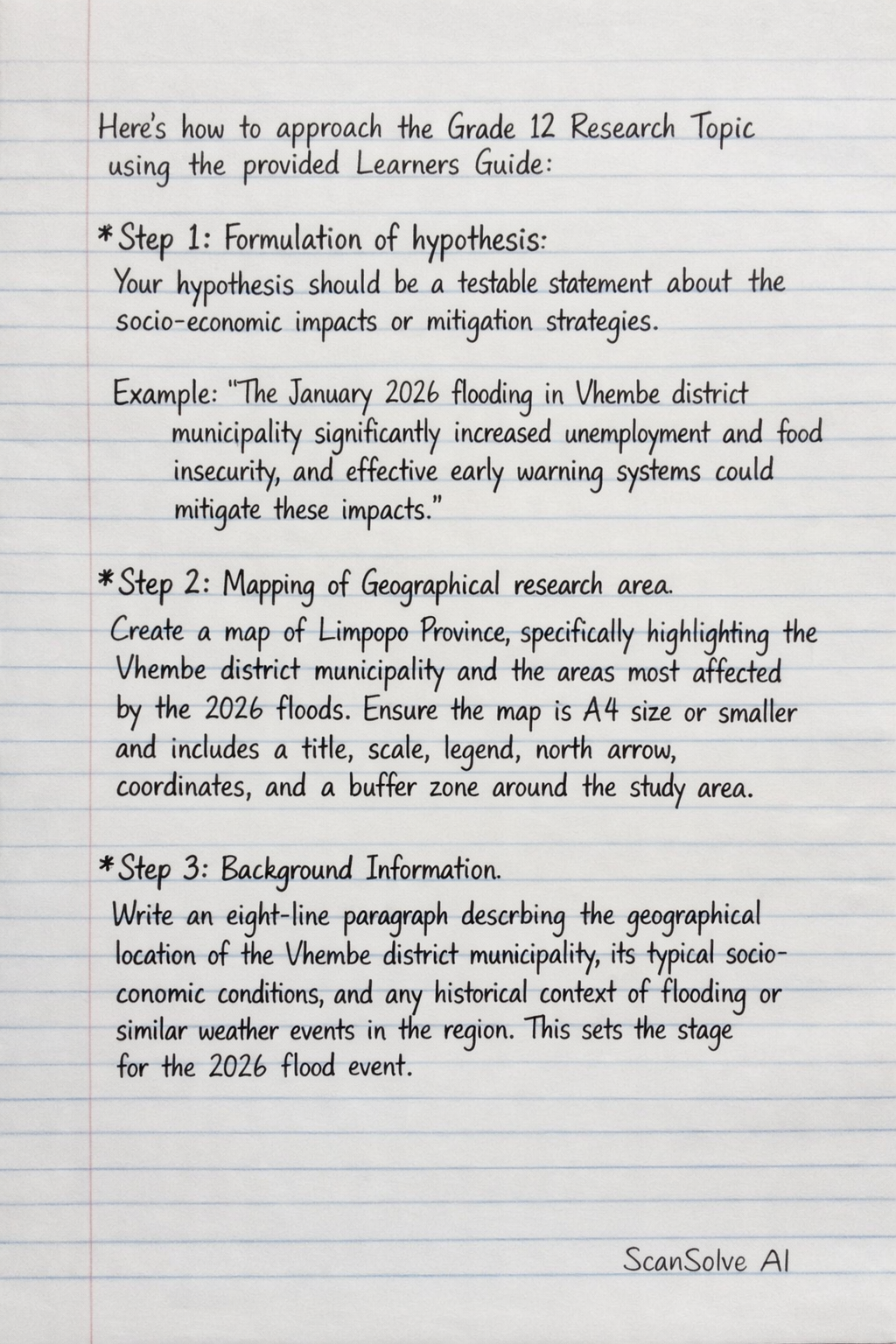
Handwritten Step-by-Step Solution
Get this as a handwritten image on WhatsApp — like a tutor wrote it for you.
Try on WhatsApp