
We read your photo as:
What are the primary environmental, infrastructural, and socio-economic impacts of the January 2026 floods in the Mopani and Vhembe districts of Limpopo Province?
ScanSolve AI Answer
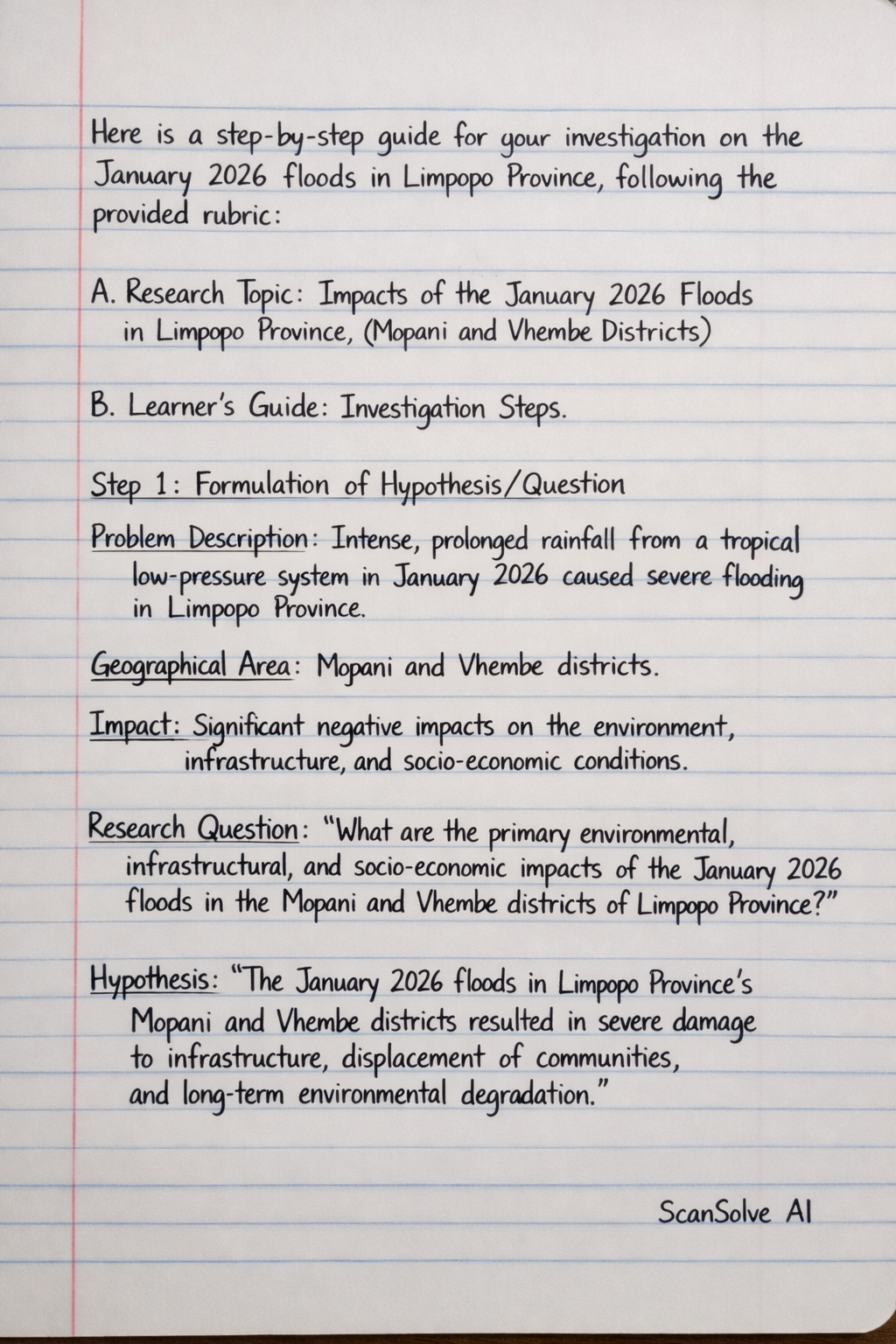
Here is a step-by-step guide for your investigation on the January 2026 floods in Limpopo Province, following the provided rubric:
A. Research Topic: Impacts of the January 2026 Floods in Limpopo Province (Mopani and Vhembe Districts)
B. Learner's Guide: Investigation Steps
-
Step 1: Formulation of Hypothesis/Question
- Problem Description: Intense, prolonged rainfall from a tropical low-pressure system in January 2026 caused severe flooding in Limpopo Province.
- Geographical Area: Mopani and Vhembe districts.
- Impact: Significant negative impacts on the environment, infrastructure, and socio-economic conditions.
- Research Question: "What are the primary environmental, infrastructural, and socio-economic impacts of the January 2026 floods in the Mopani and Vhembe districts of Limpopo Province?"
- Hypothesis: "The January 2026 floods in Limpopo Province's Mopani and Vhembe districts resulted in severe damage to infrastructure, displacement of communities, and long-term environmental degradation."
-
Step 2: Geographical Mapping of Research Area
- Create a map of Limpopo Province, clearly highlighting the Mopani and Vhembe districts.
- Include essential cartographic elements: title, scale, legend, north arrow, and coordinates.
- Mark key geographical features like major rivers, towns, and areas most affected by the floods.
-
Step 3: Background Information
- Describe the location of the Mopani and Vhembe districts within Limpopo Province, South Africa.
- Provide historical context of flood events in the region and the area's vulnerability to tropical weather systems.
- Explain the geographical factors (e.g., topography, river systems) that contributed to the severity of the January 2026 floods.
-
Step 4: Data Collection
- Primary Data: Conduct interviews with affected residents, local government officials, and NGOs. Collect photographs of flood damage and use online questionnaires.
- Secondary Data: Review newspaper articles (local and national from early 2026), meteorological reports, government disaster management reports, and academic studies on floods in Limpopo. Utilize social media posts from the time.
-
Step 5: Analysis and Synthesis of Data
- Interpret collected data to identify and categorize the impacts:
- Environmental: Soil erosion, water contamination, habitat destruction.
- Infrastructural: Damage to roads, bridges, homes, schools, water supply, and power lines.
- Socio-economic: Displacement, loss of livelihoods (agriculture, businesses), health risks, food insecurity.
- Provide clear insight into the extent and severity of these impacts across the affected districts.
- Interpret collected data to identify and categorize the impacts:
-
Step 6: Recommendations and Possible Solutions
- Propose relevant short-term and long-term solutions to mitigate future flood impacts and aid recovery.
- Short-term: Emergency relief, temporary infrastructure repairs.
- Long-term: Improved early warning systems, flood-resistant infrastructure, land-use planning, community education, and sustainable environmental management.
-
Step 7: Conclusion - ACCEPT/REJECT the Hypothesis
- Based on your data analysis, state whether your initial hypothesis is accepted or rejected.
- Provide a detailed summary of the key findings regarding the impacts of the January 2026 floods in the Mopani and Vhembe districts.
-
Step 8: Bibliography
- Compile a comprehensive list of all sources used (e.g., websites, articles, interviews, reports).
- Ensure consistent application of a correct referencing style, such as Harvard.
-
Step 9: Cover Page
- Design a professional cover page with a clear title (e.g., "Investigation into the Impacts of the January 2026 Floods in Limpopo Province"), your name, school, subject, and the submission date.
- Include an appropriate image or graphic related to the research.
-
Step 10: Content / Index Page
- Create a detailed table of contents listing all sections and subsections with their corresponding page numbers.
-
Step 11: Presentation (General Impression)
- Ensure the research task is professionally presented with a clear structure, appropriate headings, and logical flow.
- Incorporate relevant graphs, tables, and diagrams to demonstrate the nature and scope of the collected data effectively.
This structured approach will guide you through completing your investigation thoroughly and accurately.
Still stuck on this one?
Ask a follow-up, and the answer starts from this question.
More Geography Questions
Handwritten Step-by-Step Solution
Get this as a handwritten image on WhatsApp — like a tutor wrote it for you.
Try on WhatsApp