
We read your photo as:
Prepare a report on soil variations on Mt. Elgon slopes, including objectives, methods, and findings.
Geography
ScanSolve AI Answer
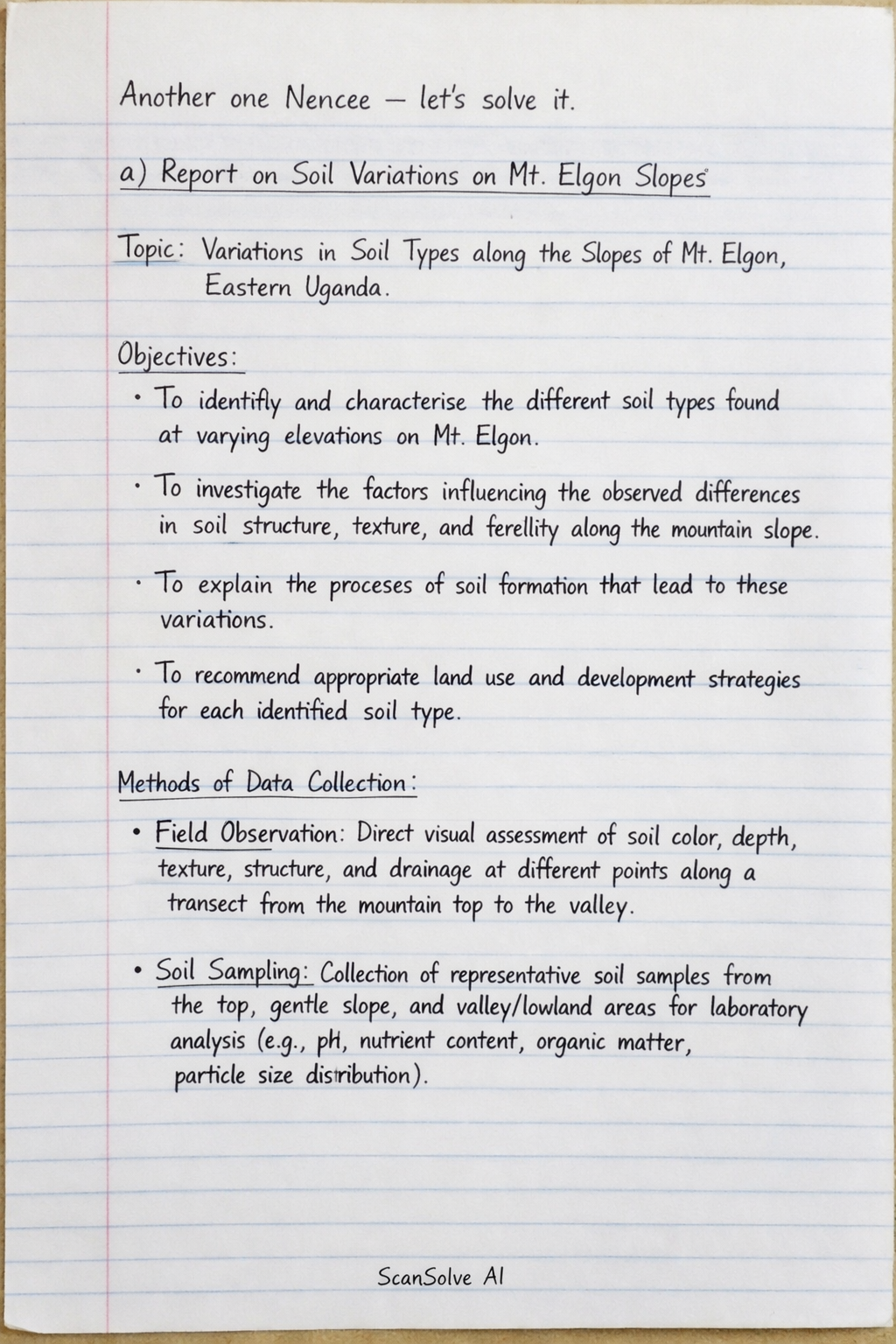
a) Report on Soil Variations on Mt. Elgon Slopes
- Topic: Variations in Soil Types along the Slopes of Mt. Elgon, Eastern Uganda.
- Objectives:
- To identify and characterize the different soil types found at varying elevations on Mt. Elgon.
- To investigate the factors influencing the observed differences in soil structure, texture, and fertility along the mountain slope.
- To explain the processes of soil formation that lead to these variations.
- To recommend appropriate land use and development strategies for each identified soil type.
- Methods of Data Collection:
- Field Observation: Direct visual assessment of soil color, depth, texture, structure, and drainage at different points along a transect from the mountain top to the valley.
- Soil Sampling: Collection of representative soil samples from the top, gentle slope, and valley/lowland areas for laboratory analysis (e.g., pH, nutrient content, organic matter, particle size distribution).
- Transect Survey: Establishing a systematic line (transect) across the slope to record changes in soil properties, vegetation, and topography at regular intervals.
- Interviews: Engaging with local communities and agricultural extension officers to gather indigenous knowledge on soil characteristics and traditional farming practices.
b) Explanation of Findings about the Formation of Soil Structure
The observed variations in soil structure, texture, and fertility along the Mt. Elgon slope are primarily due to differences in parent material weathering, erosion rates, organic matter accumulation, and drainage conditions at different elevations.
- Top of the Mountain (Thin, coarse, pre-mature, rocky soils):
- Formation: High altitude and steep slopes lead to increased exposure to weathering agents (wind, temperature fluctuations, frost action) and high rates of erosion. This removes fine soil particles and organic matter, leaving behind coarse, rocky material. Limited vegetation cover also means less organic matter input, resulting in thin, immature soils.
- Gentle Slope (Fairly deep, dark colored, fertile soils):
- Formation: Reduced slope gradient compared to the top leads to lower erosion rates and increased deposition of weathered material from upslope. Favorable conditions for vegetation growth contribute to significant organic matter accumulation, which gives the soil its dark color and enhances fertility. Good drainage and aeration promote biological activity, leading to well-developed soil structure.
- Valley and Lowlands (Fine texture, grey in color, poorly drained, very deep, dark colored, fertile, and mature soils):
- Formation: These areas act as sediment traps, accumulating fine soil particles (silt and clay) washed down from higher elevations. The flat topography often results in poor drainage and a high water table, leading to anaerobic conditions that can cause the soil to appear grey (gleying). High water availability and accumulated organic matter contribute to deep, dark, and highly fertile soils that are considered mature due to long-term development and deposition.
c) Recommendations for Developments on Such Soil
- Top of the Mountain (Thin, coarse, rocky soils):
- Recommendations: Focus on conservation and protection. Implement afforestation programs with indigenous tree species to stabilize slopes and reduce erosion. Promote agroforestry systems where suitable. Limit intensive agriculture and grazing to prevent further soil degradation.
- Gentle Slope (Fairly deep, dark colored, fertile soils):
- Recommendations: Ideal for sustainable agriculture. Encourage cultivation of cash crops like coffee, tea, and horticulture using practices such as contour plowing, terracing, and crop rotation to maintain soil fertility and prevent erosion. Implement agroforestry for diversified production and soil health.
- Valley and Lowlands (Fine texture, poorly drained, very deep, fertile soils):
- Recommendations: Suitable for crops that tolerate or thrive in wet conditions, such as rice cultivation. For other crops, implement drainage systems (e.g., canals, raised beds) to improve aeration and prevent waterlogging. Consider aquaculture (fish farming) in suitable areas. Promote wetland conservation where appropriate due to their ecological importance.
Was this helpful?
Still stuck on this one?
Ask a follow-up, and the answer starts from this question.
Got a different question?Ask your own question
More Geography Questions
QStep 7: Conclusion for a Geography project on soil creep and mudslides in Bungeni village.QPrepare a fieldwork report on Population Distribution and Density in your local area, including…QPrepare a fieldwork report on population distribution and density in your local area, including…QHow to write a report for rabbit farming based on KCSE ReportQWrite a report to submit a proposal to the SMT, motivating the need for sustainable and environment…
Browse by topic:Earth Science
Handwritten Step-by-Step Solution
Get this as a handwritten image on WhatsApp — like a tutor wrote it for you.
Try on WhatsApp