
We read your photo as:
Q2. Explain any three types of land survey and their relevance to urban and rural development.
ScanSolve AI Answer
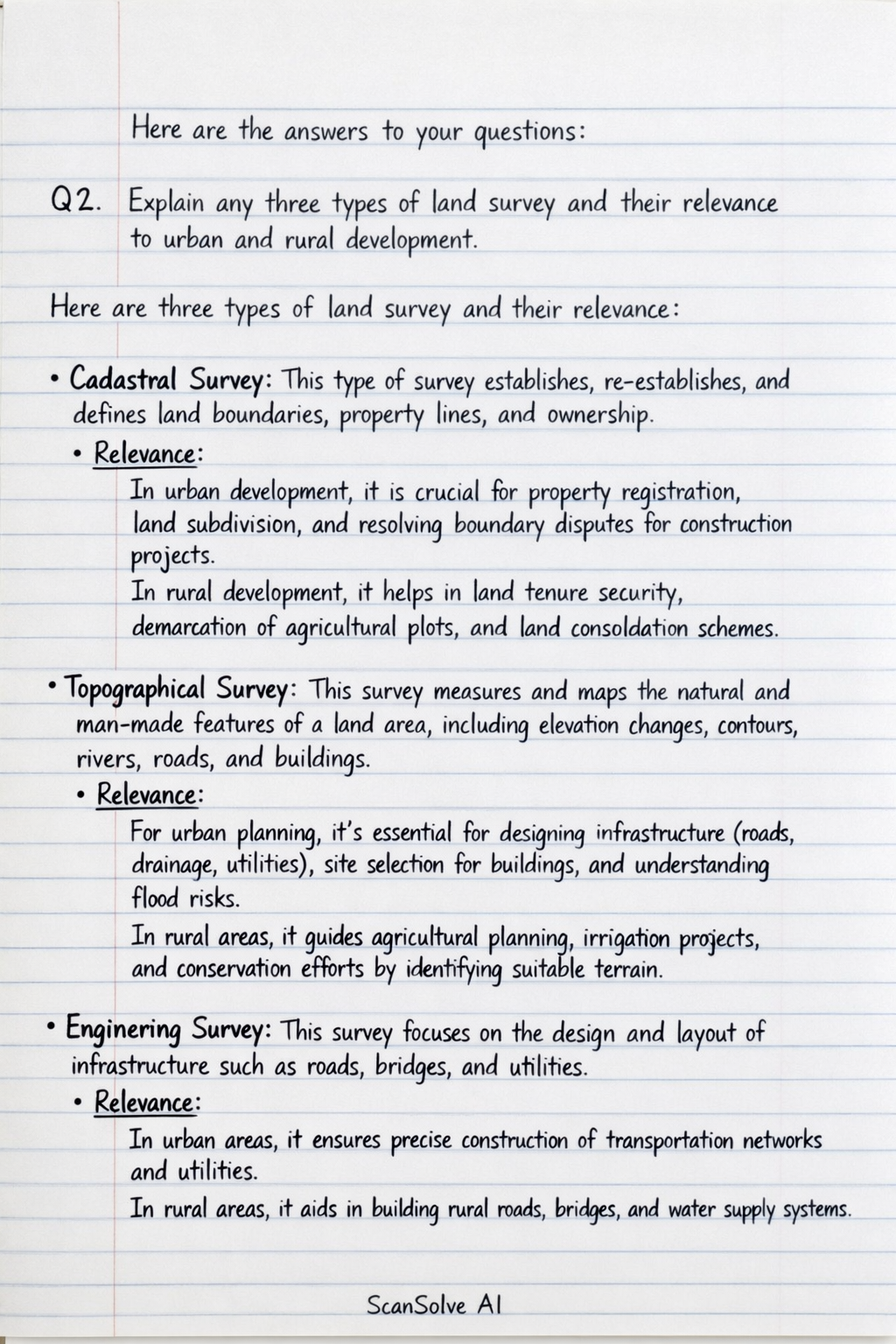
Here are the answers to your questions:
Q2. Explain any three types of land survey and their relevance to urban and rural development.
Here are three types of land survey and their relevance:
- Cadastral Survey: This type of survey establishes, re-establishes, and defines land boundaries, property lines, and ownership.
- Relevance: In urban development, it is crucial for property registration, land subdivision, and resolving boundary disputes for construction projects. In rural development, it helps in land tenure security, demarcation of agricultural plots, and land consolidation schemes.
- Topographical Survey: This survey measures and maps the natural and man-made features of a land area, including elevation changes, contours, rivers, roads, and buildings.
- Relevance: For urban planning, it's essential for designing infrastructure (roads, drainage, utilities), site selection for buildings, and understanding flood risks. In rural areas, it guides agricultural planning, irrigation projects, and conservation efforts by identifying suitable terrain.
- Engineering Survey: These surveys are conducted to gather data for the design, planning, and construction of engineering projects. They involve setting out points, measuring distances, and determining elevations for specific construction works.
- Relevance: In urban development, it's vital for the precise layout of buildings, bridges, roads, and utility networks. In rural development, it supports the construction of dams, irrigation canals, rural roads, and other infrastructure projects.
Q3. Define the term urban zoning and explain its relevance for urban planning.
Urban zoning is a land-use planning tool used by local governments to regulate how land within a municipality can be used. It divides urban areas into different zones (e.g., residential, commercial, industrial, recreational) and specifies the types of activities, building heights, density, and other development standards permitted within each zone.
Relevance for urban planning:
- Orderly Development: Zoning ensures that urban growth is organized and predictable, preventing incompatible land uses from coexisting (e.g., heavy industry next to residential areas).
- Public Health and Safety: It helps protect public health by separating polluting industries from residential zones and ensures adequate light, air, and open space.
- Infrastructure Planning: Zoning guides the provision of public services and infrastructure by indicating where population and activity concentrations will occur, allowing for efficient planning of roads, utilities, and public facilities.
- Property Value Protection: By regulating development, zoning helps maintain and protect property values by ensuring consistent land use and development standards within specific areas.
Q4. Explain the link between the characteristics of Kenya's urban areas and poor health outcomes.
The characteristics of Kenya's urban areas, particularly rapid and unplanned growth, create several links to poor health outcomes:
- Informal Settlements and Overcrowding: Many urban residents live in informal settlements (slums) characterized by high population density, inadequate housing, and lack of space. This overcrowding facilitates the rapid spread of communicable diseases like tuberculosis, cholera, and respiratory infections.
- Poor Sanitation and Water Supply: Informal settlements often lack access to safe drinking water and proper sanitation facilities (toilets, waste disposal). This leads to the contamination of water sources and the environment, resulting in high incidences of waterborne diseases such as cholera, typhoid, and dysentery.
- Air Pollution: High concentrations of vehicles, industrial activities, and the burning of solid fuels for cooking in urban areas contribute to severe air pollution. This leads to increased rates of respiratory illnesses (e.g., asthma, bronchitis) and other chronic diseases.
- Inadequate Waste Management: Poorly managed solid waste in urban areas, especially in informal settlements, creates breeding grounds for vectors like mosquitoes and rodents, leading to diseases such as malaria and leptospirosis. Uncollected waste also poses direct health hazards.
- Limited Access to Healthcare: While cities have more health facilities, the sheer number of urban poor, coupled with financial barriers and long distances from informal settlements, means many still have limited access to quality healthcare services, leading to delayed treatment and worse health outcomes.
- Unhealthy Lifestyles: Urbanization can lead to more sedentary lifestyles and increased consumption of processed foods, contributing to a rise in non-communicable diseases like diabetes, hypertension, and obesity.
Q5. Explain how rural-urban migration has affected human development rural areas in Kenya.
Rural-urban migration significantly impacts human development in rural areas in Kenya:
- Brain Drain and Labor Shortage: The migration of young, educated, and skilled individuals from rural areas to cities leads to a loss of human capital and a shortage of productive labor in agriculture and other rural sectors. This hinders rural economic growth and innovation.
- Aging Population: With younger people leaving, rural areas are often left with an aging population, which can reduce agricultural productivity and innovation, as older individuals may have less capacity for strenuous labor or adopting new farming techniques.
- Remittances: Migrants often send remittances back to their rural families. These funds can improve living standards, access to education, and healthcare for those left behind, thus positively contributing to human development.
- Social Disruption: Migration can lead to the breakdown of traditional family structures and social support networks, particularly when parents migrate, leaving children in the care of grandparents or other relatives.
- Reduced Investment: The perception of limited opportunities in rural areas can discourage both public and private investment, further perpetuating underdevelopment and limiting access to essential services and infrastructure.
Q6. Describe the legal framework for land use, physical planning and urban/rural development in Kenya.
Kenya's legal framework for land use, physical planning, and urban/rural development is primarily anchored in the Constitution of Kenya (2010) and several key statutes:
- Constitution of Kenya (2010): Chapter 5 on Land establishes principles of land policy, including equitable access, security of tenure, and sustainable management. It mandates the state to regulate land use and property rights for public interest.
- Physical and Land Use Planning Act (2019): This is the primary legislation governing physical planning. It provides for the preparation and implementation of national, county, and local physical and land use development plans. It outlines procedures for zoning, subdivision, change of user, and enforcement of planning standards. It replaced the Physical Planning Act (1996).
- Land Act (2012): This Act consolidates laws on land, providing for the management and administration of land, land tenure, and land transactions. It addresses issues like land registration, leases, and compulsory acquisition, which are fundamental to development.
- Land Registration Act (2012): This Act provides for the registration of titles to land, ensuring security of tenure and facilitating land transactions. Clear land titles are crucial for investment and development.
- National Land Commission Act (2012): This Act establishes the National Land Commission, an independent body responsible for managing public land on behalf of national and county governments, advising on land policy, and investigating historical land injustices.
- County Governments Act (2012): This Act devolves planning functions to county governments, empowering them to prepare county integrated development plans (CIDPs) that guide local land use and development.
- Environmental Management and Co-ordination Act (EMCA, 1999, revised 2015): This Act provides for the establishment of an appropriate legal and institutional framework for the management of the environment. It mandates Environmental Impact Assessments (EIAs) for development projects, ensuring environmental sustainability in land use and planning.
Q7. Explain any five opportunities of the rapid population increase in Kenya.
Rapid population increase in Kenya, while posing challenges, also presents several opportunities:
- Large Labor Force: A growing population means a larger pool of young, potentially productive labor. This can drive economic growth if properly educated, skilled, and employed, providing a demographic dividend.
- Expanded Domestic Market: A larger population translates to an increased demand for goods and services, creating a bigger domestic market. This can stimulate local industries, encourage investment, and foster economic diversification.
- Innovation and Entrepreneurship: A youthful and growing population often brings new ideas, creativity, and a strong entrepreneurial spirit. This can lead to the development of new businesses, technologies, and solutions to societal challenges.
- Increased Tax Base: A larger working-age population, if employed, contributes to a broader tax base, which can increase government revenue. This revenue can then be invested in public services, infrastructure, and development projects.
- Cultural Diversity and Richness: Population growth, especially through internal migration, can lead to greater cultural exchange and diversity within urban centers. This can enrich social life, foster new perspectives, and contribute to a vibrant national identity.
Still stuck on this one?
Ask a follow-up, and the answer starts from this question.
More Geography Questions
Handwritten Step-by-Step Solution
Get this as a handwritten image on WhatsApp — like a tutor wrote it for you.
Try on WhatsApp