
We read your photo as:
SECTION A (25 marks) Answer all questions in this section.
ScanSolve AI Answer
Here are the answers to the questions:
-
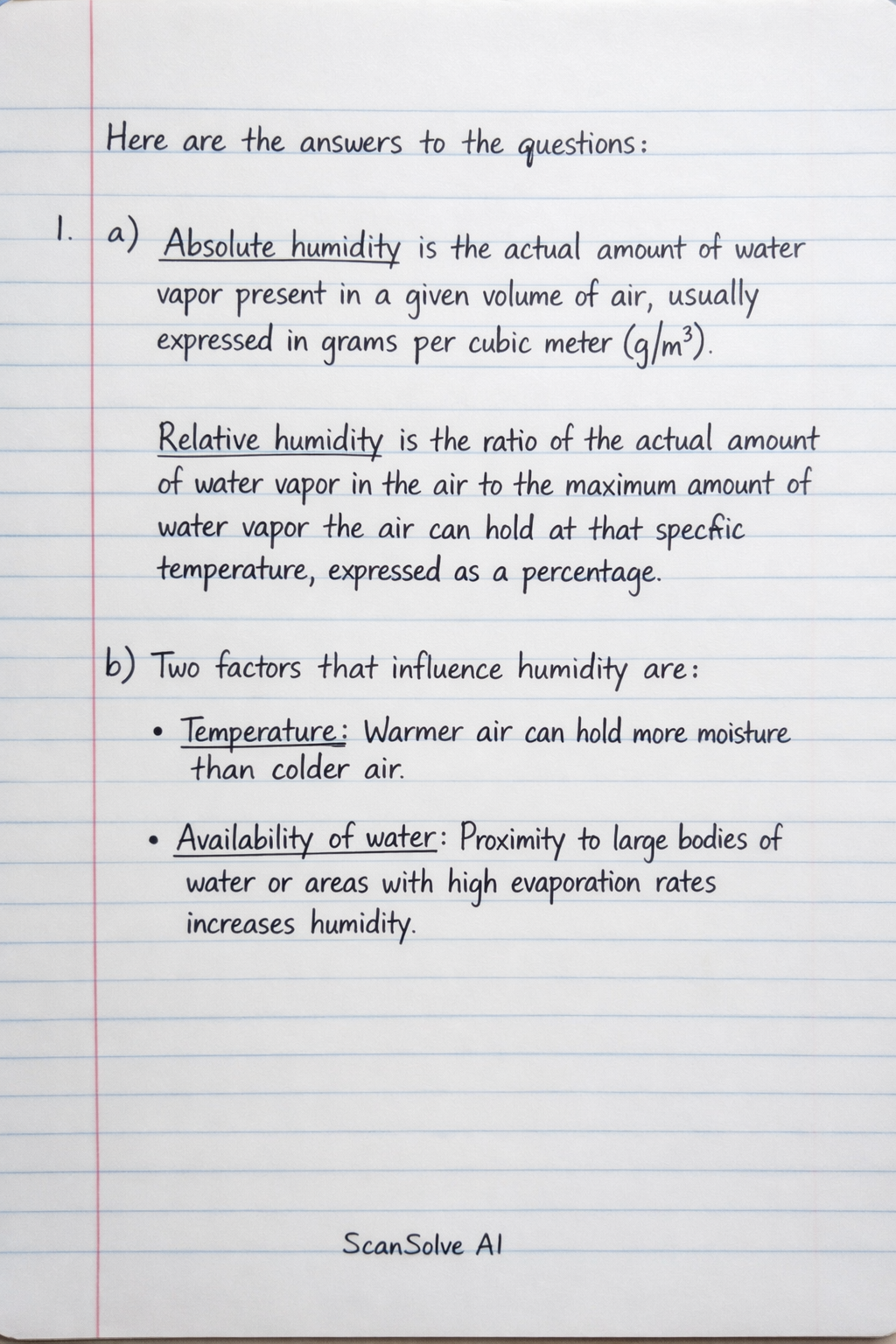
a) Absolute humidity is the actual amount of water vapor present in a given volume of air, usually expressed in grams per cubic meter (). Relative humidity is the ratio of the actual amount of water vapor in the air to the maximum amount of water vapor the air can hold at that specific temperature, expressed as a percentage. b) Two factors that influence humidity are:
- Temperature: Warmer air can hold more moisture than colder air.
- Availability of water: Proximity to large bodies of water or areas with high evaporation rates increases humidity.
-
a) An earthquake is a sudden and violent shaking of the ground, resulting from the sudden release of energy in the Earth's lithosphere that creates seismic waves. b) Three natural causes of earthquakes are:
- Tectonic plate movement: The most common cause, where plates slide past, collide with, or pull apart from each other.
- Volcanic activity: Movement of magma within or beneath a volcano can cause tremors.
- Faulting: Sudden movement along existing cracks or fractures in the Earth's crust.
-
a) Two types of earth movement are:
- Folding: The bending of rock layers due to compressional forces.
- Faulting: The fracturing and displacement of rock layers along a plane. b) A glacier is a large, perennial accumulation of crystalline ice, snow, rock, sediment, and liquid water that originates on land and moves down slope under the influence of its own weight and gravity.
-
a) Two processes through which wind erodes the Earth's surface are:
- Deflation: The lifting and removal of loose, dry, unconsolidated particles (like sand and dust) from the surface by wind.
- Abrasion: The wearing away of rock surfaces by the impact of wind-borne particles (like sand grains). b)
- (i) The feature is a barchan dune.
- (ii) Identify the:-
- (i) The part marked X: Slip face (or leeward slope).
- (ii) Air current marked Y: Eddy current (or turbulent flow).
- (iii) The slope marked Z: Windward slope.
- (iv) The slope marked K: Horn (or wing).
-
a) Three types of faults are:
- Normal fault
- Reverse fault (or thrust fault)
- Strike-slip fault b) Apart from compressional forces, two other forces that cause faulting are:
- Tensional forces: Forces that pull rocks apart, leading to normal faults.
- Shear forces: Forces that cause rocks to slide past each other horizontally, leading to strike-slip faults.
Still stuck on this one?
Ask a follow-up, and the answer starts from this question.
More Geography Questions
Handwritten Step-by-Step Solution
Get this as a handwritten image on WhatsApp — like a tutor wrote it for you.
Try on WhatsApp