

This geography problem is solved step by step below, with detailed explanations to help you understand the method and arrive at the correct answer.
ScanSolve AI Answer
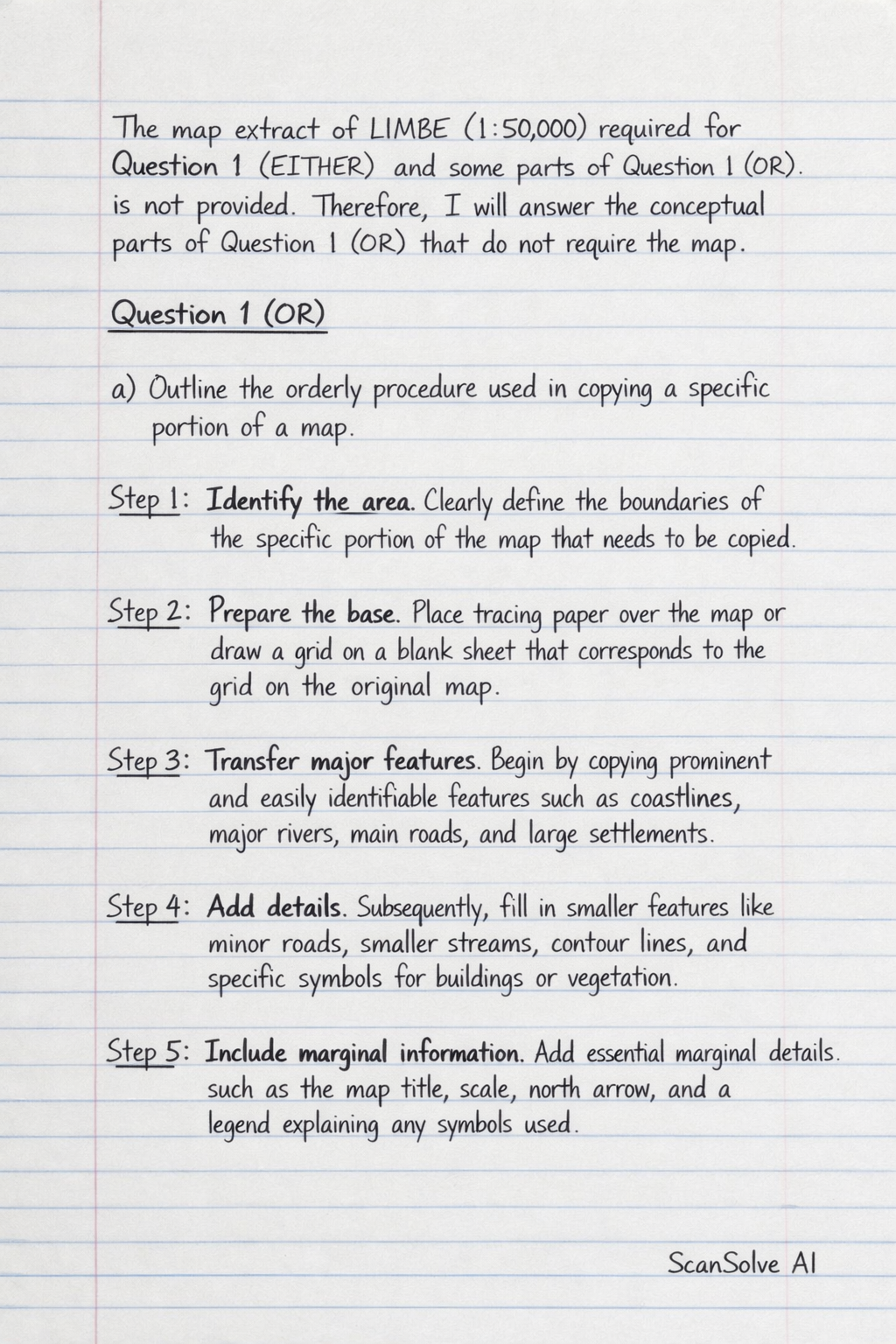
The map extract of LIMBE (1:50,000) required for Question 1 (EITHER) and some parts of Question 1 (OR) is not provided. Therefore, I will answer the conceptual parts of Question 1 (OR) that do not require the map. Question 1 (OR) a) Outline the orderly procedure used in copying a specific portion of a map. Step 1: Identify the area. Clearly define the boundaries of the specific portion of the map that needs to be copied. Step 2: Prepare the base. Place tracing paper over the map or draw a grid on a blank sheet that corresponds to the grid on the original map. Step 3: Transfer major features. Begin by copying prominent and easily identifiable features such as coastlines, major rivers, main roads, and large settlements. Step 4: Add details. Subsequently, fill in smaller features like minor roads, smaller streams, contour lines, and specific symbols for buildings or vegetation. Step 5: Include marginal information. Add essential marginal details such as the map title, scale, north arrow, and a legend explaining any symbols used. Step 6: Check accuracy. Compare the copied portion with the original map to ensure all features are accurately represented and positioned. b) i) Describe how the six figure grid reference can be used to identify specified features. A six-figure grid reference provides a precise location for a feature within a 100-meter square on a map. • First, locate the easting grid line to the immediate west of the feature and read its two-digit number. Then, mentally divide the 1 km square to the east into ten equal parts and estimate the third digit (0-9) for the feature's position within that square. • Next, locate the northing grid line to the immediate south of the feature and read its two-digit number. Similarly, mentally divide the 1 km square to the north into ten equal parts and estimate the sixth digit (0-9) for the feature's position within that square. • Combine these six digits, with the three easting digits followed by the three northing digits, to pinpoint the feature's exact location. For example, a reference like 185943 indicates a position 500 meters east of easting 18 and 300 meters north of northing 94. d) From your knowledge of Cameroon Geography, outline THREE economic activities, with evidence that can be carried out in a town like Limbe. • 1. Port Activities/Trade: Limbe is a coastal town with a natural deep-water harbor, making it a significant port for maritime trade, shipping, and fishing. • 2. Oil Refining: The Société Nationale de Raffinage (SONARA), Cameroon's national oil refinery, is situated in Limbe, indicating a major industrial activity involving the processing of crude oil. • 3. Agriculture/Plantations: The fertile volcanic soils surrounding Limbe support extensive agricultural plantations, particularly for crops like palm oil, rubber, and cocoa, contributing significantly to the local economy. Send me the next one 📸