

This geography problem is solved step by step below, with detailed explanations to help you understand the method and arrive at the correct answer.
ScanSolve AI Answer
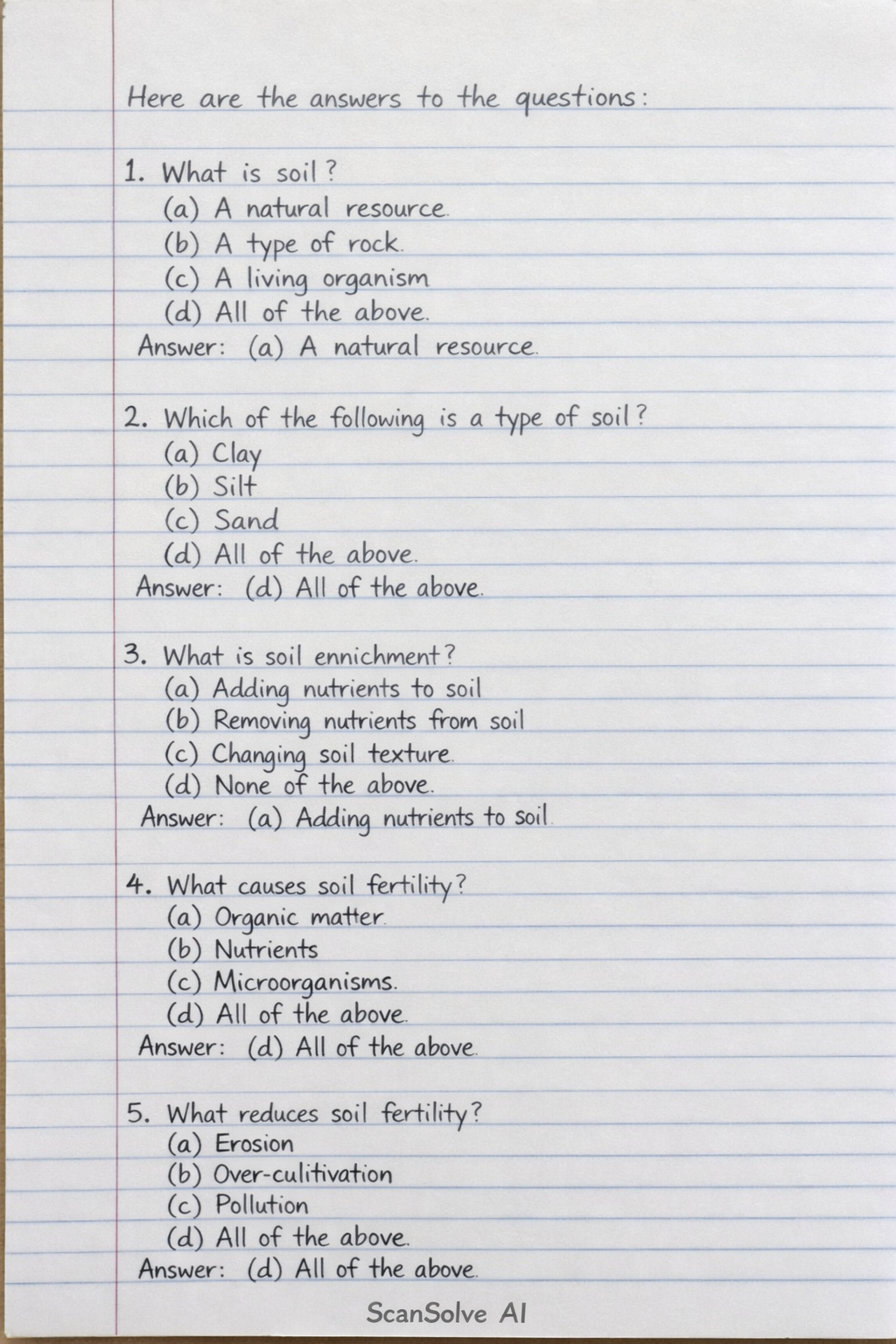
Here are the answers to the questions: 1. What is soil? (a) A natural resource (b) A type of rock (c) A living organism (d) All of the above Answer: (a) A natural resource 2. Which of the following is a type of soil? (a) Clay (b) Silt (c) Sand (d) All of the above Answer: (d) All of the above 3. What is soil enrichment? (a) Adding nutrients to soil (b) Removing nutrients from soil (c) Changing soil texture (d) None of the above Answer: (a) Adding nutrients to soil 4. What causes soil fertility? (a) Organic matter (b) Nutrients (c) Microorganisms (d) All of the above Answer: (d) All of the above 5. What reduces soil fertility? (a) Erosion (b) Over-cultivation (c) Pollution (d) All of the above Answer: (d) All of the above 6. What is erosion? (a) Removal of soil particles (b) Deposition of soil particles (c) Weathering of rocks (d) None of the above Answer: (a) Removal of soil particles 7. How can soil fertility be maintained? (a) Crop rotation (b) Mulching (c) Fertilizers (d) All of the above Answer: (d) All of the above 8. What is mulching? (a) Covering soil with organic matter (b) Removing weeds from soil (c) Adding fertilizers to soil (d) None of the above Answer: (a) Covering soil with organic matter 9. What is crop rotation? (a) Growing different crops on the same land (b) Growing the same crop on the same land (c) Leaving land fallow (d) None of the above Answer: (a) Growing different crops on the same land 10. What is the meaning of "living land"? (a) Land that is fertile (b) Land that is cultivated (c) Land that is inhabited by living organisms (d) None of the above Answer: (c) Land that is inhabited by living organisms 11. Which of the following is a benefit of mulching? (a) Retains moisture (b) Suppresses weeds (c) Regulates soil temperature (d) All of the above Answer: (d) All of the above 12. What is the purpose of adding organic matter to soil? (a) To improve soil structure (b) To increase soil fertility (c) To support microorganisms (d) All of the above Answer: (d) All of the above 13. What is the effect of soil erosion? (a) Loss of fertile land (b) Increased crop yield (c) Improved soil structure (d) None of the above Answer: (a) Loss of fertile land 14. Which of the following is a type of soil erosion? (a) Water erosion (b) Wind erosion (c) Sheet erosion (d) All of the above Answer: (d) All of the above 15. What is the importance of soil conservation? (a) Maintains soil fertility (b) Prevents erosion (c) Supports biodiversity (d) All of the above Answer: (d) All of the above 16. What is the role of microorganisms in soil? (a) Decompose organic matter (b) Fix nitrogen (c) Solubilize minerals (d) All of the above Answer: (d) All of the above 17. What is the difference between fertile and infertile soil? (a) Infertile soil does not have nutrients, fertile soil is rich in organic matter (b) Fertile soil supports plant growth, infertile soil does not (c) Infertile soil does not have nutrients, fertile soil supports plant growth (d) All of the above Answer: (d) All of the above 18. Which of the following is a method of soil conservation? (a) Afforestation (b) Reforestation (c) Terracing (d) All of the above Answer: (d) All of the above 19. What is the purpose of fertilizers? (a) To provide nutrients to plants (b) To improve soil structure (c) To increase crop yield (d) All of the above Answer: (d) All of the above 20. What is the importance of soil testing? (a) Determines soil fertility (b) Identifies soil type (c) Recommends fertilizers (d) All of the above Answer: (d) All of the above