
We read your photo as:
Define solstice, equinox, revolution, and rotation in relation to Earth. Describe three measures to solve water shortages.
ScanSolve AI Answer
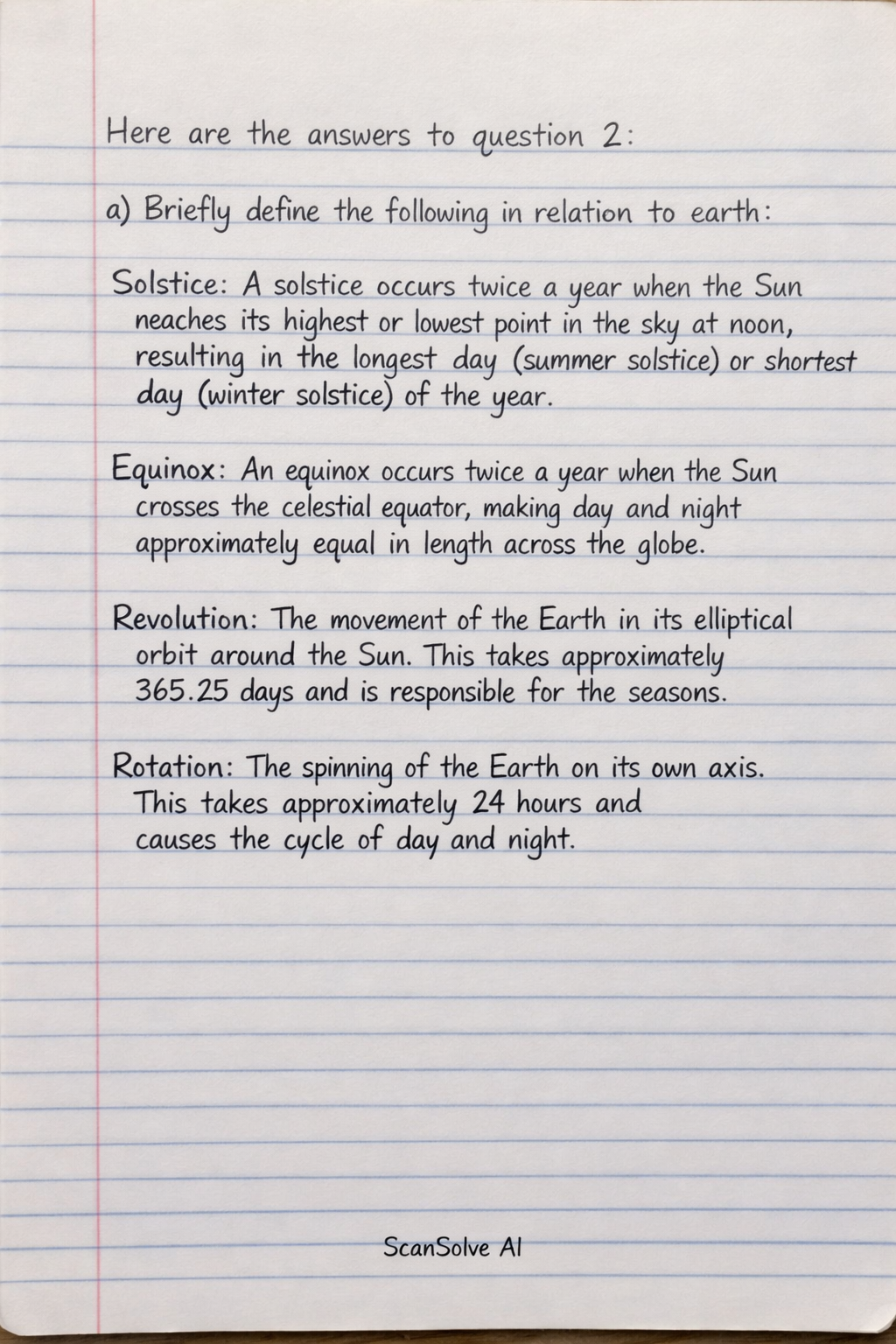
Here are the answers to question 2:
a) Briefly define the following in relation to earth:
- Solstice: A solstice occurs twice a year when the Sun reaches its highest or lowest point in the sky at noon, resulting in the longest day (summer solstice) or shortest day (winter solstice) of the year.
- Equinox: An equinox occurs twice a year when the Sun crosses the celestial equator, making day and night approximately equal in length across the globe.
- Revolution: The movement of the Earth in its elliptical orbit around the Sun. This takes approximately 365.25 days and is responsible for the seasons.
- Rotation: The spinning of the Earth on its own axis. This takes approximately 24 hours and causes the cycle of day and night.
b) Describe THREE measures that can be used to solve the problems of water shortages.
- Rainwater Harvesting: Collecting and storing rainwater from rooftops or other surfaces for later use, reducing reliance on conventional water sources.
- Desalination: The process of removing salt and other minerals from seawater or brackish water to produce fresh, potable water.
- Water Recycling/Reclamation: Treating wastewater (sewage) to remove impurities and make it suitable for non-potable uses like irrigation, industrial processes, or even groundwater recharge.
- Efficient Irrigation Methods: Implementing techniques such as drip irrigation or sprinkler systems in agriculture to deliver water directly to plant roots, minimizing evaporation and runoff.
c) Write a message to your friends explaining to them WHY global temperature is increasing and HOW the situation can be reduced.
Hey everyone,
I wanted to share some important info about why global temperatures are rising and what we can do. The main reason is the enhanced greenhouse effect. Human activities, like burning fossil fuels for energy and transportation, and deforestation, release huge amounts of greenhouse gases (like carbon dioxide and methane) into the atmosphere. These gases trap heat, causing the Earth to warm up.
To reduce this, we need to make some changes. We should switch to renewable energy sources like solar and wind power instead of fossil fuels. Also, we need to improve energy efficiency in our homes and transport. Planting more trees (afforestation) and stopping deforestation are crucial because trees absorb carbon dioxide. Let's all try to reduce our carbon footprint!
d) Why should man conserve the soil?
Man should conserve the soil for several critical reasons:
- Food Security: Soil is the foundation of agriculture, providing essential nutrients and support for crops, which are vital for human and animal food supply.
- Biodiversity: Healthy soil supports a vast ecosystem of microorganisms, insects, and other life forms, contributing to overall biodiversity and ecosystem health.
- Water Regulation: Soil acts as a natural filter, purifying water as it percolates through, and also stores water, which is crucial for plant growth and replenishing groundwater.
- Preventing Erosion and Desertification: Conserving soil prevents its degradation through erosion by wind and water, which can lead to loss of fertile land, desertification, and increased dust storms.
Still stuck on this one?
Ask a follow-up, and the answer starts from this question.
More Geography Questions
Handwritten Step-by-Step Solution
Get this as a handwritten image on WhatsApp — like a tutor wrote it for you.
Try on WhatsApp