
We read your photo as:
Describe the sub-groups of linguistic groups in Kenya and the social effects of the settlement and expansion of the Bantu group in Kenya.
Geography
ScanSolve AI Answer
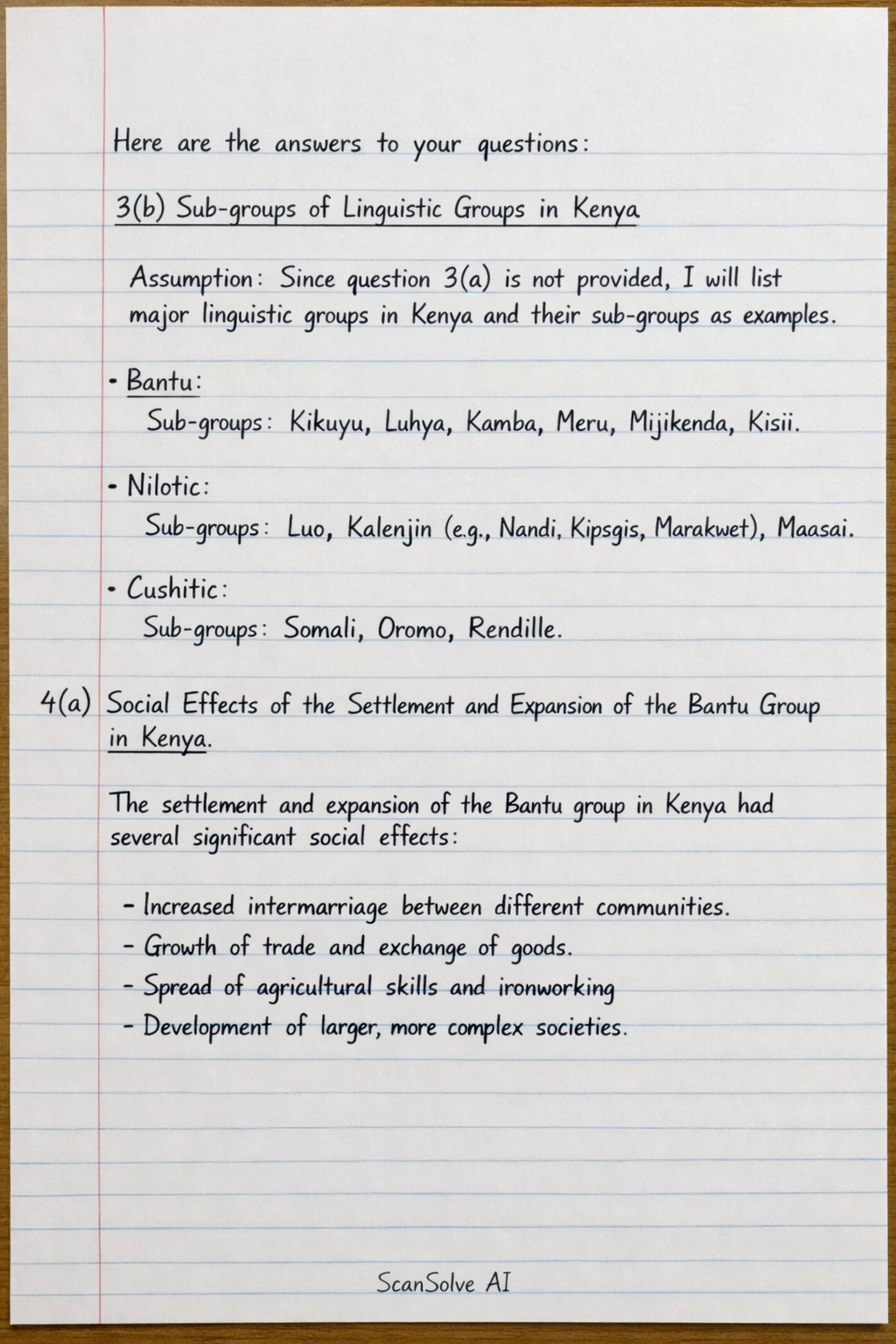
Here are the answers to your questions:
3(b) Sub-groups of Linguistic Groups in Kenya
- Assumption: Since question 3(a) is not provided, I will list major linguistic groups in Kenya and their sub-groups as examples.
- Bantu:
- Sub-groups: Kikuyu, Luhya, Kamba, Meru, Mijikenda, Kisii.
- Nilotic:
- Sub-groups: Luo, Kalenjin (e.g., Nandi, Kipsigis, Marakwet), Maasai.
- Cushitic:
- Sub-groups: Somali, Oromo, Rendille.
- Bantu:
4(a) Social Effects of the Settlement and Expansion of the Bantu Group in Kenya
The settlement and expansion of the Bantu group in Kenya had several significant social effects:
- Population Increase: Settling in fertile highlands led to high population density in certain areas, especially in central and western Kenya.
- Cultural Exchange and Interactions: The Bantu absorbed and intermixed with indigenous communities they encountered, leading to the exchange of ideas, customs, and practices. This often resulted in the adoption of new technologies or social structures.
- Formation of New Communities: Intermarriage and assimilation led to the emergence of new communities and ethnic identities, blending Bantu and pre-existing cultures.
- Displacement and Conflict: The expansion of the Bantu sometimes led to the displacement of existing hunter-gatherer or pastoralist communities, and in some cases, resulted in conflicts over resources and territory.
- Spread of Agricultural Practices: The Bantu introduced and spread advanced agricultural techniques, leading to settled lifestyles and the development of permanent villages.
- Development of Complex Social Structures: As communities grew and became more settled, more complex social and political organizations emerged, including clan systems and chieftaincies.
- Language Diffusion: Bantu languages spread widely across the region, influencing and sometimes replacing the languages of the indigenous groups they interacted with.
Was this helpful?
Still stuck on this one?
Ask a follow-up, and the answer starts from this question.
Got a different question?Ask your own question
More Geography Questions
QWhat were the effects of the Bantu migration in Kenya?QWhat are the social organizations and language groups in Eastern Africa, including migration reasons…QExplain the concept of an ethnic group, its distinction from a tribe, and provide reasons for ethnic…QWhat are the language groups in Marsabit County, Kenya, and which communities and locations are…QHighlight 5 similarities in social organization of the Agikuyu and luo during precolonial period in…
Handwritten Step-by-Step Solution
Get this as a handwritten image on WhatsApp — like a tutor wrote it for you.
Try on WhatsApp