
We read your photo as:
Explain the term food security. Outline the measures that have been taken to promote food security in small-scale farming areas.
ScanSolve AI Answer
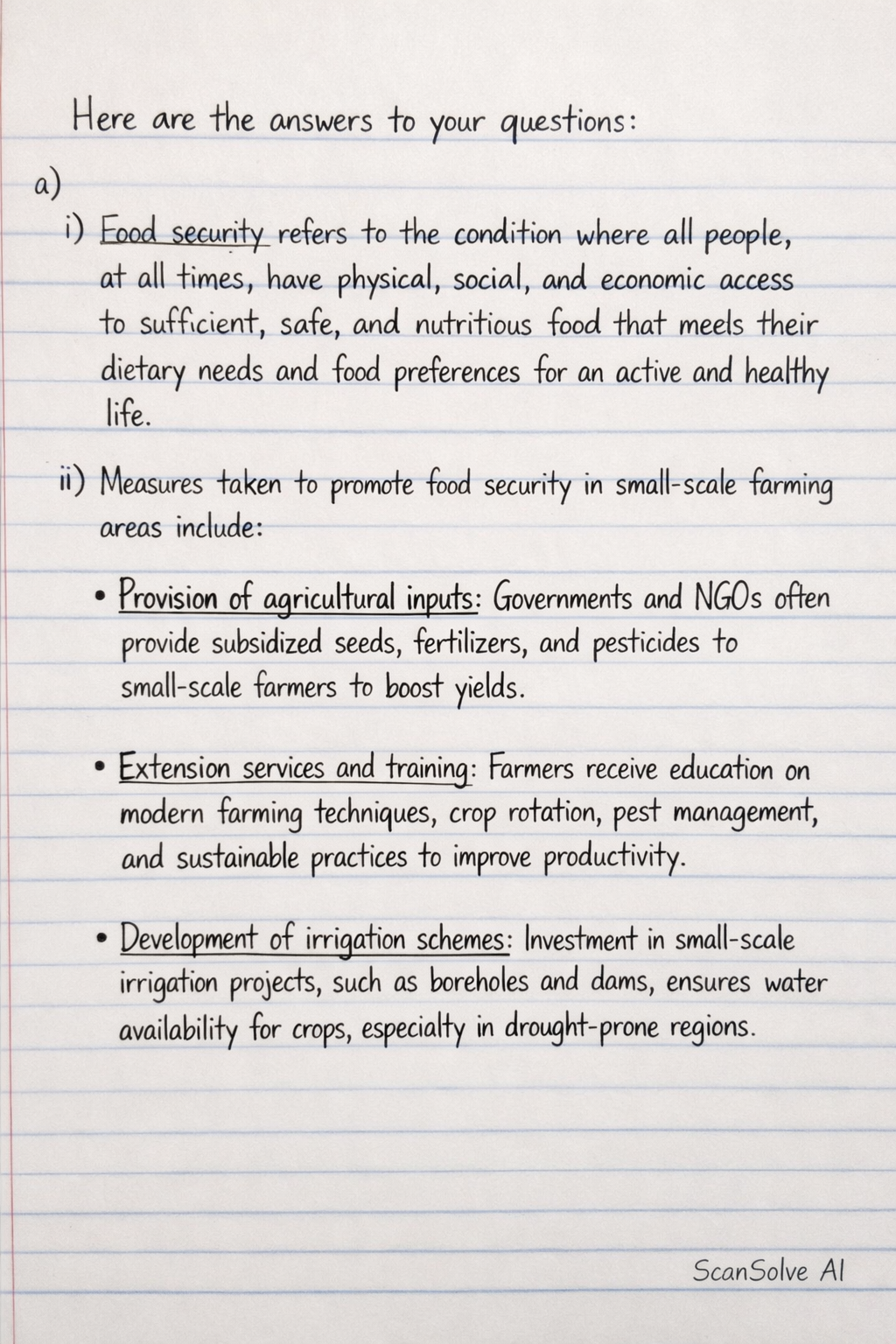
Here are the answers to your questions:
a)
i) Food security refers to the condition where all people, at all times, have physical, social, and economic access to sufficient, safe, and nutritious food that meets their dietary needs and food preferences for an active and healthy life.
ii) Measures taken to promote food security in small-scale farming areas include:
- Provision of agricultural inputs: Governments and NGOs often provide subsidized seeds, fertilizers, and pesticides to small-scale farmers to boost yields.
- Extension services and training: Farmers receive education on modern farming techniques, crop rotation, pest management, and sustainable practices to improve productivity.
- Development of irrigation schemes: Investment in small-scale irrigation projects, such as boreholes and dams, ensures water availability for crops, especially in drought-prone regions.
- Access to credit and markets: Facilitating microfinance loans and improving market linkages helps farmers invest in their farms and sell their produce at fair prices, increasing their income and capacity to purchase food.
b)
i) The irrigation methods shown are:
- Sprinkler Irrigation (in the background): This method involves pumping water through a system of pipes to sprinklers that spray water over the crops, mimicking natural rainfall.
- Drip Irrigation (Method B, in the foreground): This method delivers water slowly and directly to the root zone of plants through a network of tubes and emitters, minimizing water loss due to evaporation or runoff.
ii)
- Sprinkler Irrigation:
- Advantage: Can cover large areas and is suitable for various terrains and soil types.
- Disadvantage: High water loss due to evaporation and wind drift, and can lead to fungal diseases if leaves remain wet.
- Drip Irrigation:
- Advantage: Highly water-efficient as water is delivered directly to the plant roots, reducing waste and weed growth.
- Disadvantage: High initial installation cost and emitters can easily clog if water is not properly filtered.
iii) The crop produced using method B appears to be vegetables (e.g., tomatoes or peppers) or young fruit trees.
c)
i) Benefits of contract farming to communal farmers include:
- Guaranteed market and price: Farmers have an assured buyer for their produce and often a pre-agreed price, reducing market uncertainty.
- Access to inputs and credit: Contractors often provide necessary inputs like seeds, fertilizers, and technical advice, or facilitate access to credit, which farmers might otherwise struggle to obtain.
- Skill transfer and technology adoption: Farmers gain knowledge of modern farming techniques, quality standards, and new technologies from the contracting company.
- Reduced risk: The risk of crop failure or market price fluctuations is often shared with the contractor, providing financial stability to farmers.
ii) The benefits stated in c(i) assist farmers to be self-reliant by:
- Increased and stable income: Guaranteed markets and prices lead to more predictable and often higher incomes, allowing farmers to invest in their farms, improve their livelihoods, and reduce reliance on external aid.
- Enhanced skills and knowledge: Access to technical assistance and training empowers farmers with the expertise to manage their farms more efficiently and sustainably, making them less dependent on external guidance.
- Improved access to resources: Provision of inputs and credit enables farmers to acquire necessary resources independently, fostering their ability to sustain production without constant external financial support.
Still stuck on this one?
Ask a follow-up, and the answer starts from this question.
More Geography Questions
Handwritten Step-by-Step Solution
Get this as a handwritten image on WhatsApp — like a tutor wrote it for you.
Try on WhatsApp