
We read your photo as:
What are the answers to questions 1.2.1 to 1.2.6 concerning aspects, sunrays, frost pockets, shadow zones, urban heat islands, and artificial surfaces?
Geography
ScanSolve AI Answer
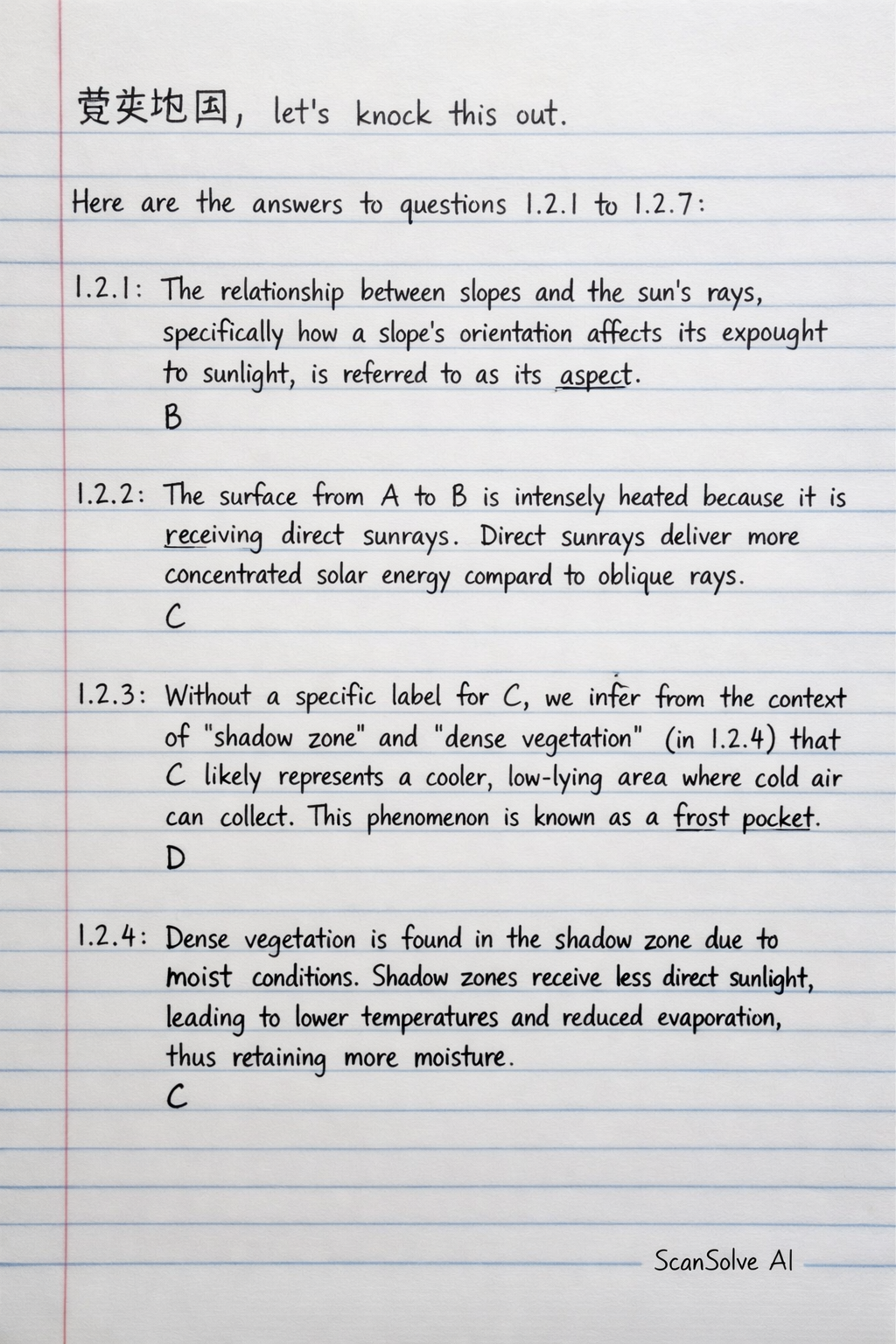
Here are the answers to questions 1.2.1 to 1.2.7:
- 1.2.1: The relationship between slopes and the sun's rays, specifically how a slope's orientation affects its exposure to sunlight, is referred to as its aspect.
- B
- 1.2.2: The surface from A to B is intensely heated because it is receiving direct sunrays. Direct sunrays deliver more concentrated solar energy compared to oblique rays.
- C
- 1.2.3: Without a specific label for C, we infer from the context of "shadow zone" and "dense vegetation" (in 1.2.4) that C likely represents a cooler, low-lying area where cold air can collect. This phenomenon is known as a frost pocket.
- D
- 1.2.4: Dense vegetation is found in the shadow zone due to moist conditions. Shadow zones receive less direct sunlight, leading to lower temperatures and reduced evaporation, thus retaining more moisture.
- C
- 1.2.5: The sketch shows temperatures increasing from the rural area (8°C, 10°C, 12°C) towards the urban center (14°C). This represents the urban heat island effect, where urban areas are warmer than surrounding rural areas. Graph B accurately depicts a continuous increase in temperature from rural to urban.
- B
- 1.2.6: The change in temperature (urban heat island effect) is due to artificial surfaces (like concrete and asphalt) that absorb and retain more heat, and urban storm-water systems that lead to less water retention and thus less evaporative cooling.
- D
- 1.2.7: The wind direction from the rural area to the urban area is influenced by warmer temperatures in urban areas, which cause air to rise, creating lower air pressure. This pressure difference drives wind from the higher pressure rural areas to the lower pressure urban areas.
- B
Was this helpful?
Still stuck on this one?
Ask a follow-up, and the answer starts from this question.
Got a different question?Ask your own question
More Geography Questions
QWhat are the answers to these meteorology questions about cloud formation, temperature inversions…QWhat are the answers to the following questions: 1.1.10, 1.2.1-1.2.5, 1.3.1-1.3.5?QWhat are the answers to questions 1.1.15, 1.2, 1.3.1, and 1.3.2 regarding tourism and geography?QWhat are the answers to Question 1.1.1 − 1.1.4 about the stadium map?QWhat are the answers to 2.1.1-2.1.8 and 2.2.1-2.2.4?
Handwritten Step-by-Step Solution
Get this as a handwritten image on WhatsApp — like a tutor wrote it for you.
Try on WhatsApp