
We read your photo as:
What are the answers to these meteorology questions about cloud formation, temperature inversions, fog, and warm fronts?
ScanSolve AI Answer
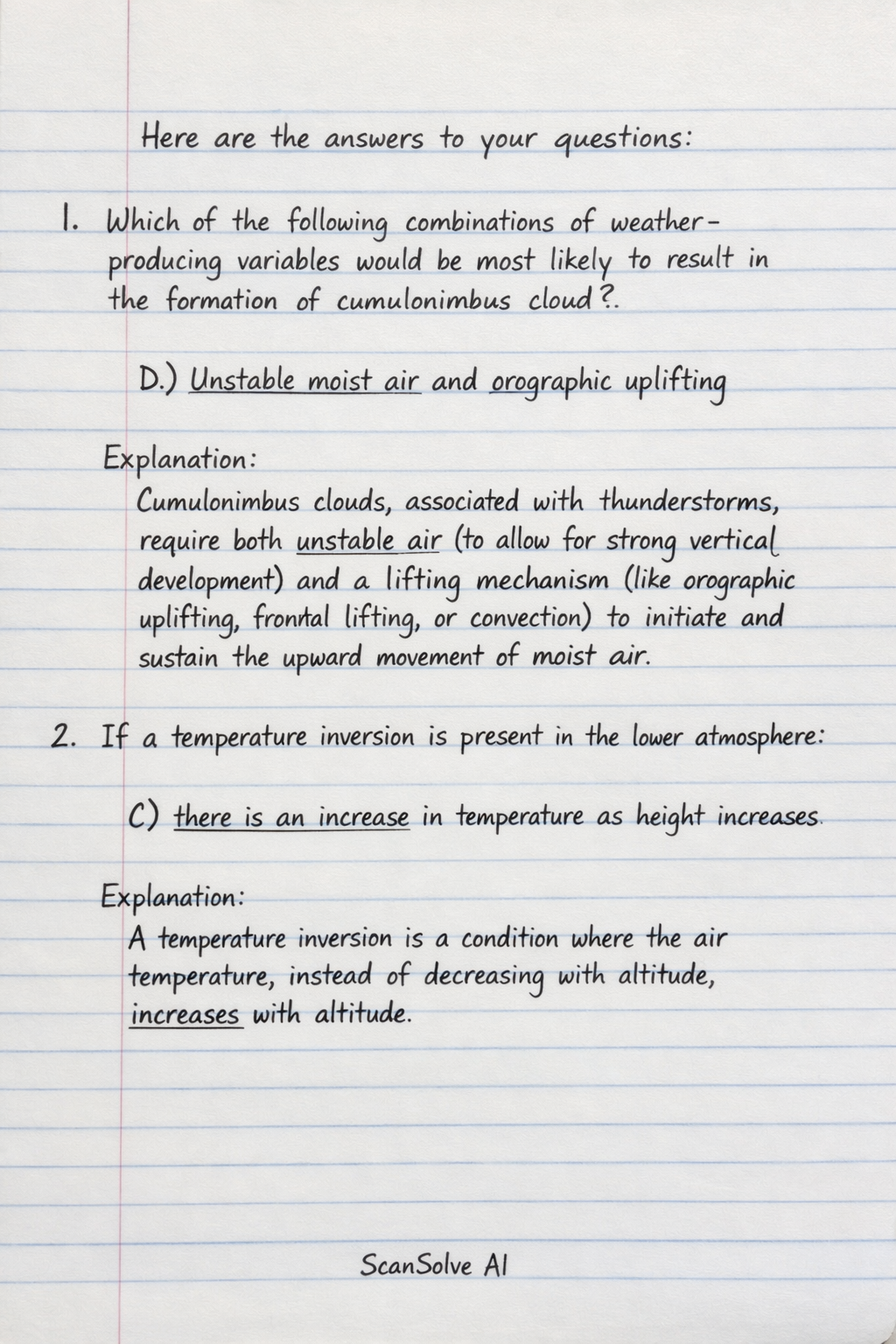
Here are the answers to your questions:
-
Which of the following combinations of weather-producing variables would be most likely to result in the formation of cumulonimbus cloud? D) Unstable moist air and orographic uplifting Explanation: Cumulonimbus clouds, associated with thunderstorms, require both unstable air (to allow for strong vertical development) and a lifting mechanism (like orographic uplifting, frontal lifting, or convection) to initiate and sustain the upward movement of moist air.
-
If a temperature inversion is present in the lower atmosphere: C) there is an increase in temperature as height increases Explanation: A temperature inversion is a condition where the air temperature, instead of decreasing with altitude, increases with altitude.
-
A type of fog commonly found around coastlines, that develops rapidly both by day or night is typically: A) advection fog Explanation: Advection fog forms when warm, moist air moves horizontally over a cooler surface, such as land cooled by cold ocean currents or warm moist air from the sea moving over cold land. This process can occur at any time of day or night.
-
Seen from the surface, the passage of a warm front is characterised by which of the following cloud types, seen in sequence: C) Cirrus, cirrostratus, altostratus, nimbostratus and finally cirrus Explanation: The classic sequence of clouds associated with an approaching warm front, from highest and furthest to lowest and closest, is Cirrus, followed by Cirrostratus, then Altostratus, and finally Nimbostratus (which brings continuous precipitation). The "finally cirrus" might refer to the post-frontal conditions or a slight variation in the typical description.
-
The method by which heat energy is transferred from one body to another, with which it is in contact, is called: C) conduction Explanation: Conduction is the transfer of heat energy through direct physical contact between substances.
-
When two air masses converge in a depression, and warmer air replaces the colder air at the surface, the front is known as: B) A warm front with a typical slope of 1:150 Explanation: A warm front is defined by warmer air replacing colder air at the surface. Warm fronts are characterized by a gradual slope, typically around 1:150 to 1:200, which leads to widespread, continuous precipitation.
Still stuck on this one?
Ask a follow-up, and the answer starts from this question.
More Geography Questions
Handwritten Step-by-Step Solution
Get this as a handwritten image on WhatsApp — like a tutor wrote it for you.
Try on WhatsApp