
We read your photo as:
What are the answers to the questions from the image regarding a ground photograph, time of day, drought indicators, features, and solutions for pastoralists in Northern Kenya?
ScanSolve AI Answer
Here are the answers to the questions from the image:
6. (a) (i) Identify the type of photograph above.
- Ground photograph
6. (a) (ii) If the camera man was facing north what time of the day the photograph could have been taken.
The shadows are falling towards the west, indicating the sun is in the east.
- Morning (e.g., between 8:00 AM and 10:00 AM)
6. (a) (iii) Give three indicators that the area was experiencing drought when the photograph was taken.
- Sparse/dry vegetation
- Bare ground/soil erosion
- Dusty conditions
- Lean/emaciated animals
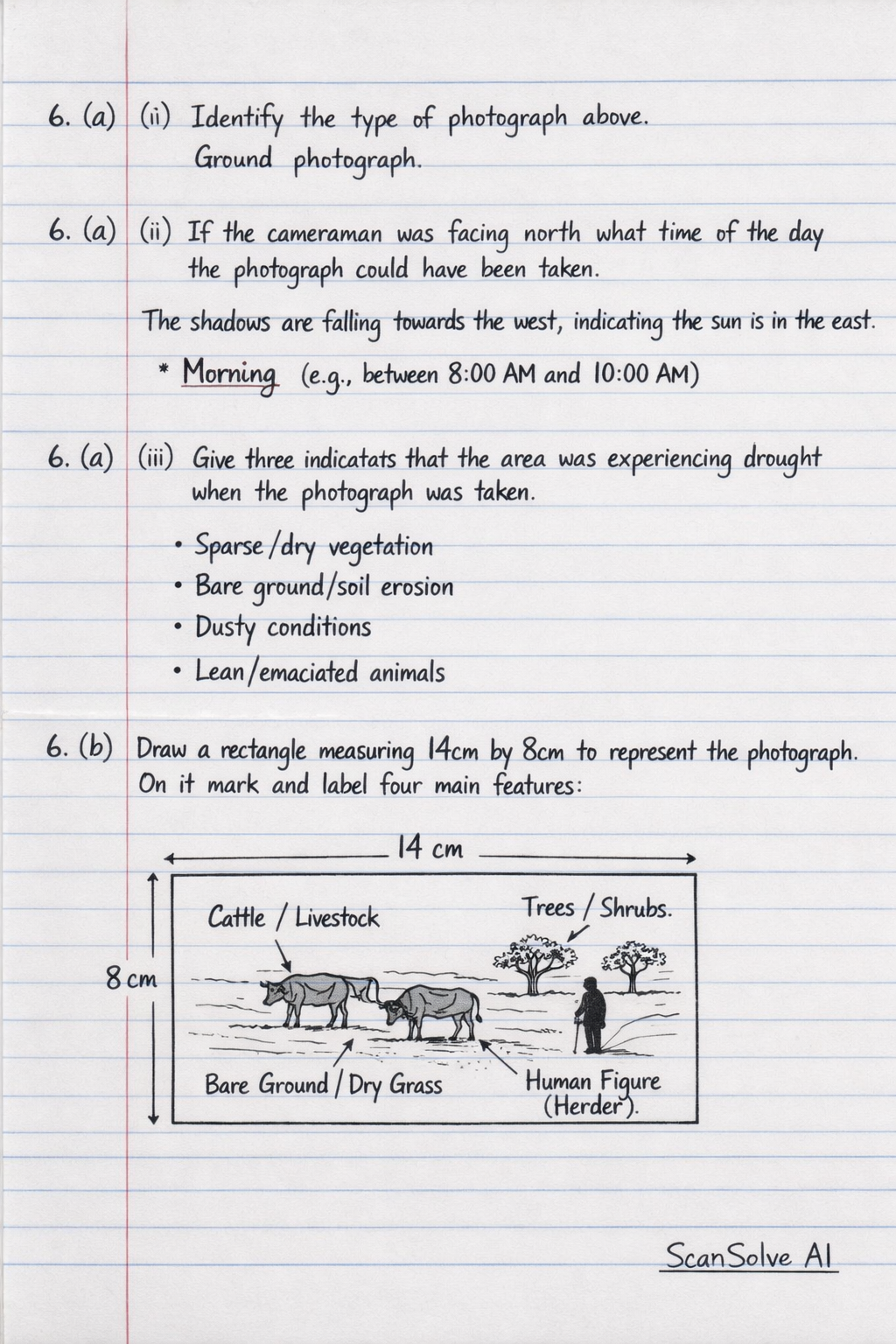
6. (b) Draw a rectangle measuring 14cm by 8cm to represent the photograph. On it mark and label four main features.
As an AI, I cannot draw. However, here are four main features visible in the photograph that you could mark and label on your rectangle:
- Cattle/Livestock
- Trees/Shrubs
- Bare ground/Dry grass
- Human figure (herder)
6. (c) Explain any three solutions to problems facing pastoralists in the Northern part of Kenya.
- Provision of water: Drilling boreholes, constructing dams, and developing water pans to ensure a reliable supply of water for both livestock and human consumption, especially during dry seasons.
- Fodder production and storage: Promoting the cultivation of drought-resistant fodder crops, hay making, and silage production to provide supplementary feed for livestock when natural pastures are scarce.
- Disease control and veterinary services: Establishing mobile veterinary clinics, vaccination programs, and dipping facilities to control common livestock diseases and improve animal health, reducing losses.
- Peacebuilding and conflict resolution: Implementing initiatives to resolve conflicts over resources (like pasture and water) and reduce cattle rustling, which often leads to insecurity and displacement.
- Market access and value addition: Improving road infrastructure to connect pastoral areas to markets, establishing organized livestock markets, and encouraging value addition to livestock products (e.g., milk processing, leather crafts) to enhance income.
6. (d) Discuss nomadic pastoralist in Kenya under the following sub-headings:
i. The cattle breeds kept
- Nomadic pastoralists in Kenya primarily keep Zebu cattle (e.g., Boran, Sahiwal) and Small East African Zebu. These breeds are known for their hardiness, drought resistance, and tolerance to diseases prevalent in arid and semi-arid regions.
ii. The pattern of movement.
- Their movement follows a seasonal pattern (transhumance), driven by the search for pasture and water. They typically move to higher grounds or riverine areas during dry seasons and spread out to utilize fresh pastures during wet seasons. Movement can also be influenced by insecurity or disease outbreaks.
iii. Marketing of the animals.
- Marketing primarily involves the sale of live animals in local livestock markets (barazas) or directly to traders. There is often limited value addition to livestock products at the pastoralist level. Challenges include poor infrastructure, lack of market information, exploitation by middlemen, and disease-related restrictions on movement and sale.
7. (a) (i) State any two forms in which minerals occur.
- Veins and lodes (minerals deposited in cracks or fissures in rocks)
- Beds and seams (layered deposits, often sedimentary)
- Alluvial deposits/Placers (minerals concentrated in riverbeds or beaches)
- Disseminated deposits (minerals scattered throughout a rock mass)
7. (a) (ii) Name three places where limestone is mined in Kenya.
- Athi River
- Koru
- Bamburi
- Sultan Hamud
7. (b) Explain how the following factors influence the exploitation of a mineral.
i. Market
- A high demand for a mineral and favorable market prices make its exploitation economically viable and attractive. Proximity to markets also reduces transportation costs, increasing profitability. Conversely, low demand or prices can render exploitation unprofitable.
ii. The quality of ore
- The grade of the ore (concentration of the mineral) significantly influences exploitation. High-grade ores are more profitable to mine as they yield more mineral per ton of rock, reducing processing costs. Low-grade ores may only be exploited if market prices are very high or advanced, cost-effective technology is available.
iii. Technology
- Advanced technology enables efficient extraction of minerals from deeper deposits, difficult terrains, or even low-grade ores. Modern processing techniques improve mineral recovery rates and reduce environmental impact. Technology also aids in exploration, identifying new deposits.
7. (c) (i) Name two provinces in South Africa where gold is mined.
- Gauteng
- Free State
- North West
7. (c) (ii) Explain three problems facing gold mining in South Africa.
- Deep-level mining: Gold deposits are found at extreme depths, leading to very high operational costs, intense heat, and significant safety risks such as rock bursts and seismic activity.
- Declining ore grades: Many easily accessible, high-grade gold deposits have been depleted, forcing miners to extract lower-grade ores, which are less profitable and require more extensive processing.
- High labor costs and strikes: The mining sector faces frequent labor disputes and demands for higher wages, which significantly increase operational expenses and can disrupt production.
- Safety concerns: Deep-level mining is inherently dangerous, leading to high accident rates and fatalities, which poses a major challenge for the industry.
- Environmental issues: Gold mining generates large amounts of waste rock and tailings, leading to acid mine drainage, land degradation, and dust pollution, requiring costly rehabilitation efforts.
7. (d) Describe the processing of diamond in South Africa.
- Mining: Diamonds are extracted from kimberlite pipes (primary deposits) through open-pit or underground mining, or from alluvial deposits (secondary deposits) in riverbeds or coastal areas.
- Crushing: The kimberlite ore is carefully crushed into smaller pieces to liberate the diamonds without damaging them.
- Washing and scrubbing: The crushed material is then washed and scrubbed to remove clay and lighter waste materials.
- Heavy Media Separation (HMS): The material is passed through a dense liquid (ferrosilicon slurry) in a cyclone. Diamonds, being denser, sink to the bottom, while lighter waste floats and is removed.
- X-ray Sorting: The concentrate from HMS is exposed to X-rays. Diamonds fluoresce under X-rays, and sensors detect this, triggering air jets that separate the diamonds from other minerals.
- Cleaning and Grading: The recovered diamonds are thoroughly cleaned, weighed, and then sorted by skilled graders based on the "4 Cs": carat (weight), cut, color, and clarity.
Still stuck on this one?
Ask a follow-up, and the answer starts from this question.
More Geography Questions
Handwritten Step-by-Step Solution
Get this as a handwritten image on WhatsApp — like a tutor wrote it for you.
Try on WhatsApp