
We read your photo as:
What are the differences between primary and secondary resources, why is soil non-renewable, and how can farmers use water sustainably?
ScanSolve AI Answer
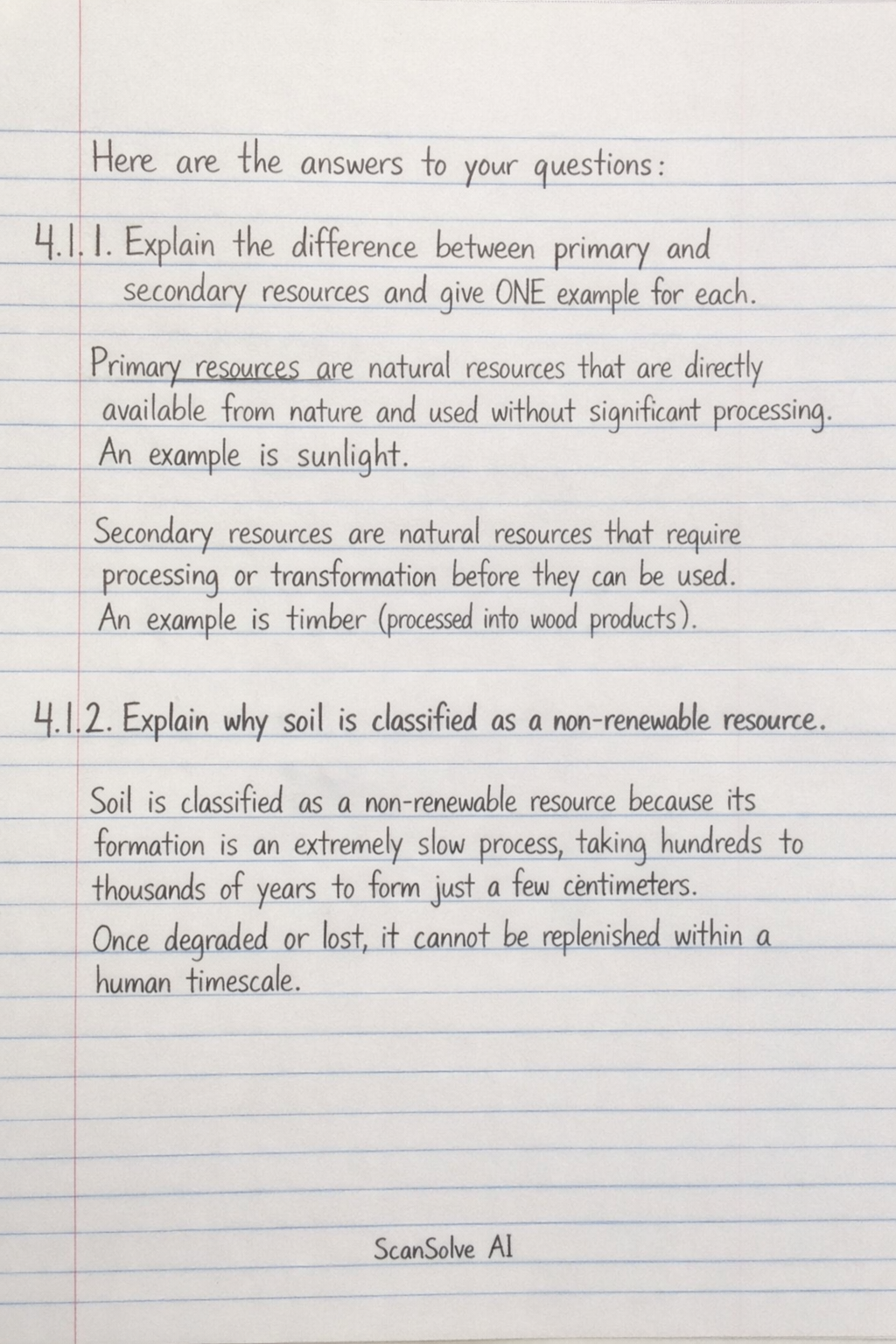
Here are the answers to your questions:
4.1.1 Explain the difference between primary and secondary resources and give ONE example for each.
- Primary resources are natural resources that are directly available from nature and used without significant processing. An example is sunlight.
- Secondary resources are natural resources that require processing or transformation before they can be used. An example is timber (processed into wood products).
4.1.2 Explain why soil is classified as a non-renewable resource.
Soil is classified as a non-renewable resource because its formation is an extremely slow process, taking hundreds to thousands of years to form just a few centimeters. Once degraded or lost, it cannot be replenished within a human timescale.
4.1.3 Suggest THREE ways in which farmers can utilize water in a sustainable way.
- Farmers can use drip irrigation to deliver water directly to plant roots, minimizing evaporation and runoff.
- They can implement rainwater harvesting systems to collect and store rainwater for later use.
- Farmers can select drought-resistant crop varieties that require less water, especially in arid regions.
4.1.4 Define the concept Sustainable Agriculture.
Sustainable agriculture is a system of farming that aims to meet society's food and textile needs in the present without compromising the ability of future generations to meet their own needs. It integrates environmental health, economic profitability, and social and economic equity.
4.1.5 The following are agricultural resources: coal, machinery, gas, and biofuel. TABULATE the difference between renewable and non-renewable resources.
| Renewable Resources | Non-Renewable Resources |
|---|---|
| Can be replenished naturally over a short period. | Exist in finite quantities and cannot be replenished. |
| Examples: Biofuel, solar energy, wind energy, water. | Examples: Coal, gas, petroleum, machinery (made from non-renewable metals). |
4.2.1 Identify other examples of soil degradation represented by letters A, B and C in the diagram above.
- A (Physical): Soil compaction or soil erosion.
- B (Chemical): Acidification or nutrient depletion.
- C (Biological): Loss of soil biodiversity or reduction in organic matter.
4.2.2 Give THREE agricultural practices that cause soil degradation in agricultural land.
- Excessive tillage can break down soil structure and organic matter.
- Overgrazing by livestock can lead to soil compaction and erosion.
- Improper use of fertilizers and pesticides can cause chemical imbalances and pollution.
4.2.3 Recommend TWO control measures that can be implemented to reduce surface run-off in arable lands.
- Implement contour plowing or terracing to slow down water movement across slopes.
- Maintain crop residue or plant cover crops to protect the soil surface and increase infiltration.
4.2.4 Define soil degradation.
Soil degradation is the decline in soil quality and productivity due to various factors, including physical, chemical, and biological processes, often resulting from human activities.
Still stuck on this one?
Ask a follow-up, and the answer starts from this question.
More Geography Questions
Handwritten Step-by-Step Solution
Get this as a handwritten image on WhatsApp — like a tutor wrote it for you.
Try on WhatsApp