
We read your photo as:
The map below shows Zimbabwe and its neighbouring countries. A map of Zimbabwe and neighbouring countries. Use information above to answer the questions that follow.
ScanSolve AI Answer
Answers
4 partsStep-by-step solution
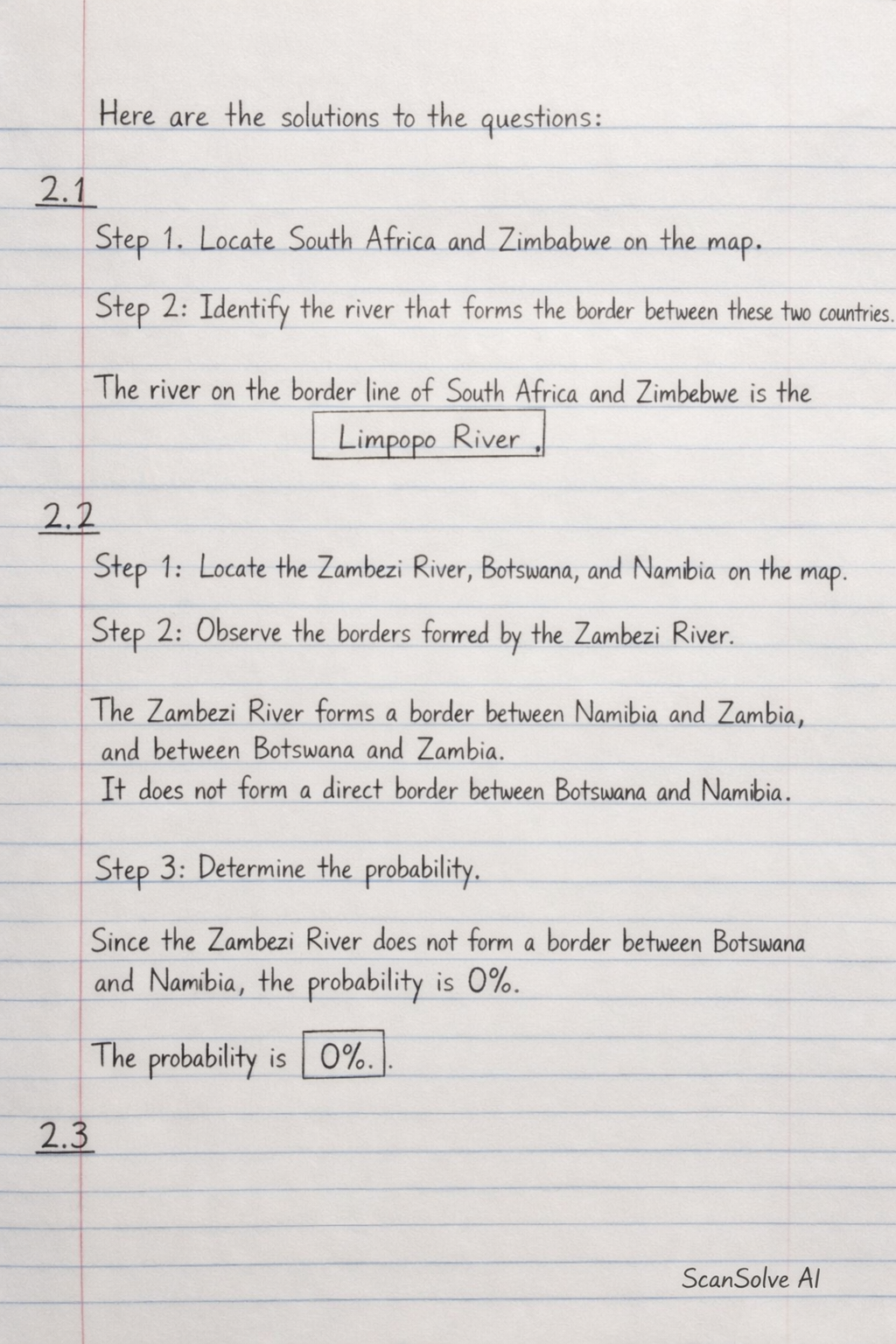
13 stepsHere are the solutions to the questions:
Part 2.1· 2 steps
Locate South Africa and Zimbabwe on the map.
Identify the river that forms the border between these two countries.
The river on the border line of South Africa and Zimbabwe is the .
Part 2.2
Locate the Zambezi River, Botswana, and Namibia on the map.
Observe the borders formed by the Zambezi River.
The Zambezi River forms a border between Namibia and Zambia, and between Botswana and Zambia. It does not form a direct border between Botswana and Namibia.
Determine the probability.
Since the Zambezi River does not form a border between Botswana and Namibia, the probability is .
The probability is .
Part 2.3
Locate Victoria Falls on the map (north-west of Zimbabwe, near Namibia and Zambia).
Locate Kruger National Park on the map (south-east of Zimbabwe, in South Africa).
Determine the compass direction from Kruger National Park to Victoria Falls.
Victoria Falls is to the north-west of Kruger National Park.
The compass direction is .
Part 2.4
Understand the claimed scale.
The claimed scale is . This means on the map represents in reality.
Convert the real-world distance from the claimed scale to a more practical unit.
on the map represents in reality.
Convert to kilometers:So, according to the claimed scale, on the map represents in reality.
Calculate the expected map length for using the claimed scale.
If represents , then would be represented by:
Compare this calculated length with the actual length of the bar scale on the map.
By visually inspecting the map, the bar scale segment labeled "" measures approximately .
Conclude whether the claim is valid.
Since the calculated map length for () matches the visual length of the bar scale on the map, the claim is .
Try one yourself
A new problem that tests the same skill.
Still stuck on this one?
Ask a follow-up, and the answer starts from this question.
More Geography Questions
Handwritten Step-by-Step Solution
Get this as a handwritten image on WhatsApp — like a tutor wrote it for you.
Try on WhatsApp