
We read your photo as:
The Prime Meridian is the starting point for measuring longitude. It passes through Greenwich, England. Are both statements true and does R explain A?
ScanSolve AI Answer
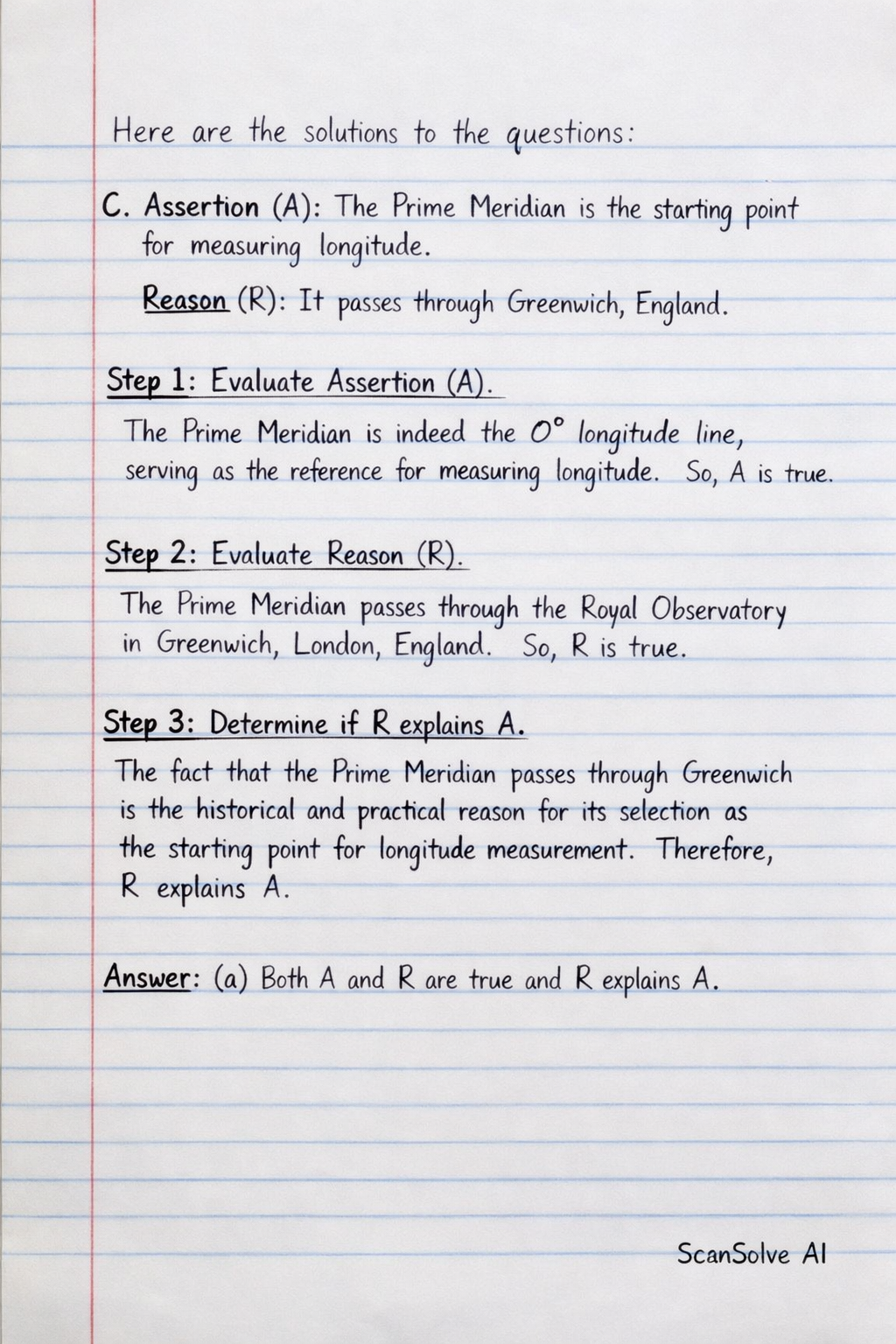
Here are the solutions to the questions:
C. In the question given below, there are two statements marked as Assertion (A) and Reason (R). Read the statements and select the correct option.
Assertion (A): The Prime Meridian is the starting point for measuring longitude.
Reason (R): It passes through Greenwich, England.
- Step 1: Evaluate Assertion (A). The Prime Meridian is indeed the longitude line, serving as the reference for measuring longitude. So, A is true.
- Step 2: Evaluate Reason (R). The Prime Meridian passes through the Royal Observatory in Greenwich, London, England. So, R is true.
- Step 3: Determine if R explains A. The fact that the Prime Meridian passes through Greenwich is the historical and practical reason for its selection as the starting point for longitude measurement. Therefore, R explains A.
- Answer: (a) Both A and R are true and R explains A.
D. Read the information given below and choose the correct option.
Varun lives in a small town near Bhopal. He tells his friend Naman that they will not be able to sleep tonight. A day and night cricket match between India and England starts at 2 PM in London. If it would be 7:30 PM in India. The time difference between India and London is-
- Step 1: Identify the given times. London time is 2 PM. India time is 7:30 PM.
- Step 2: Calculate the time difference.
- Answer: (c) 5 hours 30 minutes
E. Short Answer Questions
-
How do latitudes and longitudes help us locate places on the Earth's surface? Latitudes and longitudes form a grid system on the Earth's surface. Latitudes specify the north-south position relative to the Equator, while longitudes specify the east-west position relative to the Prime Meridian. Together, these two coordinates provide a unique and precise address for any location on Earth.
-
Give one real-life example where knowledge of latitudes and longitudes would be crucial. Knowledge of latitudes and longitudes is crucial for navigation, such as guiding ships across oceans or airplanes through airspaces, using GPS (Global Positioning System) devices to pinpoint exact locations.
-
Why is the International Date Line not a straight line? The International Date Line (IDL) is not a straight line because it zigzags to avoid cutting through landmasses or island groups. This ensures that countries and their administrative regions remain on the same calendar day, preventing confusion and practical difficulties for local populations.
-
Why does the torrid zone receive the maximum amount of heat? The torrid zone, located between the Tropic of Cancer and the Tropic of Capricorn, receives the maximum amount of heat because it gets direct or nearly direct sunlight throughout the year. The sun's rays hit the Earth's surface at a high angle of incidence, concentrating solar energy over a smaller area.
-
Differentiate between parallels and meridians.
- Parallels (Latitudes): These are imaginary circles running east-west, parallel to the Equator. They measure angular distance north or south of the Equator. They vary in length, decreasing towards the poles.
- Meridians (Longitudes): These are imaginary semicircles running north-south, connecting the North and South Poles. They measure angular distance east or west of the Prime Meridian. All meridians are of equal length.
-
How does the concept of longitude impact time zones around the world? The Earth rotates in 24 hours, meaning it rotates of longitude every hour (). This rotation causes different longitudes to experience sunrise and sunset at different times. To standardize time, the world is divided into time zones, generally of longitude wide, with each zone having a uniform time based on its central meridian.
F. Long Answer Questions
-
How is time determined with the help of longitudes? Explain with the help of an example. Time is determined by longitudes based on the Earth's rotation. The Earth rotates in 24 hours, which means it covers of longitude every hour. As one moves eastward, time advances by 1 hour for every of longitude, and as one moves westward, time lags by 1 hour for every of longitude. Example: If it is 12:00 PM (noon) at the Prime Meridian ( longitude), then at East longitude, it would be 1:00 PM. Conversely, at West longitude, it would be 11:00 AM.
-
List the three heat zones of the Earth. Why do different heat zones have different climates? The three heat zones of the Earth are:
- Torrid Zone: Located between the Tropic of Cancer ( N) and the Tropic of Capricorn ( S).
- Temperate Zones: Located between the Tropic of
Still stuck on this one?
Ask a follow-up, and the answer starts from this question.
More Geography Questions
Handwritten Step-by-Step Solution
Get this as a handwritten image on WhatsApp — like a tutor wrote it for you.
Try on WhatsApp