
We read your photo as:
What are the types of river erosion, factors affecting erosion rates, causes of deposition, and features resulting from these processes?
ScanSolve AI Answer
here are the answers to your questions:
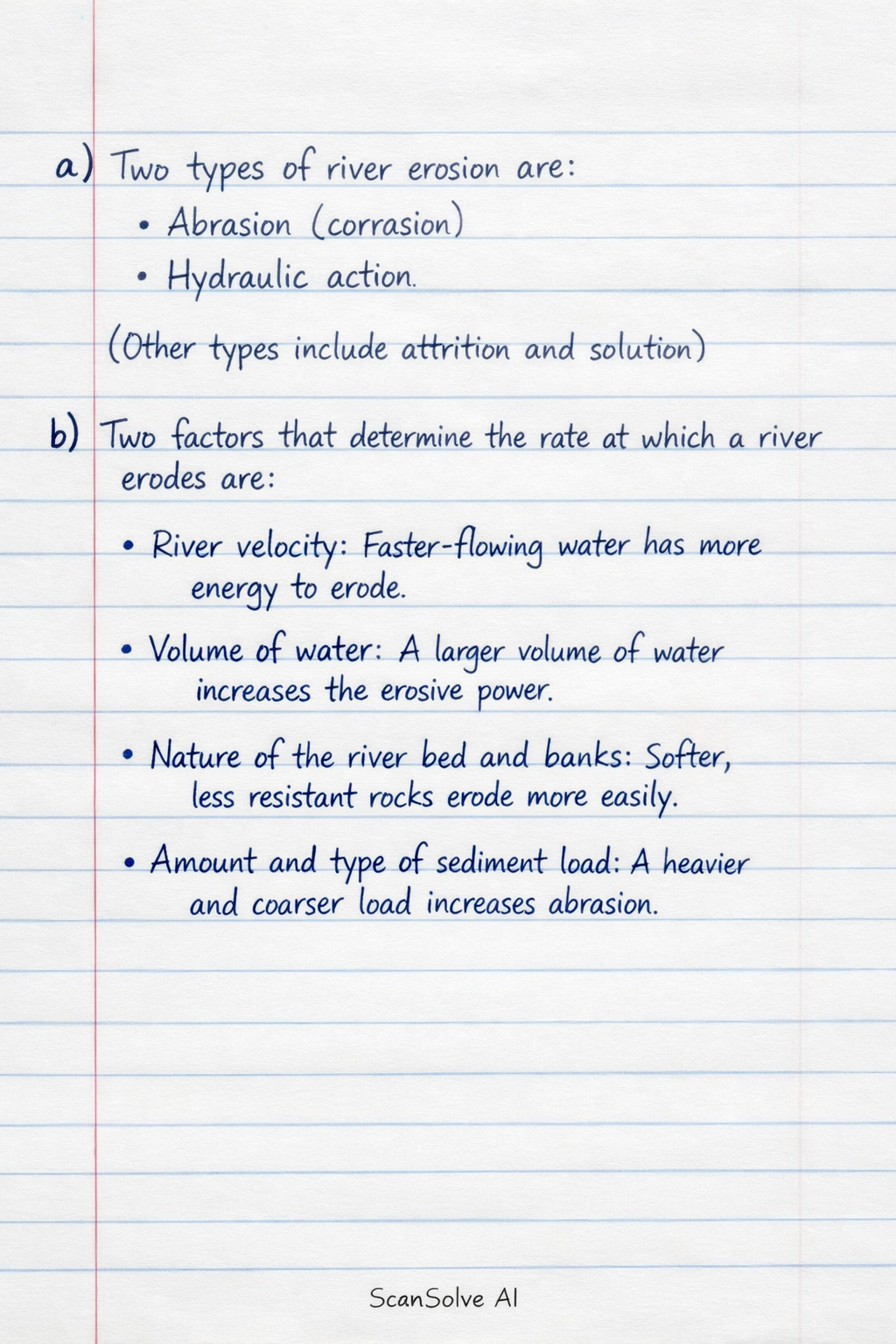
a) Two types of river erosion are: * Abrasion (corrasion) * Hydraulic action * (Other types include attrition and solution)
b) Two factors that determine the rate at which a river erodes are: * River velocity: Faster-flowing water has more energy to erode. * Volume of water: A larger volume of water increases the erosive power. * Nature of the river bed and banks: Softer, less resistant rocks erode more easily. * Amount and type of sediment load: A heavier and coarser load increases abrasion.
c) Two causes of river deposition are: * Decrease in river velocity: When the river's speed slows down, it loses energy and can no longer carry its sediment load, causing it to drop. This can happen when the gradient lessens, the river enters a lake or sea, or during floods when water spreads out. * Increase in sediment load: If the river picks up more sediment than it can transport, it will deposit the excess. * Obstacles in the river channel: Features like boulders or vegetation can reduce flow and cause deposition.
d) Three features resulting from river erosion or deposition are: * V-shaped valleys (erosion) * Meanders (erosion and deposition) * Oxbow lakes (erosion and deposition) * Floodplains (deposition) * Deltas (deposition)
e) A student carried out a field study in the river's old stage. * i) Four features they are likely to see are: * Oxbow lakes * Wide floodplains * Natural levees * Extensive meanders * Deltas (if near the mouth) * ii) Two objectives they would have formulated are: * To identify and describe the landforms characteristic of the old stage of a river. * To measure the river's velocity and depth in different sections of the old stage. * To collect samples of deposited sediment for analysis. * iii) Two reasons why it was necessary to prepare a working schedule are: * To ensure efficient use of time and cover all planned activities within the study period. * To allocate specific tasks to group members, promoting teamwork and organization. * To ensure all necessary equipment is prepared and available for each activity. * iv) Three follow-up activities they did after the study are: * Data analysis and interpretation: Processing collected measurements and observations. * Report writing: Compiling findings, conclusions, and recommendations into a formal report. * Presentation of findings: Sharing the results with peers or teachers. * Mapping: Creating maps of the studied area showing river features.
Still stuck on this one?
Ask a follow-up, and the answer starts from this question.
More Geography Questions
Handwritten Step-by-Step Solution
Get this as a handwritten image on WhatsApp — like a tutor wrote it for you.
Try on WhatsApp