
We read your photo as:
Please answer the following questions about soil and river erosion: 8. List two economic uses of weathered soil. 9. a) Identify the type of delta for the Niger, Omo, and Nile rivers. b) Describe erosi
ScanSolve AI Answer
Here are the answers to your questions:
-
Two economic uses of weathered soil are:
- Agriculture: Weathered soil forms the basis for fertile farmland, supporting crop growth and livestock.
- Construction materials: Clay, a product of weathered rocks, is used to make bricks, pottery, and cement.
-
a) The type of delta found at the mouth of each of the following rivers:
- i) River Niger: Arcuate delta
- ii) River Omo: Bird's foot delta
- iii) River Nile: Arcuate delta
b) Two features of erosion found at each stage of a river:
- Youthful Stage: V-shaped valleys, waterfalls, rapids, gorges.
- Mature Stage: Meanders, interlocking spurs (less pronounced), wider valleys.
- Old Stage: Oxbow lakes, floodplains, levees, wide, shallow valleys.
c) You're required to carry out a field study on river erosion in the youthful stage of a river.
- i) Three types of river erosion you'd like to identify are:
- Abrasion (corrasion): The grinding away of the bed and banks by the sediment load carried by the river.
- Hydraulic action: The force of the water itself dislodging and eroding material from the bed and banks.
- Attrition: The wearing down of the sediment particles as they collide with each other and the river bed.
- Solution (corrosion): The dissolving of soluble minerals from the bed and banks by the river water.
- ii) Three advantages of studying a river through field work are:
- It provides first-hand experience and direct observation of river features and processes.
- It allows for the collection of primary data (e.g., river velocity, depth, sediment size) which can be analyzed.
- It helps in understanding the dynamic nature of river systems and their interaction with the environment.
- iii) A negative effect of a river to people from your area of study (assuming an area prone to flooding) is flooding. Flooding can destroy homes, agricultural land, infrastructure (roads, bridges), and lead to loss of life, displacement of communities, and economic disruption.
d) The formation of an oxbow lake:
An oxbow lake forms in the old stage of a river. As a river flows across a flat floodplain, it develops large bends called meanders. Erosion is strongest on the outer bank of the meander (where the water flows fastest), and deposition occurs on the inner bank (where the water is slower). Over time, the neck of the meander becomes narrower as erosion continues on both outer banks. During a flood, the river's increased energy causes it to cut across the narrow neck of the meander, taking a straighter path. The old meander bend is then cut off from the main river channel by deposition at its ends, forming a crescent-shaped oxbow lake. Eventually, the oxbow lake may dry up or become a swamp as it fills with sediment and vegetation.
Still stuck on this one?
Ask a follow-up, and the answer starts from this question.
More Geography Questions
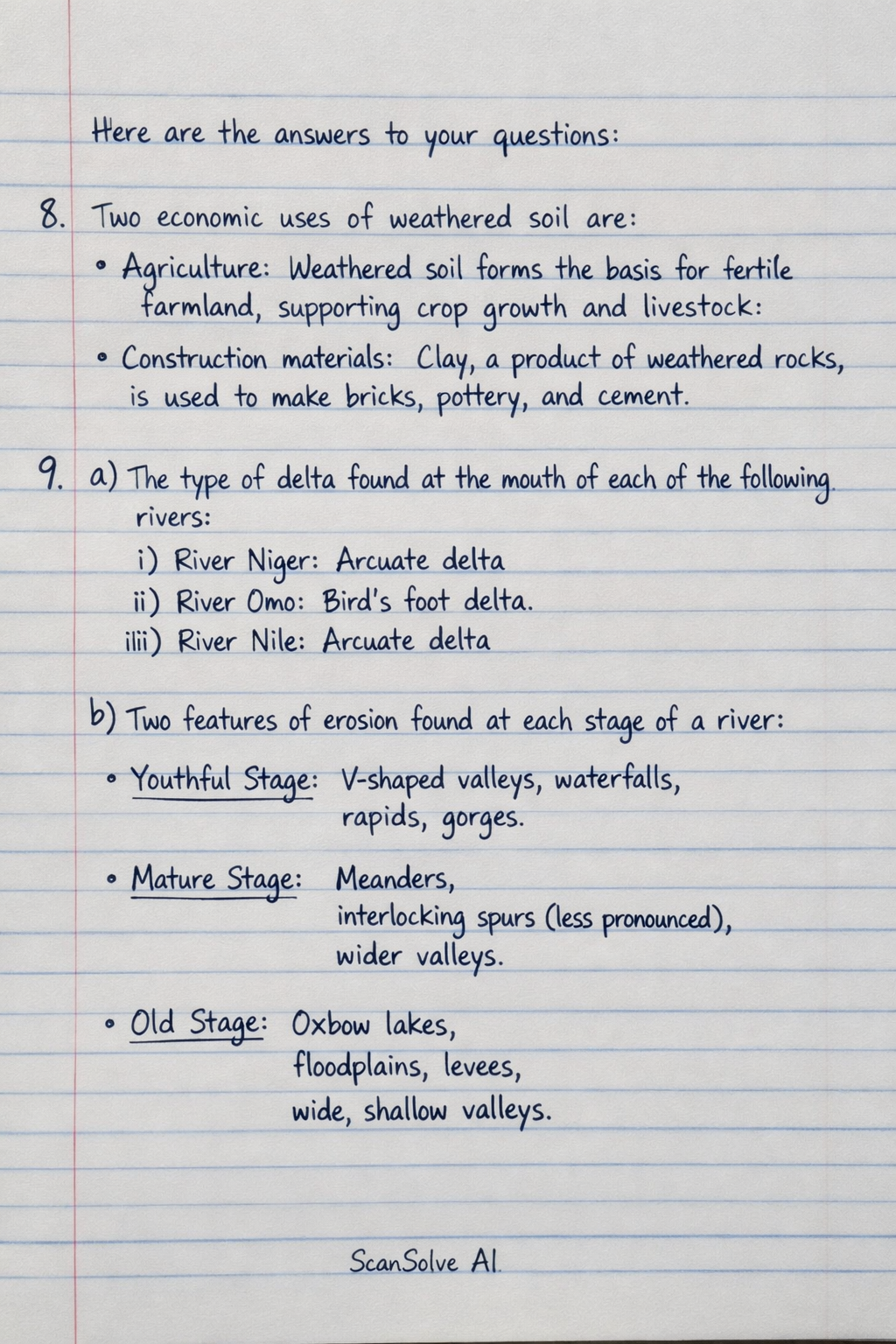
Handwritten Step-by-Step Solution
Get this as a handwritten image on WhatsApp — like a tutor wrote it for you.
Try on WhatsApp