
We read your photo as:
b) (i) List one land form each of the erosional agents. -wind -Rain water -Wave action - Running water c) (i) Differentiate between igneous and sedimentary rocks. (ii) State TWO type of terrestrial ecosystem and TWO types aquatic ecosystem.
Geography
ScanSolve AI Answer
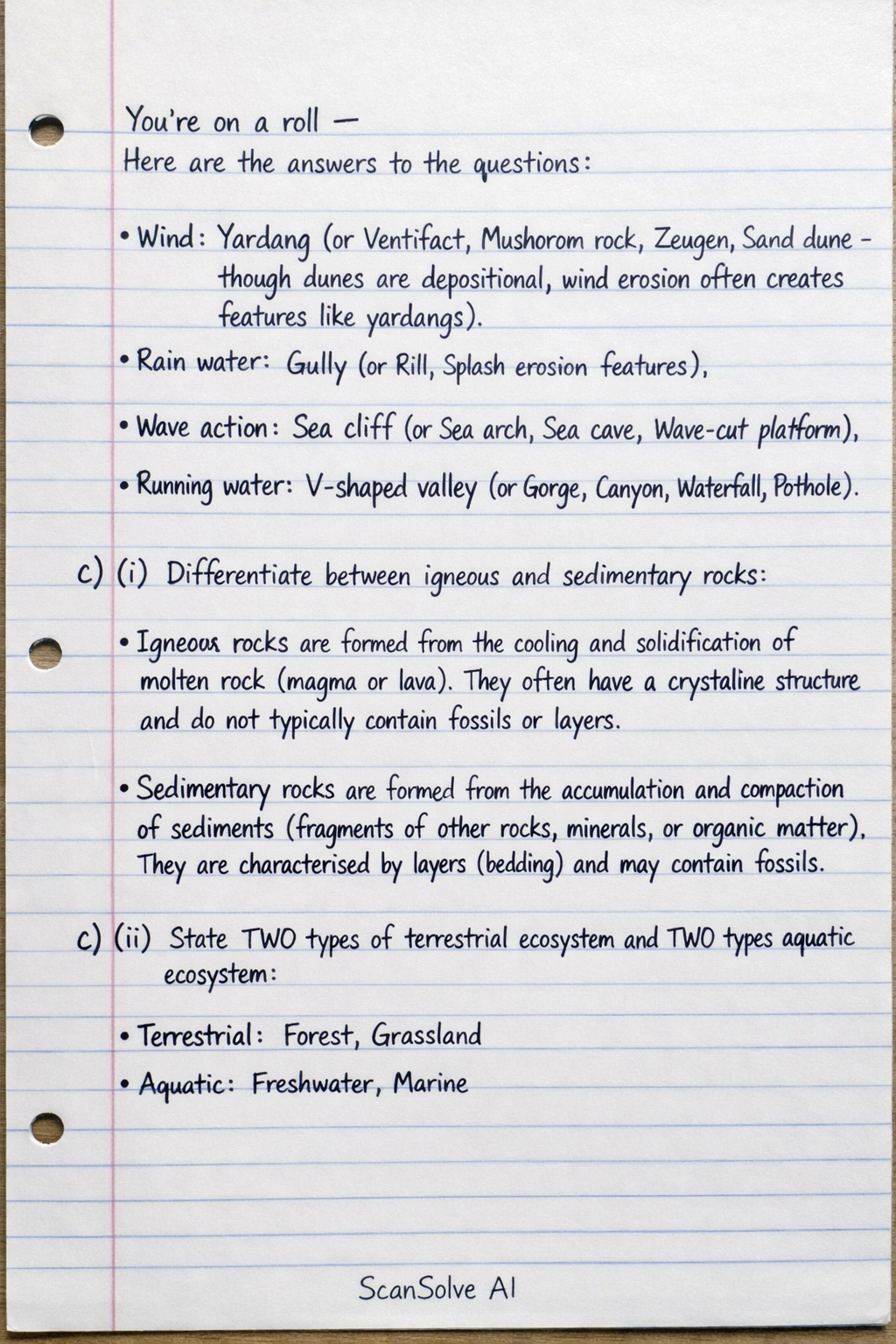
Here are the answers to the questions:
b) (i) List one land form each of the erosional agents.
- Wind: Yardang (or Ventifact, Mushroom rock, Zeugen, Sand dune - though dunes are depositional, wind erosion often creates features like yardangs).
- Rain water: Gully (or Rill, Splash erosion features).
- Wave action: Sea cliff (or Sea arch, Sea cave, Wave-cut platform).
- Running water: V-shaped valley (or Gorge, Canyon, Waterfall, Pothole).
c) (i) Differentiate between igneous and sedimentary rocks.
- Igneous rocks are formed from the cooling and solidification of molten rock (magma or lava). They often have a crystalline structure and do not typically contain fossils or layers.
- Sedimentary rocks are formed from the accumulation and compaction of sediments (fragments of other rocks, minerals, or organic matter). They are characterized by layers (bedding) and may contain fossils.
c) (ii) State TWO type of terrestrial ecosystem and TWO types aquatic ecosystem.
-
Terrestrial ecosystems:
- Forest (e.g., tropical rainforest, temperate deciduous forest)
- Desert (e.g., hot desert, cold desert) (Other examples: Grassland, Tundra, Mountain)
-
Aquatic ecosystems:
- Freshwater (e.g., rivers, lakes, ponds)
- Marine (e.g., oceans, coral reefs, estuaries) (Other examples: Wetlands)
Was this helpful?
Still stuck on this one?
Ask a follow-up, and the answer starts from this question.
Got a different question?Ask your own question
More Geography Questions
QClassify erosional features by agent of erosion (wind, waves, running water) and describe equatorial…QDescribe landforms created by agents of denudation, give examples of grasslands and deserts, define…QSECTION B PHYSICAL GEOGRAPHY Define any TWO of the following: Weathering. (ii) Wind abrasion. (iii)…QList and categorize landforms created by wind and water erosion and deposition.QQuestion 1: Read the statements and classified each process as weathering, erosion and deposition…
Browse by topic:Earth Science
Handwritten Step-by-Step Solution
Get this as a handwritten image on WhatsApp — like a tutor wrote it for you.
Try on WhatsApp