
We read your photo as:
Describe landforms created by agents of denudation, give examples of grasslands and deserts, define ecosystem and give examples of biotic and abiotic components, and describe adaptations of tropical r
ScanSolve AI Answer
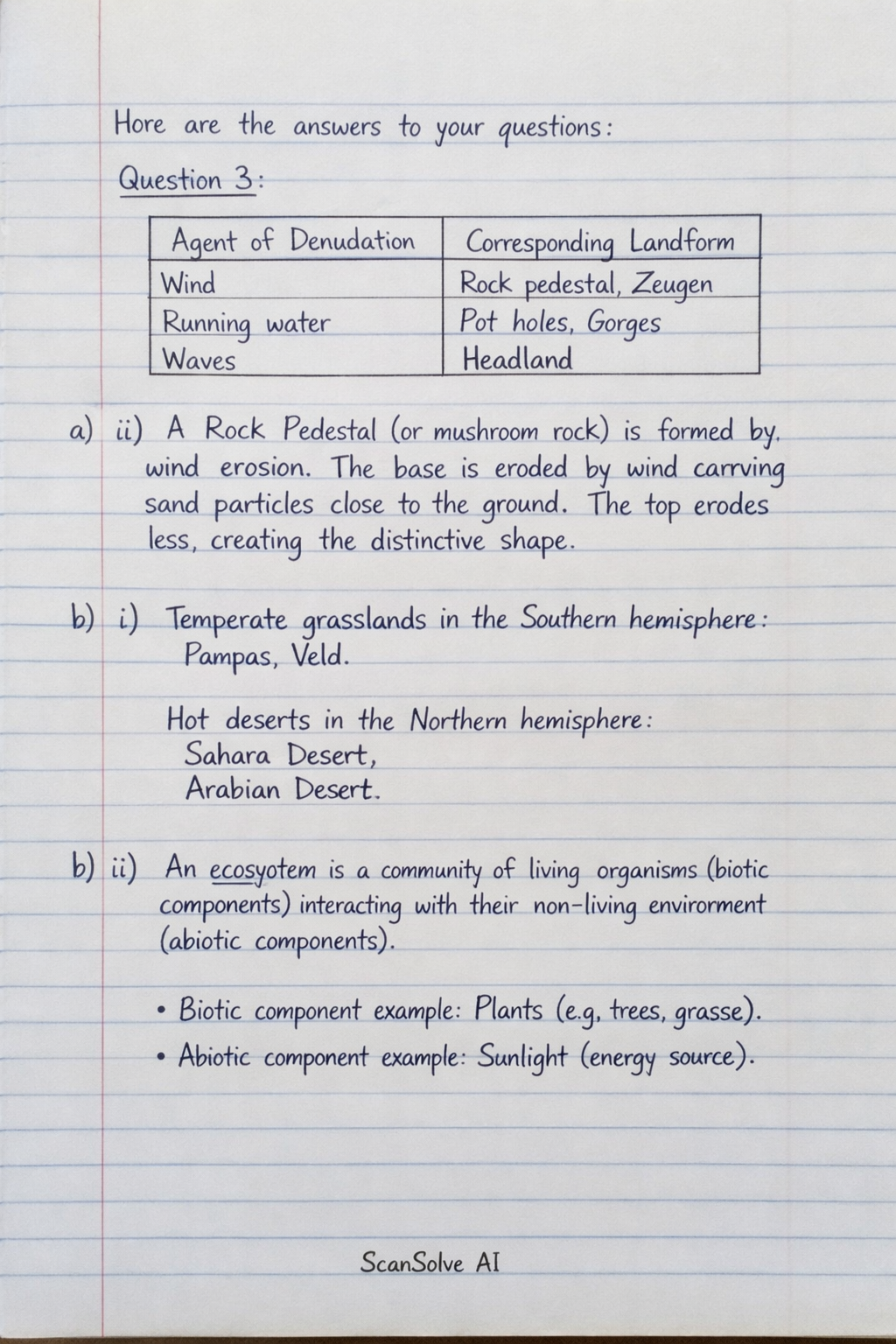
Here are the answers to your questions:
Question 3:
a) i)
a) ii)
A Rock Pedestal (or mushroom rock) is formed by wind erosion. The diagram should show a mushroom-shaped rock with a narrower base and a wider top. The base is eroded more by wind abrasion because the wind carries sand particles closer to the ground. The top is less eroded, creating the distinctive shape.
b) i)
- Temperate grasslands in the Southern hemisphere: Pampas, Veld.
- Hot deserts in the Northern hemisphere: Sahara Desert, Arabian Desert.
b) ii)
An ecosystem is a community of living organisms (biotic components) interacting with their non-living environment (abiotic components).
- Biotic component example: Plants (e.g., trees, grasses).
- Abiotic component example: Sunlight (energy source).
c) i)
Two adaptations of trees in the Tropical rainforest are:
- Buttress roots: Large, wide roots that provide stability in shallow, nutrient-poor soils.
- Drip tips: Pointed leaf tips that allow rainwater to run off quickly, preventing fungal growth.
c) ii)
Two ways to improve soil fertility are:
- Crop rotation: Growing different crops in succession on the same land to maintain soil nutrients.
- Adding organic matter: Incorporating compost or manure to enrich the soil with nutrients and improve its structure.
d)
For Earthquakes, three mitigating measures are:
- Enforcing strict building codes: Designing structures to withstand seismic forces.
- Developing early warning systems: Providing alerts to allow people to take cover.
- Implementing land-use planning: Avoiding construction on fault lines or unstable ground.
Question 4:
a) i)
Three ways to achieve sustainable development objectives are:
- Promoting renewable energy sources: Reducing reliance on fossil fuels to minimize environmental impact.
- Encouraging resource conservation: Efficiently using natural resources and reducing waste.
- Investing in education and awareness: Informing communities about sustainable practices and their benefits.
a) ii)
Two causes of poverty and their solutions:
- Cause: Lack of access to quality education. Solution: Investing in universal primary and secondary education, vocational training, and adult literacy programs.
- Cause: High unemployment rates. Solution: Promoting economic growth through job creation initiatives, supporting small and medium-sized enterprises, and providing skills training relevant to market demands.
b) i)
c) i)
Two benefits of climate-smart agriculture to any agricultural economy are:
- Increased productivity and income: By adopting practices that enhance yields despite climate challenges.
- Enhanced resilience to climate change: Helping farmers adapt to changing weather patterns and extreme events.
c) ii)
Four environmental impacts of uncontrolled felling of trees are:
- Deforestation: Leading to habitat loss and reduced biodiversity.
- Soil erosion: Exposing soil to wind and water, washing away fertile topsoil.
- Climate change: Reducing carbon sequestration and increasing greenhouse gas emissions.
- Disruption of the water cycle: Leading to altered rainfall patterns and increased risk of floods or droughts.
d)
- Advantages of solar energy over other sources:
- Renewable and clean: It is an inexhaustible energy source that produces no greenhouse gas emissions during operation.
- Reduced electricity bills: Once installed, the operational cost is low, leading to savings on energy expenses.
- Challenges faced in its installation:
- High initial cost: The upfront investment for solar panels and installation can be substantial.
- Intermittency: Solar energy generation depends on sunlight, making it unavailable at night or during cloudy weather without storage solutions.
Question 5:
a) i)
- Light industry: Focuses on the production of small consumer goods (e.g., textiles, electronics, food processing). It typically requires less capital, raw materials, and energy compared to heavy industry.
- Heavy industry: Involves the production of large, heavy, and often capital-intensive products (e.g., steel, machinery, chemicals, shipbuilding). It requires significant investment, large quantities of raw materials, and substantial energy.
a) ii)
Four ways the government of Least Industrialized Countries (LICs) can improve their industrial sector are:
- Developing infrastructure: Investing in reliable power, transport, and communication networks.
- Providing investment incentives: Offering tax breaks, subsidies, or grants to attract both domestic and foreign investors.
- Investing in education and skills training: Developing a skilled workforce to meet industrial demands.
- Ensuring political stability and good governance: Creating a predictable and secure environment for businesses to operate.
b) i)
Two positive and two negative socio-economic consequences of a youthful population:
- Positive:
- Large potential labor force: A youthful population can provide a large pool of workers for economic development.
- Innovation and dynamism: Younger populations are often more adaptable and innovative, driving economic change.
- Negative:
- High dependency ratio: A large proportion of young dependents can strain social services like education and healthcare.
- Youth unemployment: If job creation does not keep pace with population growth, it can lead to high rates of unemployment among young people.
b) ii)
Two differences between rural and urban settlements:
- Population density and size: Urban settlements have a high population density and a large population, while rural settlements have a low population density and a smaller population.
- Economic activities: Urban areas are primarily engaged in secondary (manufacturing) and tertiary (services) economic activities, whereas rural areas are predominantly involved in primary activities like agriculture, fishing, and forestry.
c)
Three benefits of the internet to students today:
- Access to vast information: Students can easily find research materials, articles, and educational content from around the world.
- Online learning opportunities: It enables participation in online courses, tutorials, and virtual classrooms, offering flexible learning.
- Enhanced communication and collaboration: Students can communicate with peers and teachers, collaborate on projects, and access academic support.
d)
- Land reclamation: The process of creating new land from oceans, seas, riverbeds, or lake beds, often by filling an area with rock or soil.
- Multi-purpose River Development: Projects designed to serve several objectives simultaneously, such as irrigation, hydroelectric power generation, flood control, navigation, and water supply.
- Pollution: The introduction of harmful substances or products into the environment, causing adverse effects on living organisms and ecosystems.
Still stuck on this one?
Ask a follow-up, and the answer starts from this question.
More Geography Questions
Handwritten Step-by-Step Solution
Get this as a handwritten image on WhatsApp — like a tutor wrote it for you.
Try on WhatsApp